

17th-Century Style European Gentleman Holding a Quill and Document, Oil on Copper Portrait Miniature (Mid-17th to Early 18th C)
17th-Century Style European Gentleman Holding a Quill and Document, Oil on Copper Portrait Miniature (Mid-17th to Early 18th C)
No se pudo cargar la disponibilidad de retiro
Compartir
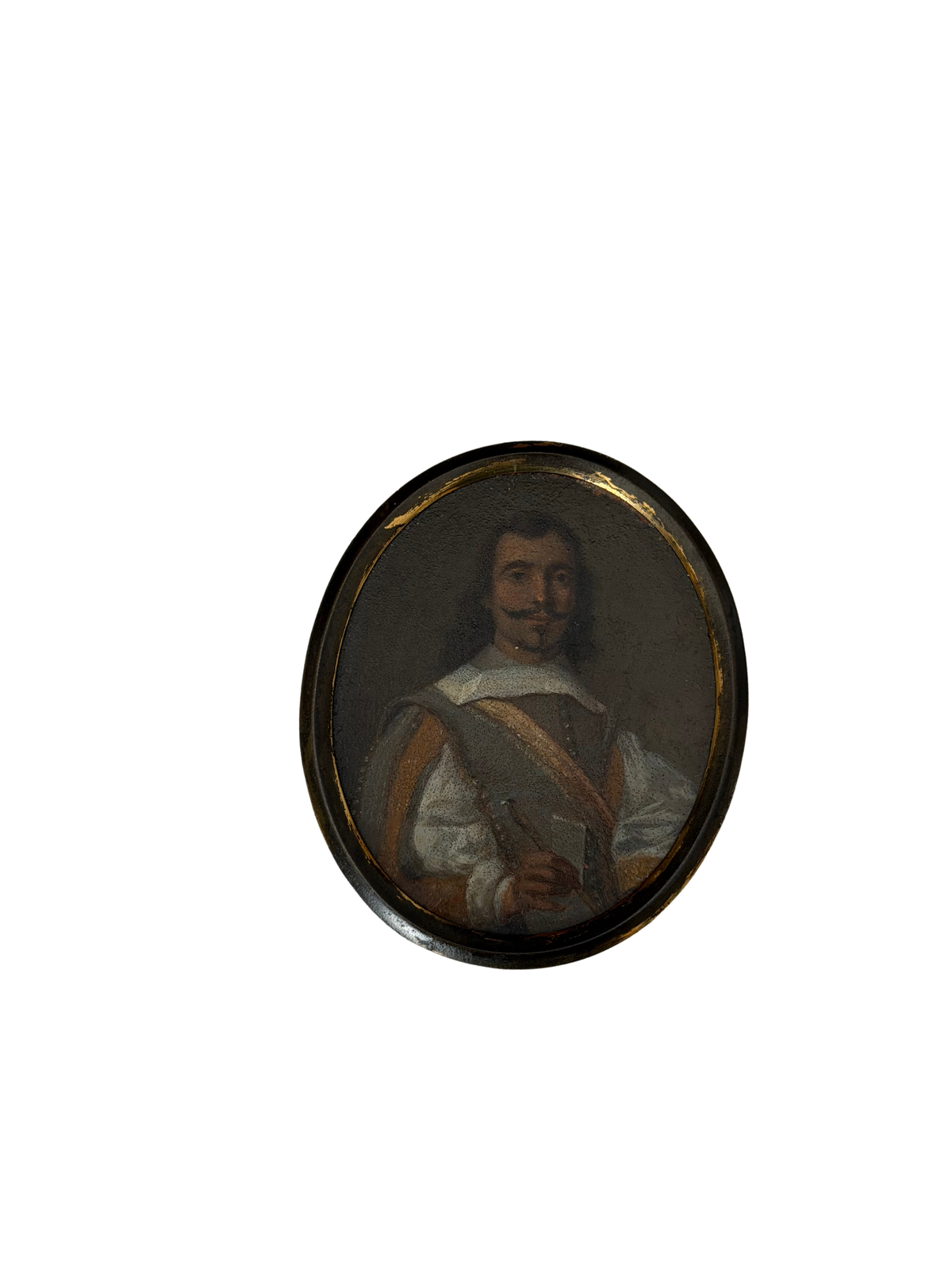
Item Title: 17th-Century Style European Gentleman Holding a Quill and Document, Oil on Copper Portrait Miniature, Possibly Dutch School
## Additional Description
An intriguing antique oval portrait miniature, executed in oil on copper, depicting a distinguished gentleman dressed in the fashion of the early-to-mid 17th century, possibly of Dutch or Flemish origin.
The unidentified sitter is presented half-length against a subdued brown-grey background, his dark, shoulder-length hair framing a face distinguished by an elegantly curled moustache and small pointed beard.
He wears a blue-grey fitted doublet or jerkin over a voluminous white shirt with dramatically puffed sleeves. Contrasting orange-red fabric appears along the upper arms and at the cuffs, while a prominent golden-orange sash crosses his chest diagonally.
Of particular interest, the gentleman holds what appears to be a quill pen and a rectangular document, folded paper, or small writing tablet. These attributes may suggest a gentleman of education, a civic official, secretary, administrator, or individual associated with government or courtly affairs.
The combination of fashionable dress, writing implements, and an orange sash is particularly evocative of Dutch portraiture during the first half of the 17th century, when members of the prosperous merchant, governing, and military classes frequently commissioned individual portraits.
The orange sash is especially noteworthy, as orange was associated with the House of Orange-Nassau and appeared in Dutch civic and military portraiture. However, its presence alone does not establish the sitter's nationality, political allegiance, or official position.
The miniature is executed on an oval copper panel, retaining its visible copper reverse, and is housed within a closely fitted black oval frame with remnants of gilt decoration around the inner border.
Its intimate scale, restrained composition, and richly historical costume give the piece the character of a European cabinet portrait.
While the subject is unmistakably dressed in the fashion of the 17th century, the precise date of the painting remains unconfirmed. It may represent an early portrait or a later historical interpretation after an earlier composition.
## Era
**Depicted Period:** Circa 1625–1650, early-to-mid 17th century.
**Estimated Date of Execution:** Possibly 17th–18th century; a 19th-century historical copy cannot be excluded without further examination.
**School:** Continental European, possibly Dutch or Flemish.
**Artist:** Unidentified.
The sitter's falling white collar, fitted doublet, puffed sleeves, shoulder-length hairstyle, and pointed facial hair closely reflect fashionable masculine dress during the first half of the 17th century.
The composition is particularly reminiscent of Dutch Golden Age portraiture, although similar fashions were also prevalent in England, France, Flanders, and the German-speaking territories.
The oil-on-copper technique was widely employed for small-scale European paintings from the late 16th century onward, particularly during the 17th century. Its continued use in subsequent centuries prevents the support alone from establishing an early date.
## History
Portrait miniatures and small cabinet portraits occupied an important place in European artistic and social culture during the 17th century.
Unlike monumental portraits intended for formal reception rooms, smaller paintings offered intimate representations of individuals and were frequently displayed in private chambers, cabinets, or collections.
**Oil Painting on Copper**
Copper became a favored support for small-scale paintings among European artists beginning in the late Renaissance.
Its smooth, rigid surface permitted fine brushwork and detailed rendering without the pronounced texture associated with canvas.
Oil paintings on copper were produced throughout the Netherlands, Flanders, Italy, and other European artistic centers, particularly during the 16th and 17th centuries, although the technique remained in use considerably later.
The exposed reverse of this portrait confirms its copper support, while the surviving folded metal retaining tabs provide evidence of its historical framing construction.
**Costume and Social Standing**
The gentleman's blue-grey doublet or jerkin, puffed white sleeves, contrasting orange-red fabric, and broad falling collar are consistent with fashionable dress during approximately 1625–1650.
Such garments were worn by gentlemen of considerable means, including members of the merchant class, civic administrations, military establishments, and aristocratic households.
The golden-orange sash crossing the sitter's torso is an especially interesting feature.
Orange was closely associated with the House of Orange-Nassau, whose members played a central role in the political and military leadership of the Dutch Republic.
Orange sashes also appear in portraits of Dutch civic guard members and officials, where they could communicate institutional allegiance or position.
However, comparable decorative and ceremonial sashes were worn elsewhere in Europe, and the sash cannot independently establish a Dutch attribution.
**The Quill and Document**
The sitter appears to hold a slender quill or writing instrument alongside a rectangular document, folded paper, or small tablet.
If correctly identified, these objects may be symbolic of literacy, scholarship, official correspondence, or administrative authority.
Writing implements were particularly meaningful in portraits of scholars, secretaries, government officials, legal professionals, and educated gentlemen.
The presence of these attributes introduces the possibility that the sitter held an administrative or civic position rather than a strictly military occupation.
An association with the governing classes of the Dutch Republic is an intriguing possibility, though no specific office, institution, or family has been identified.
**Possible Artistic Influences**
The costume and presentation recall the broader traditions of Dutch and Flemish portraiture associated with artists such as Jan Anthonisz. van Ravesteyn, Thomas de Keyser, and their contemporaries.
These comparisons are stylistic only and do not constitute an attribution to any particular artist or workshop.
## Provenance
Continental European origin, possibly Dutch or Flemish, based on the sitter's costume and stylistic characteristics.
The sitter and artist remain unidentified.
No signature, coat of arms, family inscription, or other identifying mark has been observed in the supplied photographs.
The reverse of the copper panel is visible within its frame and exhibits age-related discoloration and surface marks.
Further research into 17th-century European portraiture, particularly Dutch civic officials, secretaries, and members of the governing classes, may assist in identifying the original composition or sitter.
## Materials
- Oil paint on copper panel
- Oval black-painted or ebonized frame, substrate unconfirmed
- Gilt-painted interior frame detailing
- Metal retaining tabs securing the copper panel
- Exposed copper reverse with oxidation and surface wear
## Dimensions
Dimensions to be confirmed.
Small oval portrait miniature, of a scale suitable for cabinet or personal display.
## Condition/Disclaimers
Antique condition with visible wear consistent with age and handling.
The painted surface exhibits widespread fine pitting, scattered abrasions, small areas of paint loss, and possible aged or deteriorated varnish.
Localized losses and surface irregularities are particularly evident under magnification across the sitter's face, costume, and surrounding background.
The composition remains legible, including the sitter's facial features, clothing, orange sash, and objects held in his hand.
The copper reverse displays discoloration, oxidation, scratches, and other signs of age.
The surrounding oval frame exhibits wear to its black finish and losses to the gilt decoration.
The metal retaining tabs are fragile and have intentionally been left undisturbed to preserve the existing assembly. The portrait has not been removed from its frame.
The precise date, artist, sitter, and geographic origin remain unverified. The costume is characteristic of the 17th century, but the painting may have been executed later.
No professional conservation assessment or laboratory examination has been performed.
## Value
**Estimated Retail Value:**
- **19th-century historical portrait on copper:** $175–350
- **18th-century oil-on-copper portrait:** $350–650
- **Authentic 17th-century oil-on-copper portrait:** $650–1,200+
These are preliminary retail estimates, not a formal appraisal or values established from verified comparable sales.
The portrait's small scale, distinctive costume, copper support, and intriguing writing attributes contribute to its decorative and historical interest.
The value would increase with confirmation of a 17th-century date, a documented artistic attribution, or identification of the sitter.
Conversely, the significant deterioration visible across the paint surface may affect desirability and realized price.
Until further authentication, an asking price of approximately **$295–450** could be considered for the antique decorative market, with adjustment based on confirmed dimensions, condition, and execution date.