

1911 Red Leather Paroissien Romain with Gilt Edges and Original Working Clasp
1911 Red Leather Paroissien Romain with Gilt Edges and Original Working Clasp
No se pudo cargar la disponibilidad de retiro
Compartir
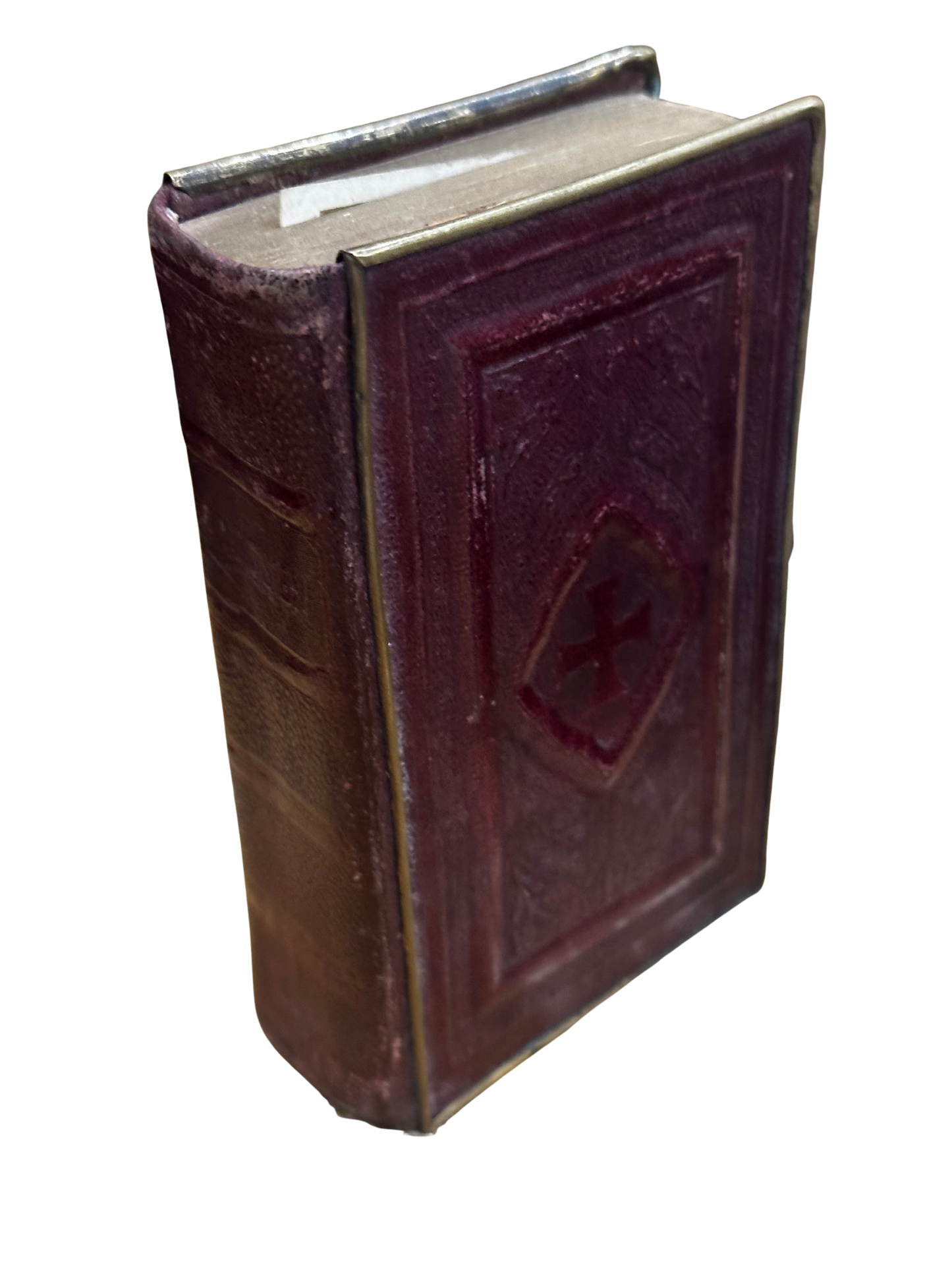
Red Leather Cross Embossed Religious Book with Clasp
Gilded Foreedge (All gilt Edges)
Paroissien Romain; Tours; Alfred Mame et Fils 1911
Rich burgundy leather, blind-stamped with a Gothic cross within a pointed arch panel, surrounded by foliate and geometric motifs.
Finely worked ornate gilt-metal clasp in the form of a stylized floral motif—still intact, which is uncommon.
Marbled paper in a delicate coral and vine pattern, typical of high-quality bindings from Mame’s early 1900s production.
Steel engravings (e.g., The Last Supper by L. Jalabert after Th. Balze, printed by Bertinatti, Tours).
Hand-colored chromolithographs depicting key biblical scenes such as La Sainte Cène (The Last Supper) and La Nativité (The Nativity), printed by the famed Parisian workshop Frick Frères.
Engraved borders and illuminated-style floral frames in vivid pigments (red, blue, green, gold).
Founded in Tours, France, Mame was one of the most prestigious Catholic publishers in Europe during the 19th and early 20th centuries.
They were known for producing luxury devotional editions—paroissiens, missals, and prayer books—often distributed for First Communions, weddings, or confirmation gifts.
Their bindings ranged from simple cloth to elaborate gilt-edged leather and metal-mounted examples like yours.
The 1911 edition coincides with the pontificate of Pope Pius X, a period of liturgical renewal and emphasis on daily Communion, hence the bilingual Latin-French texts for accessibility.
Red Leather Cross Embossed Religious Book with Clasp
Gilded Foreedge (All gilt Edges)
Paroissien Romain; Tours; Alfred Mame et Fils 1911
Rich burgundy leather, blind-stamped with a Gothic cross within a pointed arch panel, surrounded by foliate and geometric motifs.
Finely worked ornate gilt-metal clasp in the form of a stylized floral motif—still intact, which is uncommon.
Marbled paper in a delicate coral and vine pattern, typical of high-quality bindings from Mame’s early 1900s production.
Steel engravings (e.g., The Last Supper by L. Jalabert after Th. Balze, printed by Bertinatti, Tours).
Hand-colored chromolithographs depicting key biblical scenes such as La Sainte Cène (The Last Supper) and La Nativité (The Nativity), printed by the famed Parisian workshop Frick Frères.
Engraved borders and illuminated-style floral frames in vivid pigments (red, blue, green, gold).
Founded in Tours, France, Mame was one of the most prestigious Catholic publishers in Europe during the 19th and early 20th centuries.
They were known for producing luxury devotional editions—paroissiens, missals, and prayer books—often distributed for First Communions, weddings, or confirmation gifts.
Their bindings ranged from simple cloth to elaborate gilt-edged leather and metal-mounted examples like yours.
The 1911 edition coincides with the pontificate of Pope Pius X, a period of liturgical renewal and emphasis on daily Communion, hence the bilingual Latin-French texts for accessibility.