

19th Century French Gilt-Brass & Beveled Glass Miniature Easel Frame, Rococo Revival
19th Century French Gilt-Brass & Beveled Glass Miniature Easel Frame, Rococo Revival
No se pudo cargar la disponibilidad de retiro
Compartir
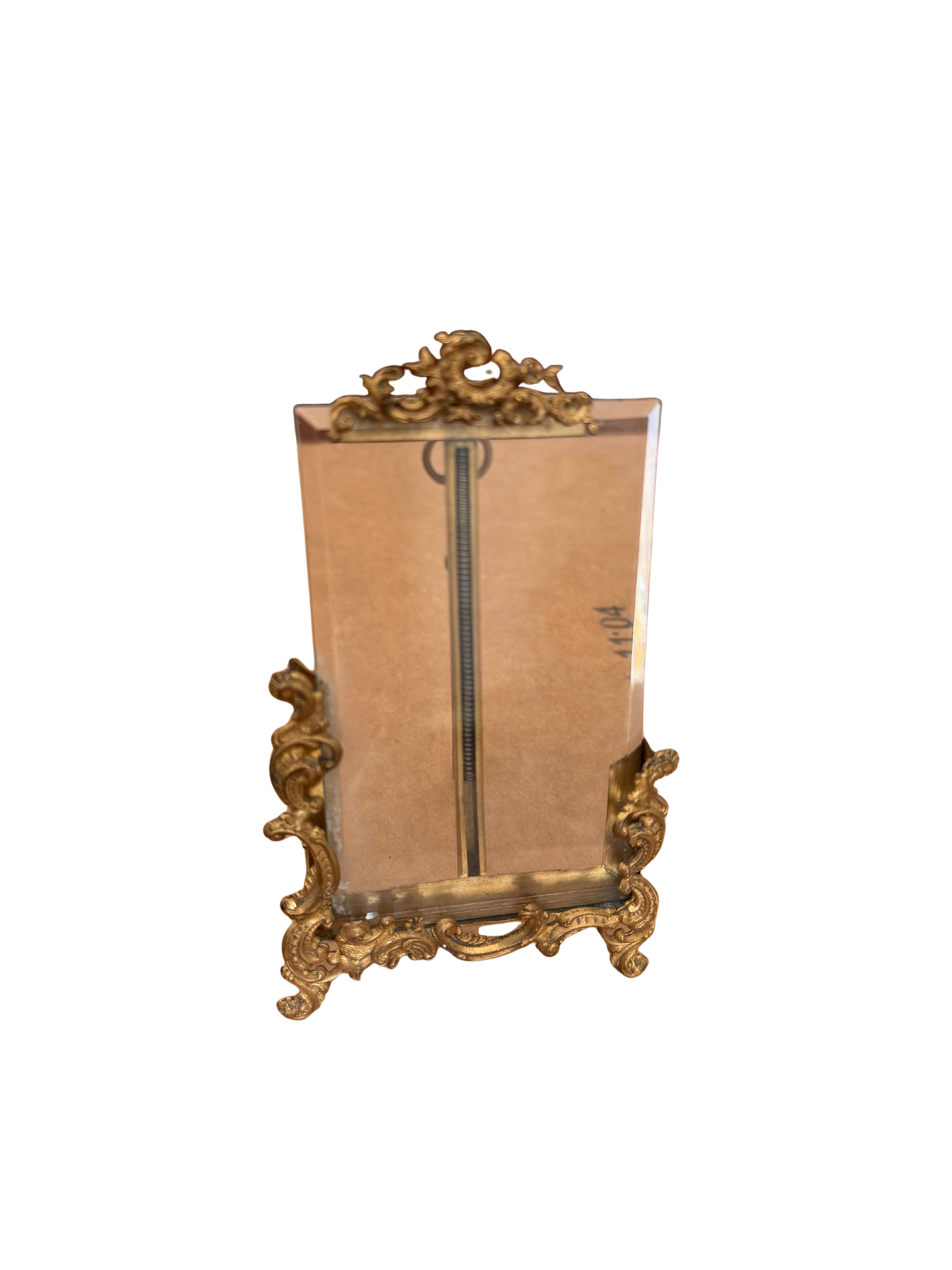
Item: 19th Century French Gilt-Brass & Beveled Glass Miniature Easel Frame, Rococo Revival
Additional Description
A highly decorative 19th-century French miniature easel frame in gilt brass, richly ornamented in the Rococo Revival taste.
The rectangular beveled glass panel is held within an elaborate gilt-brass structure with exuberant scrolling acanthus, shell, and foliate ornament. The lower corners rise into sculptural rocaille supports, while the top is crowned with an asymmetrical scrolling crest, giving the piece the light, theatrical character associated with Louis XV-inspired decoration.
A narrow vertical gilt-brass support runs behind the glass and incorporates a dark ribbed or notched element, likely part of the original mechanism for securing or adjusting a photograph, miniature, or small work on paper. The reverse retains its hinged easel support, allowing the frame to stand independently on a tabletop, dressing table, desk, or mantel.
The clear beveled glass gives the piece a particularly jewel-like quality and would beautifully display a small portrait, photograph, calling card, devotional image, or miniature artwork.
Era
Circa 1870–1900
Origin
France
Style
Rococo Revival / Louis XV Revival
Object Type
Miniature easel frame / tabletop photograph frame
Materials
- Gilt brass or bronze
- Beveled glass
- Metal easel support
History
Small decorative easel frames became especially popular during the second half of the 19th century, when photography and portrait miniatures were increasingly incorporated into domestic interiors.
French makers frequently drew on earlier Louis XV and Rococo decorative vocabulary, using scrolling acanthus leaves, shells, asymmetrical crests, and richly modeled gilt-metal mounts to transform otherwise practical photograph frames into luxury decorative objects.
Compact frames of this type were often placed on writing desks, dressing tables, mantelpieces, and small salon furniture, where they displayed intimate family portraits or treasured images.
Marks / Signature
No visible maker’s mark observed in the photographs provided.
Dimensions
Please add:
Overall: ___” H × ___” W × ___” D
Glass: ___” H × ___” W
Condition
Good antique condition with wear consistent with age and use. The gilt-metal surface shows expected rubbing, oxidation, darkening, and small areas of finish loss, particularly at projecting decorative elements.
The beveled glass appears intact with minor surface marks and edge wear consistent with age. The reverse easel support remains present and functional. Minor casting irregularities and age-related movement to the metalwork may be present.
Please review all photographs closely as they form part of the condition description.
Provenance
France, late 19th century.
Disclaimers
Dating and French attribution are based on style, materials, construction, and visible age and should be regarded as approximate unless a maker’s mark is discovered.
The metal has not been scientifically tested and is described as gilt brass or bronze based on visual examination.
Item: 19th Century French Gilt-Brass & Beveled Glass Miniature Easel Frame, Rococo Revival
Additional Description
A highly decorative 19th-century French miniature easel frame in gilt brass, richly ornamented in the Rococo Revival taste.
The rectangular beveled glass panel is held within an elaborate gilt-brass structure with exuberant scrolling acanthus, shell, and foliate ornament. The lower corners rise into sculptural rocaille supports, while the top is crowned with an asymmetrical scrolling crest, giving the piece the light, theatrical character associated with Louis XV-inspired decoration.
A narrow vertical gilt-brass support runs behind the glass and incorporates a dark ribbed or notched element, likely part of the original mechanism for securing or adjusting a photograph, miniature, or small work on paper. The reverse retains its hinged easel support, allowing the frame to stand independently on a tabletop, dressing table, desk, or mantel.
The clear beveled glass gives the piece a particularly jewel-like quality and would beautifully display a small portrait, photograph, calling card, devotional image, or miniature artwork.
Era
Circa 1870–1900
Origin
France
Style
Rococo Revival / Louis XV Revival
Object Type
Miniature easel frame / tabletop photograph frame
Materials
- Gilt brass or bronze
- Beveled glass
- Metal easel support
History
Small decorative easel frames became especially popular during the second half of the 19th century, when photography and portrait miniatures were increasingly incorporated into domestic interiors.
French makers frequently drew on earlier Louis XV and Rococo decorative vocabulary, using scrolling acanthus leaves, shells, asymmetrical crests, and richly modeled gilt-metal mounts to transform otherwise practical photograph frames into luxury decorative objects.
Compact frames of this type were often placed on writing desks, dressing tables, mantelpieces, and small salon furniture, where they displayed intimate family portraits or treasured images.
Marks / Signature
No visible maker’s mark observed in the photographs provided.
Dimensions
Please add:
Overall: ___” H × ___” W × ___” D
Glass: ___” H × ___” W
Condition
Good antique condition with wear consistent with age and use. The gilt-metal surface shows expected rubbing, oxidation, darkening, and small areas of finish loss, particularly at projecting decorative elements.
The beveled glass appears intact with minor surface marks and edge wear consistent with age. The reverse easel support remains present and functional. Minor casting irregularities and age-related movement to the metalwork may be present.
Please review all photographs closely as they form part of the condition description.
Provenance
France, late 19th century.
Disclaimers
Dating and French attribution are based on style, materials, construction, and visible age and should be regarded as approximate unless a maker’s mark is discovered.
The metal has not been scientifically tested and is described as gilt brass or bronze based on visual examination.