

19th-Century French Napoleon III Rosewood Jewelry Casket with Gilt-Bronze-Style Ivy Mounts, Hand-Painted Floral Porcelain Medallion and Working Key
19th-Century French Napoleon III Rosewood Jewelry Casket with Gilt-Bronze-Style Ivy Mounts, Hand-Painted Floral Porcelain Medallion and Working Key
No se pudo cargar la disponibilidad de retiro
Compartir
Item Title: 19th-Century French Napoleon III Rosewood Jewelry Casket with Gilt-Bronze-Style Ivy Mounts, Hand-Painted Floral Porcelain Medallion & Working Key, Circa 1860–1890
Additional Description:
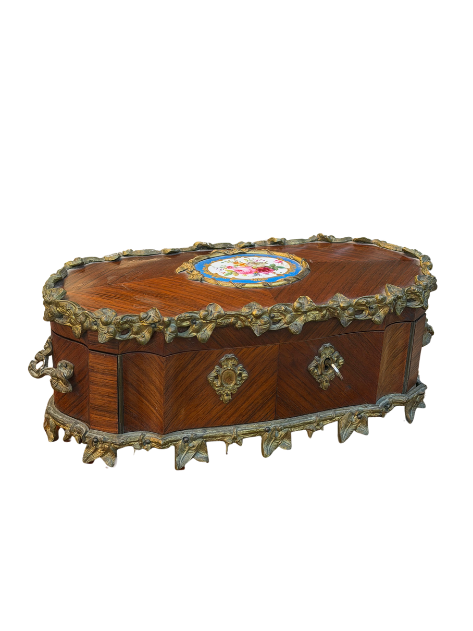
An exquisite 19th-century French Napoleon III-style jewelry casket, beautifully constructed in richly figured rosewood-style veneer and adorned with elaborate gilt-metal mounts, a delicate hand-painted floral porcelain medallion, and an unusual double-opening compartment arrangement.
The casket is distinguished by its graceful elongated form, with softly shaped ends, an elegantly proportioned hinged lid, and a striking architectural presentation.
The exterior displays beautiful reddish-brown wood grain arranged in geometric patterns, with the veneer forming angular, symmetrical compositions across the lid and sides. The warm tones of the polished wood provide a striking contrast against the ornate gilded metalwork.
Encircling the perimeter of the lid is an extraordinary continuous band of sculptural gilt-metal ornament, modeled as intertwined vines, twisting branches, and deeply articulated ivy leaves. The foliage extends outward from the casket, creating a richly textured border that exemplifies the naturalistic decorative motifs favored during the French Second Empire.
A coordinating gilt-metal border surrounds the lower edge of the casket, with beautifully modeled ivy leaves projecting beneath the base and along the corners, forming an almost sculptural foundation.
At the center of the lid is an oval porcelain medallion, framed by an elaborate gilt-metal foliate surround. The plaque is delicately painted with an arrangement of pink roses and colorful blossoms against a white ground, surrounded by a brilliant cobalt-blue border embellished with gold decoration.
The porcelain is reminiscent of the celebrated Sèvres-style floral decoration frequently incorporated into luxury French furniture and decorative objects during the 19th century.
The front features two separate gilt-metal lock escutcheons, each embellished with scrolling ornament. One is pierced to accommodate the functioning lock, while the other serves as a balancing decorative element.
The casket opens through two hinged sections: a traditional upper lid and a pair of outward-opening front doors. This unusual configuration allows the front of the box to open fully, revealing a spacious interior suitable for jewelry, keepsakes, letters, or treasured personal possessions.
The interior retains its warm, naturally finished wood, displaying attractive grain and historic patination. The underside of the lid is also wood-lined, allowing the beauty of the timber to remain visible throughout the piece.
A newly fitted working key accompanies the casket, allowing its lock to be operated.
Both functional and extraordinarily decorative, this beautiful antique casket is an elegant expression of the French Napoleon III taste for luxurious materials, historical revival styles, and finely crafted personal objects.
Era:
**Estimated date:** Circa 1860–1890.
**Period:** French Second Empire / Napoleon III and late-19th-century historicist revival.
**Style:** Napoleon III, with Louis XV Revival and naturalistic Rococo influences.
**Probable origin:** France.
**Maker:** Unidentified.
The geometric veneer arrangement, richly sculptural gilt-metal mounts, porcelain floral medallion, and elaborate fitted case construction are consistent with luxury French decorative arts of the second half of the 19th century.
The dating is provisional and based on stylistic and construction evidence rather than a documented maker's mark.
History:
During the reign of Napoleon III (1852–1870), France experienced a remarkable flourishing of luxury decorative arts, driven by a renewed fascination with the elegance of earlier French royal interiors.
Empress Eugénie, whose admiration for Marie Antoinette and 18th-century French furnishings was widely recognized, helped popularize a revival of Louis XV and Louis XVI decorative styles.
Parisian cabinetmakers, bronze founders, porcelain painters, and luxury retailers responded by producing exquisitely appointed furniture and smaller decorative objects, often combining several precious materials within a single composition.
Jewelry caskets, known in French as *coffrets à bijoux*, became especially fashionable among affluent households. These finely crafted boxes were intended to protect personal treasures while serving as decorative objects upon dressing tables, writing desks, and bedroom furnishings.
Many incorporated richly figured hardwood veneers, gilt-bronze mounts, porcelain plaques, and sophisticated locking mechanisms.
The exuberant ivy and vine ornamentation of this example reflects the 19th-century enthusiasm for naturalistic decoration. Ivy, historically associated with fidelity, attachment, and enduring affection, was a particularly appropriate decorative motif for objects intended to safeguard sentimental possessions.
The floral porcelain medallion further recalls the influence of Sèvres porcelain, whose richly colored grounds and delicately painted flowers inspired generations of French decorative artists.
The unusual combination of a hinged lid and outward-opening front doors demonstrates the ingenuity of 19th-century cabinetmaking, creating a small but architecturally sophisticated storage object.
This casket belongs to the broader tradition of French luxury decorative objects produced during the Napoleon III period, when ornamental craftsmanship and functional design were frequently united in intimate personal furnishings.
Provenance:
Private collection.
Earlier ownership history is undocumented.
No manufacturer, retailer, or cabinetmaker's mark has been identified in the supplied photographs.
The casket retains its elaborate exterior metal mounts, floral porcelain medallion, and wood-lined interior.
A new working key accompanies the piece.
Materials:
- Reddish-brown hardwood veneer, visually consistent with rosewood or a related decorative timber
- Wood case structure with geometric veneer arrangement
- Elaborate gilt-metal mounts, possibly gilt bronze or brass
- Naturalistic ivy leaf and vine ornamentation
- Oval polychrome floral porcelain medallion with cobalt-blue and gilt decoration
- Decorative gilt-metal porcelain surround
- Two gilt-metal front escutcheons
- Hinged upper lid
- Pair of outward-opening front doors
- Natural wood-lined interior
- Metal hinges and locking mechanism
- Newly fitted working key
**Porcelain attribution:** Sèvres style; not confirmed as manufactured by Sèvres.
**Metal attribution:** Gilt metal; precise alloy and gilding technique unverified.
Dimensions:
Exact measurements have not yet been provided.
**Measurements to confirm:**
- Overall length, including projecting gilt-metal mounts
- Overall depth
- Height with lid closed
- Internal compartment dimensions
- Weight
The casket appears to be a substantial tabletop jewelry or keepsake box, rather than a miniature trinket box.
Disclaimers/Condition:
The casket presents beautifully, with a warm, lustrous wood finish, richly detailed gilt-metal ornamentation, and an attractive central floral porcelain medallion.
The wood displays minor surface scratches, small marks, and variations in color consistent with age and historical use. The geometric veneer remains visually well defined, although minor separations or repairs cannot be excluded without close physical inspection.
The elaborate gilt-metal mounts display areas of patination, toning, and wear to the gilded finish, particularly within the recessed foliage and along the projecting edges.
The floral porcelain medallion appears intact in the available photographs, with no obvious major cracks or losses. Minor surface wear or restoration has not been independently ruled out.
The hinged upper lid and two front doors are shown open, revealing the original-style wood-lined interior. The interior displays natural age-related wear, discoloration, and small marks.
Both rear hinge strips are visible, and the front door construction remains present. The structural integrity of the hinges should be confirmed through careful handling.
**A newly fitted working key is included**, permitting operation of the casket's lock. The key is a replacement and should not be represented as original to the 19th century.
No significant structural breakage is apparent in the photographs. However, the exact wood species, metal composition, originality of every fitting, and date of manufacture have not been independently authenticated.
As an antique object, the casket displays imperfections and characteristics consistent with its age and historic use.