

19th Century German “Theures Andenken” Portrait Miniature with Painted Initials and Ribbonwork
19th Century German “Theures Andenken” Portrait Miniature with Painted Initials and Ribbonwork
No se pudo cargar la disponibilidad de retiro
Compartir
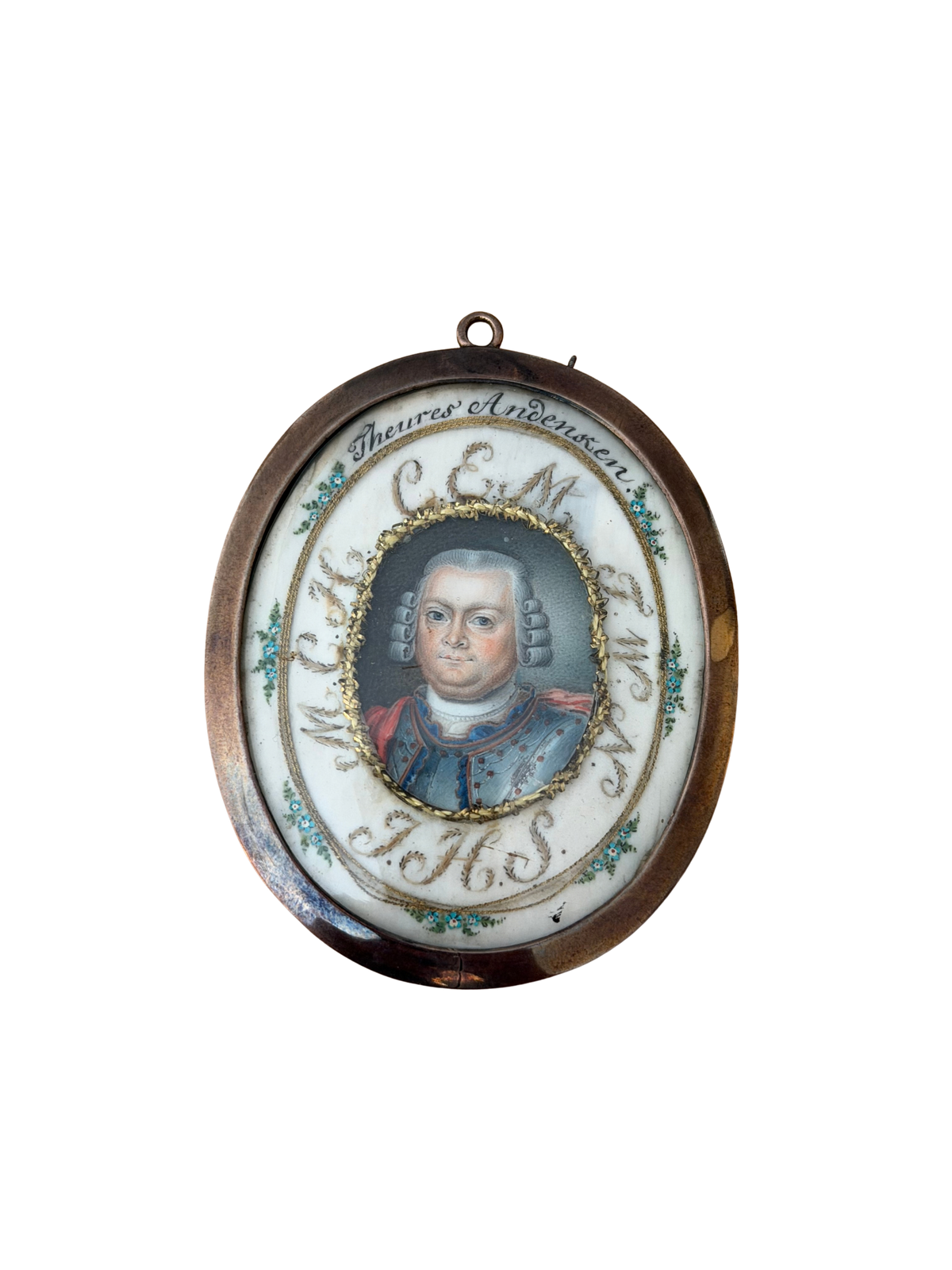
A wonderfully personal 19th-century German-language portrait miniature and sentimental keepsake, centered by a finely painted portrait of a gentleman in military dress and surrounded by painted ornament, tiny floral details, and applied metallic ribbon or braid.
The oval miniature depicts a middle-aged gentleman with gray curled hair, dressed in a steel-gray military breastplate with red and blue accents. His face is rendered in fine detail, with blue eyes, softly modeled features, and a formal frontal pose.
The portrait is bordered by a narrow decorative gold-toned metallic ribbon or braid, which separates it from the larger pale surround. Around the miniature are painted scrolling motifs, delicate blue-and-green floral sprigs, and four sets of initials positioned around the portrait:
- Top: CEM
- Right: FWN
- Bottom: JHS
- Left: MCH
Across the upper edge is the inscription:
“Theures Andenken.”
This translates approximately as “Precious Keepsake,” “Dear Remembrance,” or “Cherished Memento.”
The combination of portrait, inscription, initials, painted decoration, and ribbonwork suggests the piece was created as a highly personal family or friendship keepsake, possibly commemorating several individuals connected to the sitter.
Era
Date: Circa 1800–1840
Period: Early 19th century
Origin: German-speaking Europe, likely Germany or Austria
The inscription and decorative treatment strongly support a Germanic origin.
Inscription
The upper inscription reads:
“Theures Andenken.”
This is an older spelling of modern German “Teures Andenken,” meaning approximately:
“Precious remembrance”
“Dear keepsake”
or
“Cherished memento.”
The phrase was commonly used on sentimental objects intended to preserve the memory of a loved one, friend, family member, or meaningful relationship.
Initials
Four sets of initials are painted around the portrait:
CEM — above the portrait
FWN — to the right
JHS — below
MCH — to the left
These initials may refer to relatives, friends, or members of a close personal circle associated with the sitter.
Their deliberate placement around the central portrait strongly suggests that the object was intended as a collective remembrance piece, rather than simply a conventional portrait miniature.
Without additional provenance, the identities behind the initials remain unknown.
Portrait
The unidentified sitter is shown in formal military dress with:
- Gray curled hair
- Pale high collar
- Steel-gray breastplate or cuirass
- Red shoulder drapery
- Blue uniform accents
The costume is consistent with late 18th- to early 19th-century military portraiture, although the exact rank, regiment, and nationality cannot be determined from the image alone.
Construction & Decoration
The decorative surround consists of:
- Painted brown scrolling ornament
- Tiny painted blue-and-green floral sprays
- Applied gold-toned metallic ribbon or braid
- Decorative metallic trim around the miniature
- Pale prepared ground beneath the ornament
The piece does not appear to incorporate hairwork.
The ribbonwork and painted ornament create the intimate, handcrafted character typical of early sentimental keepsakes.
History
Portrait miniatures were highly personal objects throughout the late 18th and early 19th centuries, often created to commemorate relatives, friends, spouses, and military figures.
In German-speaking regions, sentimental keepsakes frequently incorporated the word “Andenken”, meaning remembrance or keepsake. Such objects could commemorate affection, friendship, family relationships, departure, military service, or mourning.
The four sets of initials surrounding the sitter are especially intriguing. Rather than functioning merely as decoration, they likely carried personal meaning to the original owner and may represent members of a family group or intimate social circle.
Materials
- Hand-painted portrait miniature
- Painted decorative surround
- Applied metallic ribbon / braid
- Paper or prepared card support
- Glass
- Oval metal frame
- Card or paper backing
Dimensions
Dimensions: To be added
Condition
Good antique condition with wear consistent with age.
- Portrait remains detailed and visually strong.
- Some age-related fading, toning, and minor surface variation.
- Painted initials remain legible.
- Painted floral and scrolling ornament remains substantially intact.
- Metallic ribbon and trim show tarnish, oxidation, and localized wear.
- Pale surrounding ground shows toning and scattered spotting.
- Glass exhibits minor scratches and surface wear.
- Outer metal frame has developed a darkened patina with rubbing and oxidation.
- Reverse backing shows significant age-related discoloration, residue, and old paper remnants.
- Suspension loop remains present.
- Piece has not been removed from the frame for examination.
Disclaimers
All antique and vintage items are sold in as-found condition and may exhibit wear, patina, repairs, losses, fading, staining, alterations, or other evidence of age and use.
The identities represented by the initials CEM, FWN, JHS, and MCH are unknown.
The sitter’s identity, military rank, and nationality have not been established.
Dating and origin are based on visual examination, costume, inscription, and construction.
Please review all photographs carefully as they form an important part of the description.
A wonderfully personal 19th-century German-language portrait miniature and sentimental keepsake, centered by a finely painted portrait of a gentleman in military dress and surrounded by painted ornament, tiny floral details, and applied metallic ribbon or braid.
The oval miniature depicts a middle-aged gentleman with gray curled hair, dressed in a steel-gray military breastplate with red and blue accents. His face is rendered in fine detail, with blue eyes, softly modeled features, and a formal frontal pose.
The portrait is bordered by a narrow decorative gold-toned metallic ribbon or braid, which separates it from the larger pale surround. Around the miniature are painted scrolling motifs, delicate blue-and-green floral sprigs, and four sets of initials positioned around the portrait:
- Top: CEM
- Right: FWN
- Bottom: JHS
- Left: MCH
Across the upper edge is the inscription:
“Theures Andenken.”
This translates approximately as “Precious Keepsake,” “Dear Remembrance,” or “Cherished Memento.”
The combination of portrait, inscription, initials, painted decoration, and ribbonwork suggests the piece was created as a highly personal family or friendship keepsake, possibly commemorating several individuals connected to the sitter.
Era
Date: Circa 1800–1840
Period: Early 19th century
Origin: German-speaking Europe, likely Germany or Austria
The inscription and decorative treatment strongly support a Germanic origin.
Inscription
The upper inscription reads:
“Theures Andenken.”
This is an older spelling of modern German “Teures Andenken,” meaning approximately:
“Precious remembrance”
“Dear keepsake”
or
“Cherished memento.”
The phrase was commonly used on sentimental objects intended to preserve the memory of a loved one, friend, family member, or meaningful relationship.
Initials
Four sets of initials are painted around the portrait:
CEM — above the portrait
FWN — to the right
JHS — below
MCH — to the left
These initials may refer to relatives, friends, or members of a close personal circle associated with the sitter.
Their deliberate placement around the central portrait strongly suggests that the object was intended as a collective remembrance piece, rather than simply a conventional portrait miniature.
Without additional provenance, the identities behind the initials remain unknown.
Portrait
The unidentified sitter is shown in formal military dress with:
- Gray curled hair
- Pale high collar
- Steel-gray breastplate or cuirass
- Red shoulder drapery
- Blue uniform accents
The costume is consistent with late 18th- to early 19th-century military portraiture, although the exact rank, regiment, and nationality cannot be determined from the image alone.
Construction & Decoration
The decorative surround consists of:
- Painted brown scrolling ornament
- Tiny painted blue-and-green floral sprays
- Applied gold-toned metallic ribbon or braid
- Decorative metallic trim around the miniature
- Pale prepared ground beneath the ornament
The piece does not appear to incorporate hairwork.
The ribbonwork and painted ornament create the intimate, handcrafted character typical of early sentimental keepsakes.
History
Portrait miniatures were highly personal objects throughout the late 18th and early 19th centuries, often created to commemorate relatives, friends, spouses, and military figures.
In German-speaking regions, sentimental keepsakes frequently incorporated the word “Andenken”, meaning remembrance or keepsake. Such objects could commemorate affection, friendship, family relationships, departure, military service, or mourning.
The four sets of initials surrounding the sitter are especially intriguing. Rather than functioning merely as decoration, they likely carried personal meaning to the original owner and may represent members of a family group or intimate social circle.
Materials
- Hand-painted portrait miniature
- Painted decorative surround
- Applied metallic ribbon / braid
- Paper or prepared card support
- Glass
- Oval metal frame
- Card or paper backing
Dimensions
Dimensions: To be added
Condition
Good antique condition with wear consistent with age.
- Portrait remains detailed and visually strong.
- Some age-related fading, toning, and minor surface variation.
- Painted initials remain legible.
- Painted floral and scrolling ornament remains substantially intact.
- Metallic ribbon and trim show tarnish, oxidation, and localized wear.
- Pale surrounding ground shows toning and scattered spotting.
- Glass exhibits minor scratches and surface wear.
- Outer metal frame has developed a darkened patina with rubbing and oxidation.
- Reverse backing shows significant age-related discoloration, residue, and old paper remnants.
- Suspension loop remains present.
- Piece has not been removed from the frame for examination.
Disclaimers
All antique and vintage items are sold in as-found condition and may exhibit wear, patina, repairs, losses, fading, staining, alterations, or other evidence of age and use.
The identities represented by the initials CEM, FWN, JHS, and MCH are unknown.
The sitter’s identity, military rank, and nationality have not been established.
Dating and origin are based on visual examination, costume, inscription, and construction.
Please review all photographs carefully as they form an important part of the description.