


19th Century Sepia Lithograph of a Gothic Cathedral Interior, After François Tassier
19th Century Sepia Lithograph of a Gothic Cathedral Interior, After François Tassier
No se pudo cargar la disponibilidad de retiro
Compartir
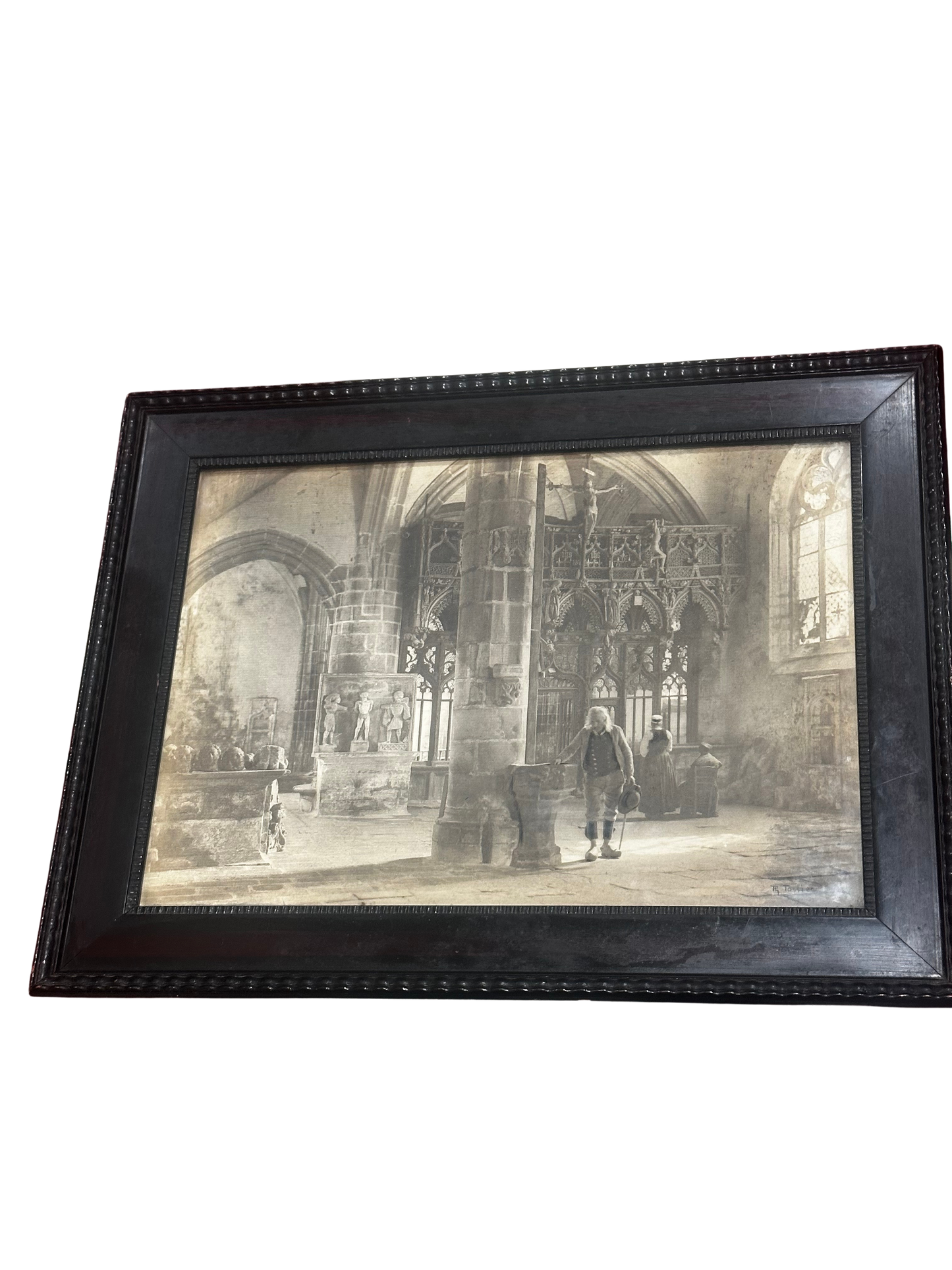
Additional Description: A finely detailed 19th-century sepia lithograph depicting the atmospheric interior of a Gothic church or cathedral. The scene shows soaring pointed arches, clustered columns, and ribbed vaulting characteristic of medieval ecclesiastical architecture. At the center of the composition stands an elaborate rood screen surmounted by a crucifix, separating the nave from the choir, while visitors quietly move through the sacred space below. It looks to resemble Le Jube of the Capelle Saint Fiacre at Le Faouet in Brittany (side chapel within the church).
The work bears the signature “Fr. Tassier”, referencing François Tassier, a 19th-century artist known for romanticized depictions of historic European church interiors. Artists of this period frequently produced detailed drawings of notable architectural monuments which were later reproduced through lithographic printing for collectors and decorators.
This example appears to be a late 19th-century lithographic print after Tassier’s original architectural drawing, rendered in a warm sepia tone that enhances the depth and drama of the Gothic interior. Figures placed within the composition provide scale and narrative, inviting the viewer into the quiet grandeur of the space.
Such prints were popular during the Gothic Revival period, when renewed interest in medieval architecture inspired artists and publishers to document historic churches across Belgium, France, and Germany.
Era: Late 19th century, circa 1880–1900
History: During the 19th century, architectural artists frequently traveled throughout Europe producing drawings of historic cathedrals and church interiors. These works were often reproduced as lithographs and photogravures, allowing collectors to acquire detailed views of famous monuments. Prints after François Tassier were part of this tradition, celebrating the beauty and antiquity of medieval architecture.
The Chapelle Saint-Fiacre in Le Faouët (Morbihan, Brittany) is one of the most important surviving rural chapels of late medieval France—particularly famous for its extraordinary carved wooden rood screen (jubé). Its history blends pilgrimage, noble patronage, and deeply symbolic Breton religious culture. The chapel was built in the mid-to-late 15th century (c. 1450–1480/90) in the Flamboyant Gothic style. It likely replaced or incorporated an earlier religious site, possibly tied to a pilgrim hospital or hospice (documented in 1436). The site formed part of a small rural devotional community (“frairie”), often supported by local nobility—particularly the de Boutteville family, who acted as patrons. This is typical of Brittany, where local chapels functioned as semi-independent centers of worship outside major parishes.
The chapel is dedicated to Saint Fiacre, a 7th-century Irish hermit who settled in France. He became the patron saint of gardeners and healers, especially associated with: cultivation of land, miraculous cures (especially skin diseases). Nearby, a sacred healing fountain reinforced this connection—pilgrims would visit both chapel and water source.
The Jubé (Rood Screen) was carved c. 1480–1492 by Olivier Le Loergan. Considered one of the finest surviving rood screens in Brittany. It is especially important because: It separates clergy (choir) from the laity (nave)—a medieval social and liturgical divide, it is richly polychromed and narrative, almost like a sculpted “comic strip.”
Scenes include:
Biblical narratives: Adam & Eve, Annunciation, Passion of Christ
Moral allegories: drunkenness, lust, laziness, theft
This reflects medieval teaching—visual storytelling for largely illiterate populations.
Provenance: France
Materials: Paper, lithographic ink, wood frame
Dimensions: Paper: 15.5" W x 11.25" H
Disclaimers: Wear consistent with age including toning to paper and minor frame wear. Please review photographs closely as they form part of the description.
Additional Description: A finely detailed 19th-century sepia lithograph depicting the atmospheric interior of a Gothic church or cathedral. The scene shows soaring pointed arches, clustered columns, and ribbed vaulting characteristic of medieval ecclesiastical architecture. At the center of the composition stands an elaborate rood screen surmounted by a crucifix, separating the nave from the choir, while visitors quietly move through the sacred space below. It looks to resemble Le Jube of the Capelle Saint Fiacre at Le Faouet in Brittany (side chapel within the church).
The work bears the signature “Fr. Tassier”, referencing François Tassier, a 19th-century artist known for romanticized depictions of historic European church interiors. Artists of this period frequently produced detailed drawings of notable architectural monuments which were later reproduced through lithographic printing for collectors and decorators.
This example appears to be a late 19th-century lithographic print after Tassier’s original architectural drawing, rendered in a warm sepia tone that enhances the depth and drama of the Gothic interior. Figures placed within the composition provide scale and narrative, inviting the viewer into the quiet grandeur of the space.
Such prints were popular during the Gothic Revival period, when renewed interest in medieval architecture inspired artists and publishers to document historic churches across Belgium, France, and Germany.
Era: Late 19th century, circa 1880–1900
History: During the 19th century, architectural artists frequently traveled throughout Europe producing drawings of historic cathedrals and church interiors. These works were often reproduced as lithographs and photogravures, allowing collectors to acquire detailed views of famous monuments. Prints after François Tassier were part of this tradition, celebrating the beauty and antiquity of medieval architecture.
The Chapelle Saint-Fiacre in Le Faouët (Morbihan, Brittany) is one of the most important surviving rural chapels of late medieval France—particularly famous for its extraordinary carved wooden rood screen (jubé). Its history blends pilgrimage, noble patronage, and deeply symbolic Breton religious culture. The chapel was built in the mid-to-late 15th century (c. 1450–1480/90) in the Flamboyant Gothic style. It likely replaced or incorporated an earlier religious site, possibly tied to a pilgrim hospital or hospice (documented in 1436). The site formed part of a small rural devotional community (“frairie”), often supported by local nobility—particularly the de Boutteville family, who acted as patrons. This is typical of Brittany, where local chapels functioned as semi-independent centers of worship outside major parishes.
The chapel is dedicated to Saint Fiacre, a 7th-century Irish hermit who settled in France. He became the patron saint of gardeners and healers, especially associated with: cultivation of land, miraculous cures (especially skin diseases). Nearby, a sacred healing fountain reinforced this connection—pilgrims would visit both chapel and water source.
The Jubé (Rood Screen) was carved c. 1480–1492 by Olivier Le Loergan. Considered one of the finest surviving rood screens in Brittany. It is especially important because: It separates clergy (choir) from the laity (nave)—a medieval social and liturgical divide, it is richly polychromed and narrative, almost like a sculpted “comic strip.”
Scenes include:
Biblical narratives: Adam & Eve, Annunciation, Passion of Christ
Moral allegories: drunkenness, lust, laziness, theft
This reflects medieval teaching—visual storytelling for largely illiterate populations.
Provenance: France
Materials: Paper, lithographic ink, wood frame
Dimensions: Paper: 15.5" W x 11.25" H
Disclaimers: Wear consistent with age including toning to paper and minor frame wear. Please review photographs closely as they form part of the description.