


Antique Continental Silvered Metal Devotional Plaque of Pope Pius XI, “Pasce Agnos Meos, Pasce Oves Meas,” Circa 1920s–1930s
Antique Continental Silvered Metal Devotional Plaque of Pope Pius XI, “Pasce Agnos Meos, Pasce Oves Meas,” Circa 1920s–1930s
No se pudo cargar la disponibilidad de retiro
Compartir


An unusual early 20th-century Catholic devotional plaque or tabletop icon depicting Pope Pius XI (Achille Ratti, pontificate 1922–1939) in low relief, set within an ornate silvered-metal easel frame.
The central rectangular plaque portrays the pontiff in ecclesiastical dress, one hand raised in a gesture of teaching or benediction. Beneath the portrait appears the Latin inscription:
“PASCE AGNOS MEOS / PASCE OVES MEAS”
translated as “Feed my lambs; feed my sheep.” The phrase derives from Christ’s words to Saint Peter in the Gospel of John and has long been closely associated with the pastoral authority of Saint Peter and, by extension, the papacy. Contemporary Vatican documentation likewise records the phrase in connection with Pope Pius XI’s role as successor to Peter.
The plaque is framed by slender vertical standards terminating in pointed finials and spherical bosses. Above is an elaborate scrolling crest centered by a radiant cross medallion, while a complementary foliate ornament anchors the lower edge.
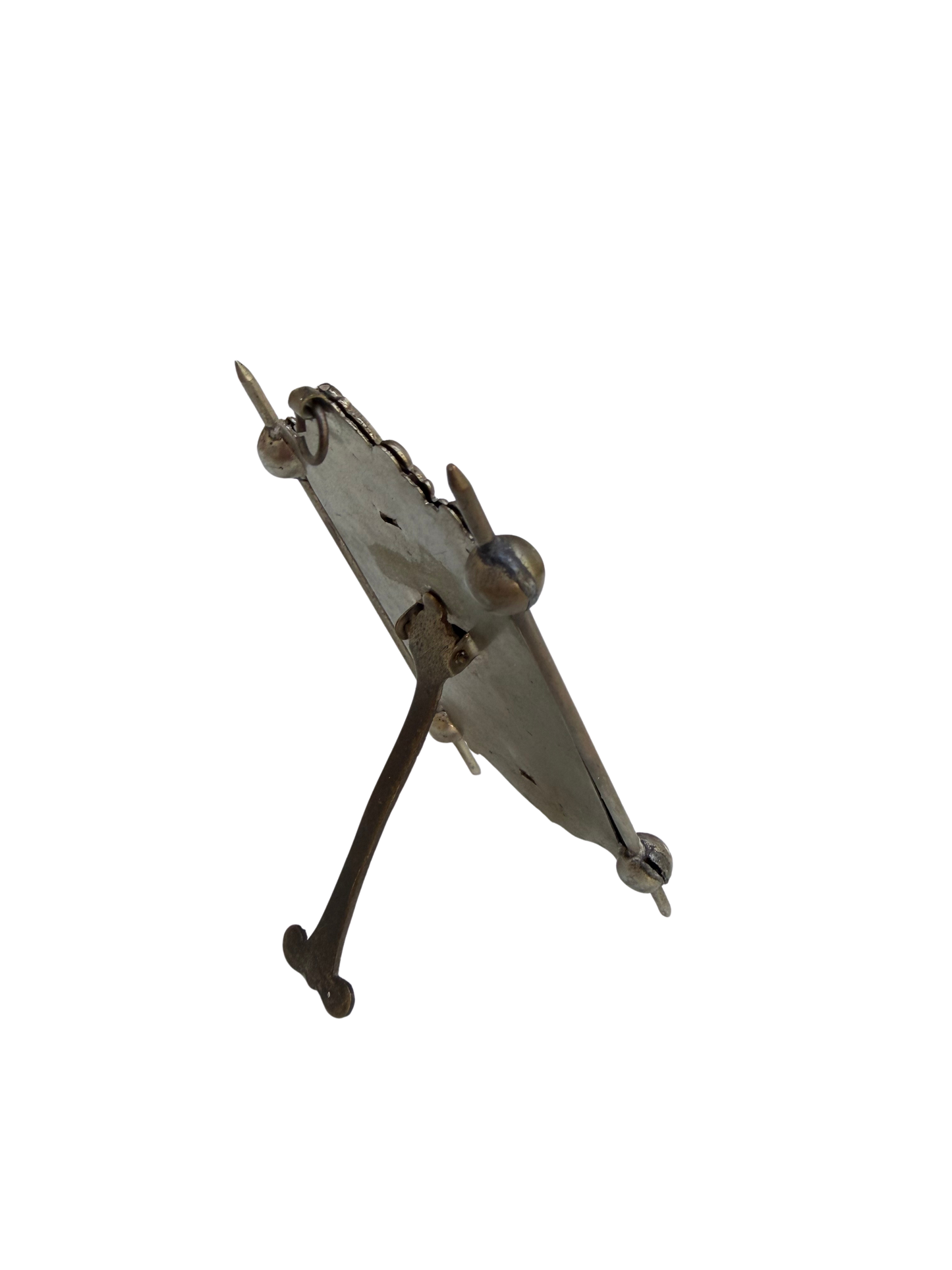
The reverse retains both a hinged easel support for tabletop display and a small suspension ring, allowing the piece to be displayed either standing or hung.
A distinctive devotional object with strong ecclesiastical character, particularly appealing as part of a collection of Catholic, Vatican, or papal memorabilia.
An unusual early 20th-century Catholic devotional plaque or tabletop icon depicting Pope Pius XI (Achille Ratti, pontificate 1922–1939) in low relief, set within an ornate silvered-metal easel frame.
The central rectangular plaque portrays the pontiff in ecclesiastical dress, one hand raised in a gesture of teaching or benediction. Beneath the portrait appears the Latin inscription:
“PASCE AGNOS MEOS / PASCE OVES MEAS”
translated as “Feed my lambs; feed my sheep.” The phrase derives from Christ’s words to Saint Peter in the Gospel of John and has long been closely associated with the pastoral authority of Saint Peter and, by extension, the papacy. Contemporary Vatican documentation likewise records the phrase in connection with Pope Pius XI’s role as successor to Peter.
The plaque is framed by slender vertical standards terminating in pointed finials and spherical bosses. Above is an elaborate scrolling crest centered by a radiant cross medallion, while a complementary foliate ornament anchors the lower edge.
The reverse retains both a hinged easel support for tabletop display and a small suspension ring, allowing the piece to be displayed either standing or hung.
A distinctive devotional object with strong ecclesiastical character, particularly appealing as part of a collection of Catholic, Vatican, or papal memorabilia.
3.75"h x 2"w x 0.25"d
3.75"h x 2"w x 0.25"d
Achille Ratti became Pope Pius XI in 1922 and served until 1939. His pontificate was a consequential period for the modern Vatican, most notably encompassing the Lateran Treaty of 1929, which established Vatican City as an independent sovereign state.
The inscription Pasce agnos meos, pasce oves meas—“Feed my lambs, feed my sheep”—comes from Christ’s commission to Saint Peter in John 21 and became a particularly appropriate papal motto or devotional inscription because Catholic tradition regards the pope as Peter’s successor.
The identification of the sitter as Pius XI is consistent with the portrait physiognomy, including the broad face, closely cropped hair, spectacles, and characteristic appearance seen in period representations. I would describe the attribution as Pope Pius XI rather than leave the sitter unidentified, though no maker’s inscription is visible in the photographs.
Small relief portraits such as this were produced throughout Catholic Europe as devotional and commemorative objects, particularly during significant pontificates, jubilees, pilgrimages, and Vatican celebrations.
Achille Ratti became Pope Pius XI in 1922 and served until 1939. His pontificate was a consequential period for the modern Vatican, most notably encompassing the Lateran Treaty of 1929, which established Vatican City as an independent sovereign state.
The inscription Pasce agnos meos, pasce oves meas—“Feed my lambs, feed my sheep”—comes from Christ’s commission to Saint Peter in John 21 and became a particularly appropriate papal motto or devotional inscription because Catholic tradition regards the pope as Peter’s successor.
The identification of the sitter as Pius XI is consistent with the portrait physiognomy, including the broad face, closely cropped hair, spectacles, and characteristic appearance seen in period representations. I would describe the attribution as Pope Pius XI rather than leave the sitter unidentified, though no maker’s inscription is visible in the photographs.
Small relief portraits such as this were produced throughout Catholic Europe as devotional and commemorative objects, particularly during significant pontificates, jubilees, pilgrimages, and Vatican celebrations.
Continental European, circa 1922–1939
Continental European, circa 1922–1939
Silvered or nickel-plated base metal; cast and repoussé metal elements; hinged metal easel support
Silvered or nickel-plated base metal; cast and repoussé metal elements; hinged metal easel support
Private collection; acquired in Washington DC
Private collection; acquired in Washington DC
Antique condition with visible age-related wear throughout. The silvered surface exhibits oxidation, tarnishing, darkening, rubbing, scattered spotting, scratches, and areas of finish loss consistent with age.
The central relief shows scattered pale surface deposits or oxidation spots. The easel support and rear hardware show additional oxidation and discoloration. Small irregularities, bends, and wear to the pointed finials and decorative frame may be present.
The hinged easel remains present and appears functional from the photographs. A hanging ring is retained at the upper reverse.
Please review all photographs carefully, as they form an important part of the condition description.
Antique condition with visible age-related wear throughout. The silvered surface exhibits oxidation, tarnishing, darkening, rubbing, scattered spotting, scratches, and areas of finish loss consistent with age.
The central relief shows scattered pale surface deposits or oxidation spots. The easel support and rear hardware show additional oxidation and discoloration. Small irregularities, bends, and wear to the pointed finials and decorative frame may be present.
The hinged easel remains present and appears functional from the photographs. A hanging ring is retained at the upper reverse.
Please review all photographs carefully, as they form an important part of the condition description.