


Antique Ecclesiastical Silk Brocade Altar Runner with Monstrance, Angels and IHS Christogram
Antique Ecclesiastical Silk Brocade Altar Runner with Monstrance, Angels and IHS Christogram
No se pudo cargar la disponibilidad de retiro
Compartir


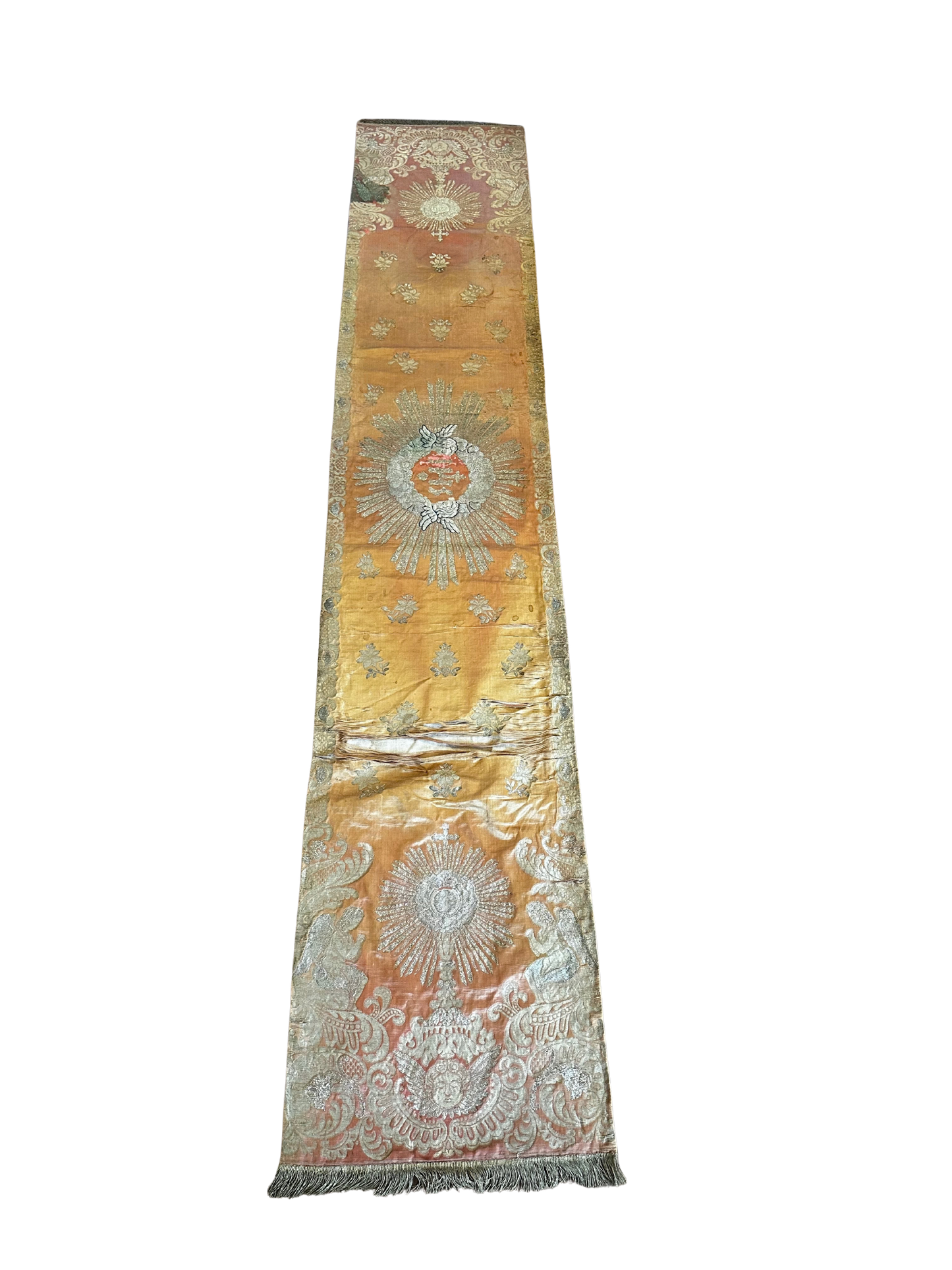
Long-format ecclesiastical textile executed in silk satin ground, richly brocaded with silver-toned metal thread. The design is centered on a radiant monstrance motif surmounted by a cross, flanked by kneeling angels in adoration, and framed by scrolling foliate ornament. A secondary central medallion incorporates the IHS Christogram, encircled by rays and winged cherubs, a symbolic reference to the Holy Eucharist.
The ground silk exhibits a warm amber-to-rose tonality with natural abrash and oxidation from age. Metallic threads (likely silver or silver-gilt wrapped silk) are woven and couched into the fabric, forming both pictorial and repeating floral motifs. Narrow decorative borders run the length of the piece, and the lower edge retains its original metallic fringe.
The reverse shows a plain silk lining in a soft rose tone, consistent with ecclesiastical construction. The textile’s scale, iconography, and materials strongly indicate use as an altar runner or frontal element, intended to dress the altar during high feast days.
Long-format ecclesiastical textile executed in silk satin ground, richly brocaded with silver-toned metal thread. The design is centered on a radiant monstrance motif surmounted by a cross, flanked by kneeling angels in adoration, and framed by scrolling foliate ornament. A secondary central medallion incorporates the IHS Christogram, encircled by rays and winged cherubs, a symbolic reference to the Holy Eucharist.
The ground silk exhibits a warm amber-to-rose tonality with natural abrash and oxidation from age. Metallic threads (likely silver or silver-gilt wrapped silk) are woven and couched into the fabric, forming both pictorial and repeating floral motifs. Narrow decorative borders run the length of the piece, and the lower edge retains its original metallic fringe.
The reverse shows a plain silk lining in a soft rose tone, consistent with ecclesiastical construction. The textile’s scale, iconography, and materials strongly indicate use as an altar runner or frontal element, intended to dress the altar during high feast days.
108"l x 20"w
108"l x 20"w
Ecclesiastical textiles of this type were produced for Catholic churches and chapels, often commissioned for major feast days such as Corpus Christi, when the monstrance—housing the consecrated Host—was displayed ceremonially. The use of metallic thread, angels, and radiant Eucharistic symbolism reflects Baroque devotional aesthetics emphasizing divine glory and sensory richness.
Such textiles were commonly woven in Italy, France, or Spain, where church workshops and luxury silk centers supplied liturgical furnishings. Over time, many altar textiles were later cut down, repurposed, or preserved as fragments once churches modernized or closed, making intact long-format examples increasingly scarce.
Ecclesiastical textiles of this type were produced for Catholic churches and chapels, often commissioned for major feast days such as Corpus Christi, when the monstrance—housing the consecrated Host—was displayed ceremonially. The use of metallic thread, angels, and radiant Eucharistic symbolism reflects Baroque devotional aesthetics emphasizing divine glory and sensory richness.
Such textiles were commonly woven in Italy, France, or Spain, where church workshops and luxury silk centers supplied liturgical furnishings. Over time, many altar textiles were later cut down, repurposed, or preserved as fragments once churches modernized or closed, making intact long-format examples increasingly scarce.
18th century (circa 1700–1780)
18th century (circa 1700–1780)
Silk satin ground, Silver or silver-gilt metal thread (wrapped silk core), Woven and couched brocade technique, Silk backing / lining, Metallic fringe trim
Silk satin ground, Silver or silver-gilt metal thread (wrapped silk core), Woven and couched brocade technique, Silk backing / lining, Metallic fringe trim
Continental Europe (likely Italy or France)
Continental Europe (likely Italy or France)
Significant age-related wear throughout, including thinning silk, splits, and losses
Oxidation and dulling to metal threads
Areas of abrasion, creasing, and historic folding lines
Scattered stains and tonal variation consistent with ecclesiastical use
Textile remains structurally fragile and should be displayed or framed with conservation care
Significant age-related wear throughout, including thinning silk, splits, and losses
Oxidation and dulling to metal threads
Areas of abrasion, creasing, and historic folding lines
Scattered stains and tonal variation consistent with ecclesiastical use
Textile remains structurally fragile and should be displayed or framed with conservation care