

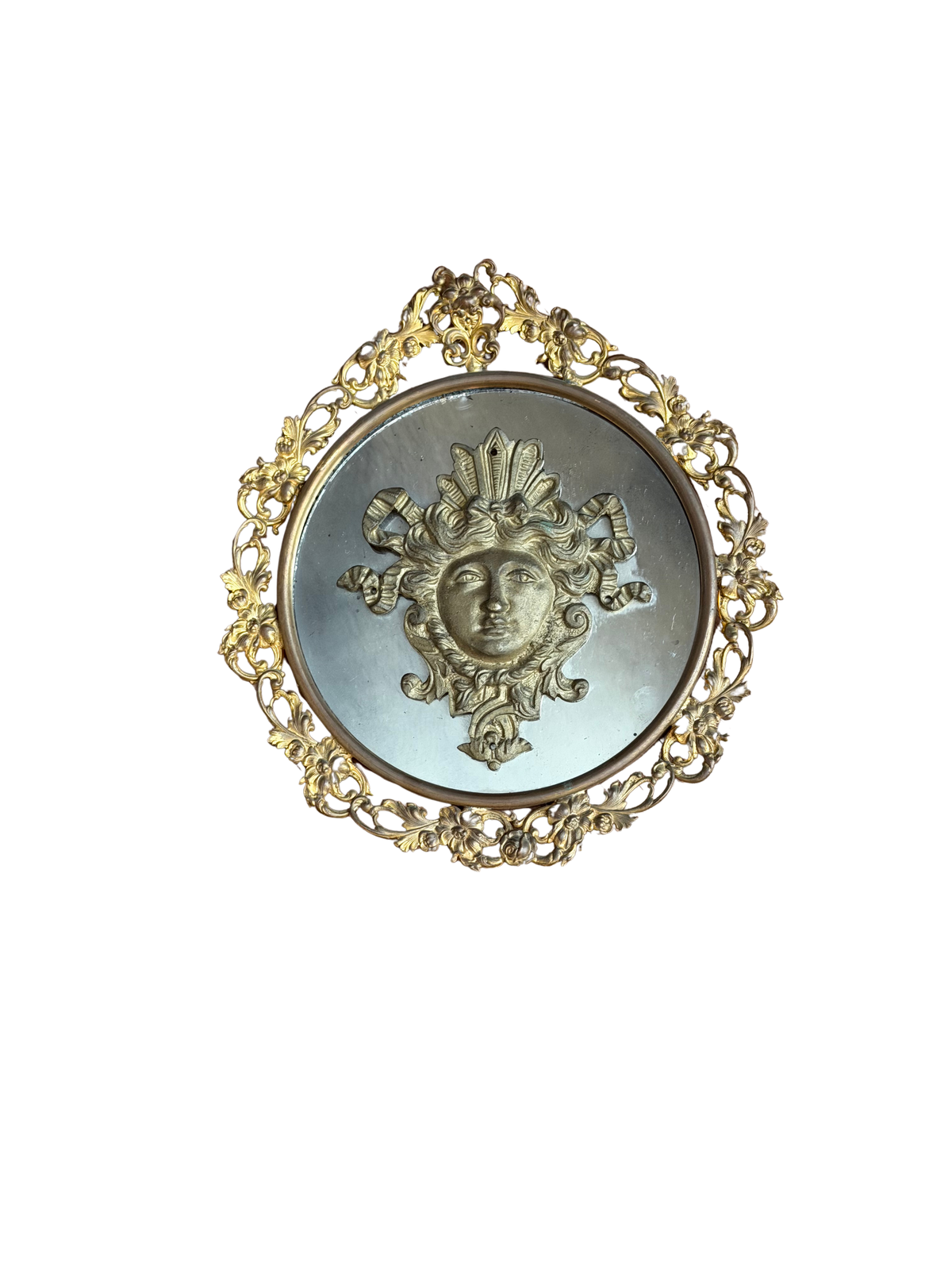
Antique French Gilt Bronze Floral Wall Mirror with Classical Female Mascaron, Possibly Medusa, Louis XV Revival Style, Late 19th Century
Antique French Gilt Bronze Floral Wall Mirror with Classical Female Mascaron, Possibly Medusa, Louis XV Revival Style, Late 19th Century
No se pudo cargar la disponibilidad de retiro
Compartir
Additional Description
An ornate antique circular wall mirror featuring an elaborate gilt bronze floral surround and a striking classical female mascaron mounted prominently at its center.
The circular mirror plate is enclosed within a finely detailed, openwork frame composed of scrolling foliage, flowering branches, and delicate rocaille-inspired ornamentation. The intricate botanical decoration combines sculptural flowerheads, curling leaves, and intertwined stems, creating an elegant, almost lace-like border.
At the center is a substantial cast-metal female mask with a serene expression, delicately modeled facial features, and elaborately arranged hair. Her coiffure is crowned by a fan-shaped ornament and tied with a bow, while ribbon-like coils extend outward on either side. The composition recalls the classical iconography of Medusa, although the precise identity of the figure remains undetermined.
The central relief retains a rich, aged bronze-gold patina, contrasting beautifully against the brighter gilding of the surrounding floral framework and reflective mirror plate.
The reverse retains an aged patterned backing and an old handwritten French-language label, apparently reading Bronze doré, referring to gilt bronze.
A beautifully decorative example of European revivalist metalwork, combining classical mythology, French ornamental design, and the romantic appeal of aged gilt bronze.
Era
Circa: 1870–1900, tentatively
Period: Late 19th Century, Napoleon III / Belle Époque transition
Style: Louis XV Revival / Neo-Rococo with classical ornamentation
Origin: Attributed to France
The elaborate openwork floral decoration, asymmetrical foliage, and classical female mascaron are consistent with ornamental designs popular during the French Second Empire and later 19th century.
The reverse label appears to contain additional numerical notations, but these cannot presently be interpreted as a reliable manufacturing date.
History
During the 19th century, French decorative arts experienced a renewed fascination with the ornamental traditions of the 18th century, particularly the styles associated with Louis XIV, Louis XV, and Louis XVI.
During the reign of Napoleon III (1852–1870), craftsmen and decorative metalworkers increasingly incorporated elaborate cast-bronze mounts, gilded floral ornamentation, and classical masks into mirrors, furniture, clocks, and other luxury interior furnishings.
The present mirror reflects this revivalist tradition through its combination of floral rocaille decoration and a sculptural female mascaron.
Of particular interest is the central mask, which bears similarities to representations of Medusa, the mythological Gorgon whose image became a recurring feature of European classical decorative arts.
Unlike the frightening depictions associated with ancient mythology, Medusa was frequently represented as a beautiful, serene female figure in neoclassical ornamentation. Such masks appeared on furniture mounts, architectural elements, and decorative objects.
The Metropolitan Museum of Art holds a French gilt-bronze Medusa mask dating to the late 18th or early 19th century, demonstrating the historical use of this imagery in decorative metalwork.
The Metropolitan Museum of Art
However, the ribbon-like forms and fan-shaped ornament of the present mask do not conclusively establish Medusa's identity. It may instead represent a generalized classical female mascaron.
The mirror's elaborately pierced floral border also relates to the ornamental bronze frames produced during the 19th century. A comparable pair of small French gilt-bronze mirrors, dated circa 1880, features decorative mascarons and floral ornamentation in the Louis XIV Revival style.
Le Louvre French Antiques
The present example likely served as an ornamental wall mirror, intended for a boudoir, dressing room, salon, or other carefully appointed interior.
Provenance
Previous ownership history undocumented.
The reverse retains an aged decorative backing with a handwritten paper label.
The upper inscription appears to read Bronze doré, French for gilt bronze. Below it are additional handwritten figures that may include “1780” and “185,” although the precise wording and significance remain uncertain.
The label may represent an earlier dealer's description, inventory notation, or pricing information. It should not be interpreted as evidence of an 18th-century manufacturing date without additional documentation.
No identifiable manufacturer's mark or foundry signature is apparent in the photographs.
Materials
Gilt bronze or gilt copper-alloy metal, subject to confirmation
Cast-metal classical female mascaron
Openwork floral and foliate metal frame
Circular mirrored glass
Decorative patterned reverse backing
Metal hanging ring
The varying coloration between the central mascaron and surrounding frame may reflect differences in gilding, patination, or the use of separately manufactured components.
The metalwork appears to have been assembled from several cast decorative elements.
Dimensions
Exact dimensions to be confirmed.
Estimated approximately 12–14 inches in overall diameter based on the photographs.
Condition/Disclaimers
Good antique condition with visible age-related wear and patination consistent with apparent age.
The gilt metal surround exhibits scattered rubbing and losses to the gilded finish, revealing warmer bronze and darker metal tones beneath. The openwork floral and foliate decoration appears largely intact in the supplied photographs, although individual projections should be checked for bending or historic repairs.
The central female mascaron displays a softened antique patina, minor surface discoloration, and areas of darker oxidation.
The mirror plate exhibits scattered spotting, light scratches, and localized deterioration of the reflective silvering, particularly around the perimeter and upper edge. These imperfections contribute to its aged appearance.
The reverse retains its patterned backing, hanging hardware, and handwritten paper label. Wear, discoloration, and abrasions are present throughout the backing.
The identification as French, the estimated dating, and the precise metal composition are based on visual examination and have not been independently authenticated.