

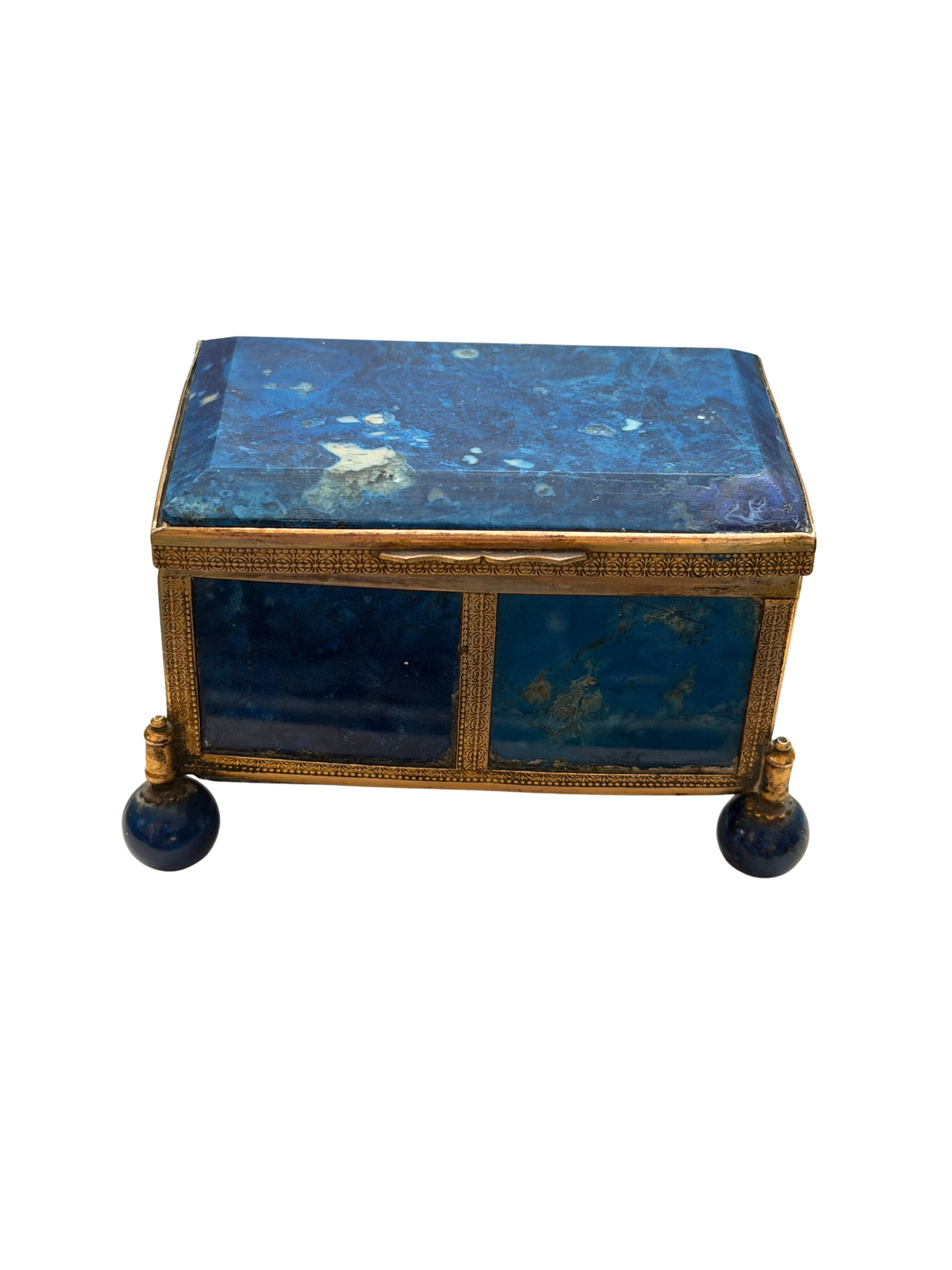
Antique French Lapis Lazuli Casket Box, with Gilt Brass Mounts and Spherical Feet, Circa 1880–1900
Antique French Lapis Lazuli Casket Box, with Gilt Brass Mounts and Spherical Feet, Circa 1880–1900
No se pudo cargar la disponibilidad de retiro
Compartir
Additional Description
A striking antique French-style casket box featuring richly colored cobalt-blue hardstone panels, possibly lapis lazuli, framed by intricately decorated gilt-brass mounts and raised on four matching spherical blue feet.
The rectangular box is constructed with polished blue stone panels of remarkable depth and color, ranging from deep ultramarine and midnight blue to lighter azure tones. Irregular white, pale gray, and turquoise-colored mineral inclusions create a distinctive marbled appearance throughout the stone.
The naturally varied blue surfaces contrast beautifully with the warm golden metalwork, which features finely detailed repeating floral and geometric ornamentation. The front is divided into two rectangular reserves by a central gilt-brass band, while the lid and remaining sides are similarly enclosed within decorative metal borders.
The box stands on four spherical blue supports, each mounted beneath a gilt-metal fitting, giving the piece an elegant architectural silhouette.
The hinged lid opens to reveal a coordinated blue interior, retaining the same richly mottled appearance as the exterior. The use of blue material throughout creates a particularly luxurious presentation.
Close examination under magnification reveals irregular pale mineral inclusions, fine natural-looking veining, and variations in blue coloration. These features are compatible with lapis lazuli, although the precise mineral composition remains unconfirmed.
A beautiful example of historicist decorative craftsmanship, combining rich ornamental color with the refinement of finely worked gilt-metal mounts.
Era
Circa: 1880–1900, estimated
Period: Late Victorian / French Third Republic
Style: Napoleon III Revival / French Decorative Arts
Origin: Possibly France or Continental Europe
The rectangular casket form, ornamental gilt-metal borders, and spherical feet are characteristic of decorative boxes produced in Europe during the second half of the 19th century.
The construction is consistent with French luxury decorative objects of the period, although an exact manufacturing origin has not been established.
History
During the 19th century, European decorative arts experienced a renewed interest in luxurious materials, ornamental hardstones, and finely mounted decorative objects.
In France, particularly during and following the reign of Napoleon III, skilled artisans produced elaborate caskets, jewelry boxes, desk accessories, and small objets d'art incorporating richly colored stone, glass, enamel, and gilt metal.
Hardstones were especially prized for their natural variations in color and pattern, and were frequently incorporated into decorative boxes intended for fashionable interiors.
Lapis lazuli, with its distinctive ultramarine coloration, had been valued since antiquity. The stone was particularly celebrated for its association with luxury, refinement, and the prized blue pigment historically used in European painting.
Its appearance frequently includes irregular white calcite inclusions, deep blue lazurite-rich areas, and, in some specimens, metallic pyrite particles.
The present box exhibits several visual characteristics compatible with lapis lazuli, including its deep ultramarine-blue coloration, substantial opacity, irregular pale mineral patches, and lack of clearly defined concentric banding.
However, other ornamental stones, including dyed chalcedony or agate, can produce similar appearances. The absence of visible banding does not conclusively distinguish lapis from these alternatives.
The elegant construction, matching spherical feet, and carefully fitted gilt-metal mounts are consistent with the decorative hardstone caskets produced for affluent European households during the late 19th century.
The box may originally have been intended for jewelry, keepsakes, small personal possessions, or dressing-table accessories.
Provenance
Previous ownership history undocumented.
Possibly French or Continental European manufacture, late 19th century.
No identifiable maker's mark, retailer's signature, or country-of-origin stamp is visible in the supplied photographs.
The construction and ornamental styling are compatible with European gilt-mounted hardstone boxes of the period.
Materials
- Deep cobalt-blue ornamental hardstone, possibly lapis lazuli
- Irregular white, gray, and turquoise-colored mineral inclusions
- Gilt-brass or gilt copper-alloy mounts
- Decorative repeating floral and geometric metal borders
- Hinged rectangular lid
- Four matching spherical blue feet
- Blue-lined or blue-paneled interior
The blue material appears thick and opaque under direct flashlight examination.
Magnified photographs show irregular pale mineral inclusions and dark veining, without clearly defined concentric agate banding.
These observations support the possibility of lapis lazuli but do not constitute a definitive mineral identification.
The precise mineral composition and any historical color treatments remain unverified.
Dimensions
Exact measurements to be confirmed.
Compact rectangular casket form with four spherical feet.
Condition/Disclaimers
Antique condition with visible age-related wear consistent with the object's presumed period.
The blue surfaces exhibit scattered scratches, abrasions, areas of dulling, and irregular pale mineral patches throughout. Some surfaces display more pronounced clouding and mottling, particularly across the lid, underside, and interior.
The gilt-metal mounts retain their intricate decorative detailing, with areas of patination, rubbing, oxidation, and minor surface discoloration.
The spherical feet appear present, although the individual fittings should be inspected for security and historic repairs.
The hinged lid opens to reveal an interior exhibiting additional wear, scratches, and irregularities in the blue finish.
The box remains visually striking despite its age-related imperfections.
The blue material is provisionally identified as ornamental hardstone, possibly lapis lazuli. This identification is based on visual inspection, opacity testing, and magnified photographs. No professional mineralogical analysis has been undertaken.
The attribution to French or Continental European manufacture and the estimated dating are likewise provisional.