

Antique French Louis XV Rococo Revival Gilt Bronze Hand Mirror with Scalloped Beveled Glass, Circa 1880–1900
Antique French Louis XV Rococo Revival Gilt Bronze Hand Mirror with Scalloped Beveled Glass, Circa 1880–1900
No se pudo cargar la disponibilidad de retiro
Compartir
Additional Description
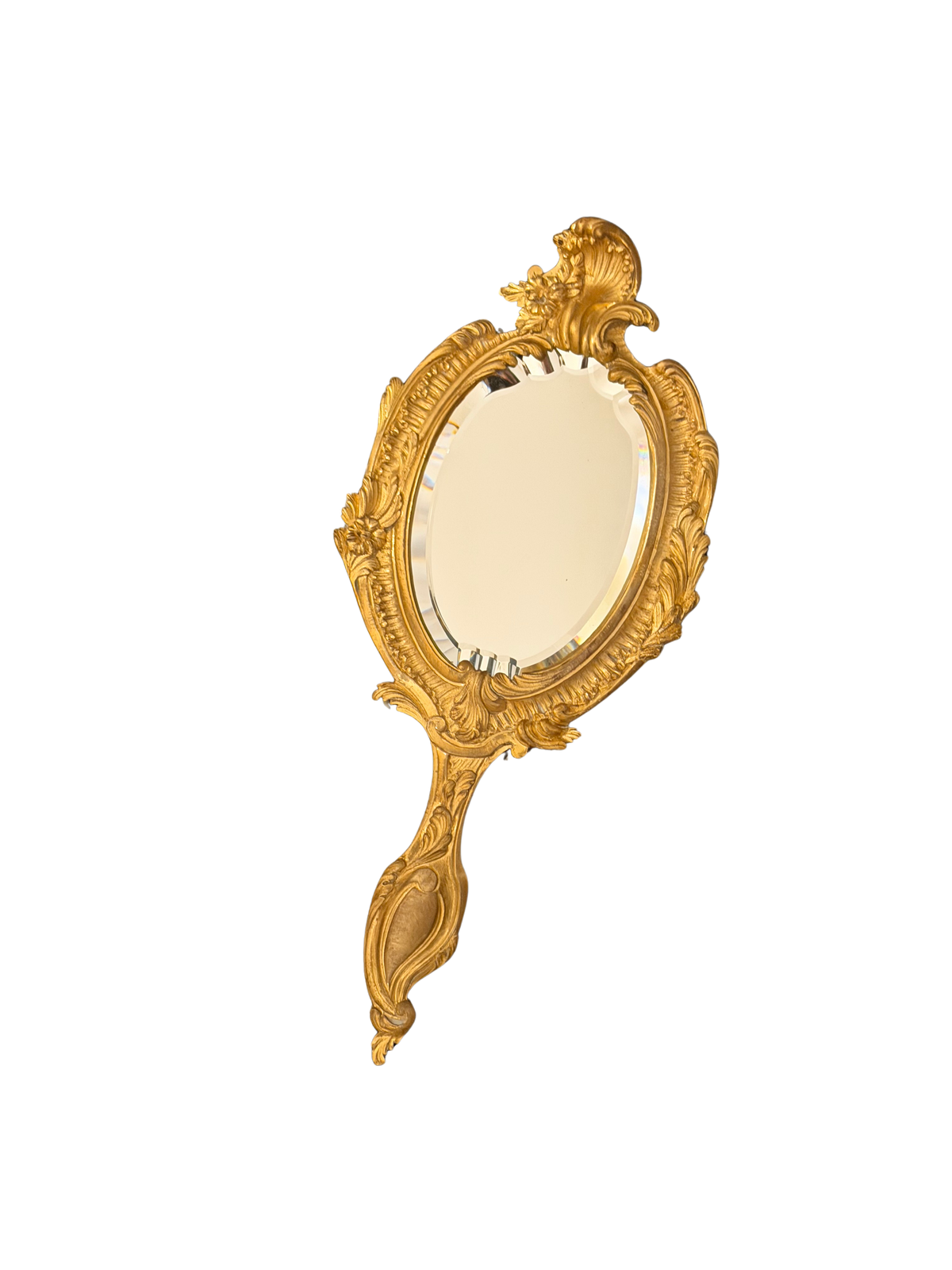
An exquisite antique French hand mirror featuring an elaborately sculpted gilt-metal frame in the romantic Louis XV Rococo style, complete with sweeping acanthus leaves, floral embellishments, and an ornate scrolling handle.
The elongated oval mirror is framed by richly detailed foliate scrollwork, with a dramatic asymmetrical crest featuring a large curling rocaille shell, delicate flowers, and flowing leaves. The sculptural ornamentation continues around the oval frame, culminating in a beautifully modeled lower flourish that transitions into the decorative handle.
Particularly striking is the original-style beveled mirror glass, featuring an unusual scalloped inner profile that echoes the organic curves of the surrounding gilt-metal frame. The substantial bevel catches and refracts light, producing a beautiful prismatic effect along its edges.
The gracefully elongated handle is decorated with scrolling botanical ornament and terminates in a delicate curled flourish. An integrated hanging ring on the reverse allows the mirror to be displayed as a decorative wall accessory when not in use.
Both functional and highly decorative, this elegant mirror would be equally at home on a French dressing table, within a collection of antique vanity accessories, or displayed among salon-style wall arrangements.
Era
Late 19th century, circa 1880–1900.
French, Louis XV / Rococo Revival style.
The asymmetric rocaille crest, naturalistic foliate ornamentation, elaborate scrollwork, and scalloped beveled glass are consistent with the Neo-Rococo decorative tradition popular in France during the second half of the 19th century. Related gilt-bronze mirrors from the Napoleon III period display many of these same ornamental characteristics.
Pamono
+1
An early 20th-century date is also possible without further examination of the casting and mirror glass.
History
The Rococo style emerged in early 18th-century France during the reign of Louis XV, departing from the rigid symmetry of earlier Baroque design in favor of graceful curves, playful asymmetry, and elaborate naturalistic ornamentation.
Derived from the French word rocaille, referring to decorative rock and shellwork, Rococo design incorporated scrolling foliage, shells, flowers, and undulating forms into furniture, mirrors, and luxury decorative accessories.
During the reign of Napoleon III (1852–1870), France experienced a renewed enthusiasm for the decorative styles of the 18th century. This revival continued into the Belle Époque, when French craftsmen produced elaborate gilt-metal mirrors, vanity accessories, and small decorative furnishings inspired by Louis XV interiors.
Handheld mirrors were important accessories of the fashionable dressing table, often crafted with elaborate metalwork and finely beveled glass. More decorative examples could also be suspended from hooks or displayed as ornamental objects.
The present mirror embodies this tradition through its sculptural shell crest, deeply modeled acanthus scrolls, floral embellishments, and unusual scalloped beveled glass.
Provenance
Attributed to France, late 19th century.
Specific maker and original ownership history unknown.
No identifiable manufacturer's mark is visible in the supplied photographs.
Materials
- Gilt metal, possibly bronze or brass
- Beveled mirror glass with scalloped edges
- Metal backing plate
- Integrated hanging ring
- Cast Rococo floral and foliate ornamentation
Dimensions
Measurements to be confirmed.
Condition/Disclaimers
Good antique condition with wear consistent with age and historical use.
The gilt-metal frame retains an attractive golden finish, with minor surface wear, areas of patination, and subtle variations in coloration.
The mirror glass retains its elaborate scalloped beveled edges and displays scattered age-related spotting and light cloudiness, particularly visible under certain lighting conditions. The reflective surface remains functional.
The reverse retains its fitted metal backing plate, secured with three visible screws, as well as an integrated hanging ring.
The ornate crest, surrounding foliate details, and elongated handle appear intact in the photographs, with no obvious major losses.
The originality of the mirror glass and the precise metal composition have not been independently verified.