

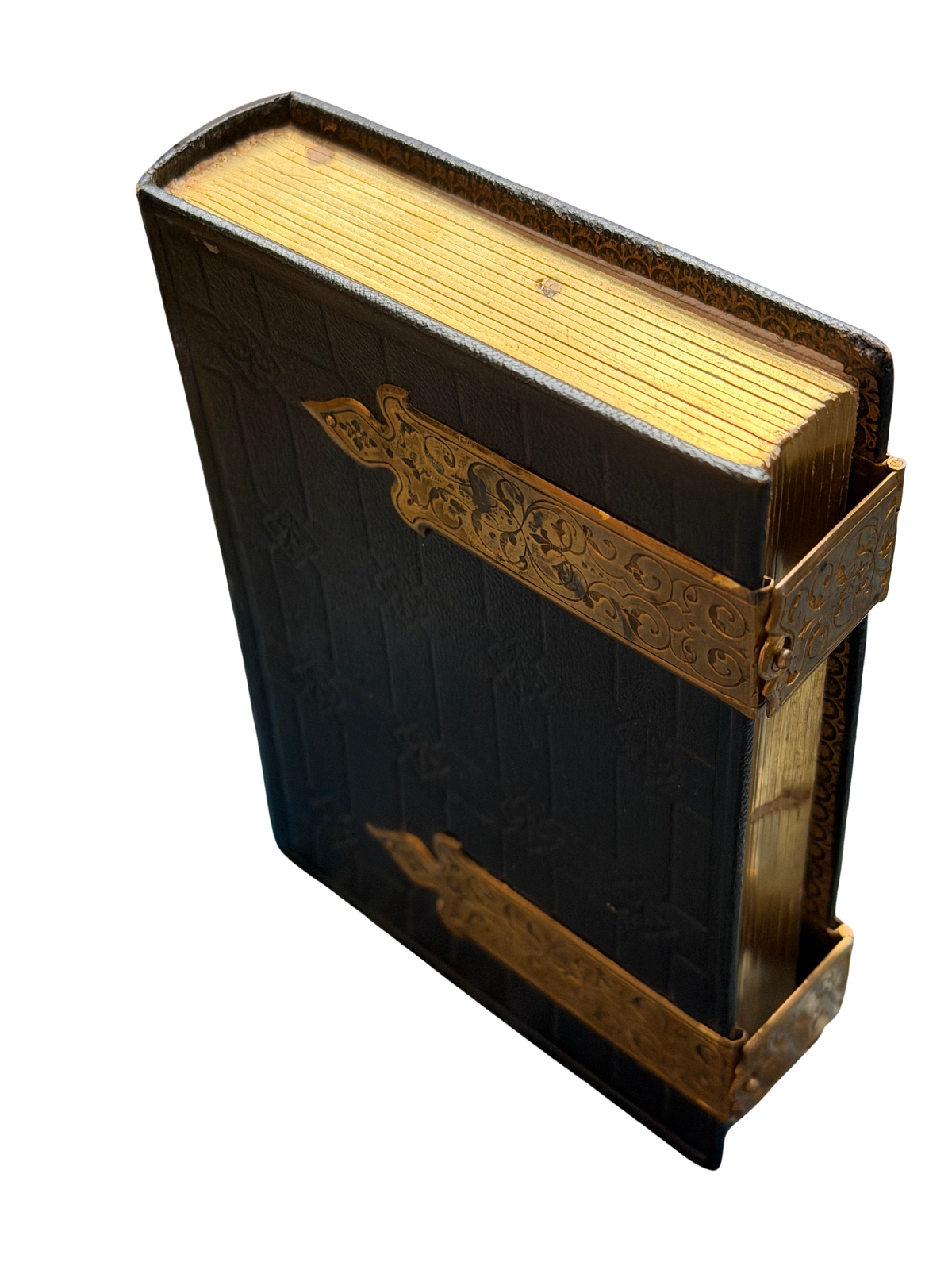
Antique Victorian Black Leather Photograph Album with Ornate Engraved Brass Clasps and Gilt Edges, Circa 1860–1880
Antique Victorian Black Leather Photograph Album with Ornate Engraved Brass Clasps and Gilt Edges, Circa 1860–1880
No se pudo cargar la disponibilidad de retiro
Compartir
Additional Description
An elegant 19th-century Victorian photograph album featuring richly textured black leather covers, intricate blind-embossed decoration, and two substantial, elaborately engraved brass clasps.
The front and back covers display a repeating geometric pattern accented by stylized fleur-de-lis motifs, lending the album a distinctly Gothic Revival character. Two beautifully detailed brass clasps stretch across the covers, featuring scrolling foliate engraving, pointed terminals, and delicate decorative flourishes.
The album retains its striking gilt page edges, which contrast beautifully with the deep black leather. Inside, thick cream-colored cardstock leaves feature recessed rectangular photographic apertures, each surrounded by fine gilt borders. These openings were designed to display individual photographic portraits, traditionally cartes de visite, while allowing photographs to be inserted and removed.
Currently without photographs, the album offers a wonderful opportunity to display a collection of antique portraits or to be appreciated as a decorative object in its own right.
Era
Victorian Era, Circa 1860–1880
Most likely dating to approximately 1865–1875, based on the embossed leather binding, engraved double-clasp construction, gilt edges, and photographic mounts.
The album's Gothic Revival decorative vocabulary is particularly characteristic of mid-19th-century bookbinding.
History
Photograph albums became fashionable household accessories during the mid-19th century, particularly following the popularization of the carte de visite photographic format in the 1850s and 1860s.
These small photographic portraits, typically mounted on cardstock, could be exchanged among family members, friends, and acquaintances. Albums provided an elegant way to preserve and display these personal collections, often occupying prominent positions in Victorian drawing rooms and parlors.
More elaborate examples were produced with embossed leather bindings, gilded page edges, and engraved brass fittings, reflecting the importance placed upon photography and family remembrance.
The double-clasp design served both a practical and decorative purpose, helping secure the substantial cardstock pages while providing an additional element of craftsmanship.
Comparable albums dating to approximately 1862–1872 are documented by Yale University's MAVCOR project, while the National Trust's photographic collections include 19th-century examples featuring embossed leather, brass hardware, and gilt-edged photographic mounts.
MAVCOR
+1
Provenance
European or American, 19th century.
The Gothic-inspired decoration and brass fittings are consistent with Victorian bookbinding traditions found in Britain, continental Europe, and North America. A specific country of manufacture has not yet been established.
No publisher's mark, binder's label, or ownership inscription is visible in the supplied photographs.
Materials
- Black leather-covered boards with blind-embossed geometric and fleur-de-lis decoration
- Engraved brass clasps and hinged fittings
- Heavy cream-colored cardstock photographic mounts
- Gilt-edged leaves
- Gold-ruled photographic apertures
Dimensions
Exact measurements to be confirmed.
Appears to be a small-format Victorian tabletop photograph album, approximately 6–7 inches tall based on hand-held scale. Measurements should be verified before listing.
Condition/Disclaimers
Good antique condition, particularly attractive for its age.
The black leather retains its embossed ornamentation with minor surface rubbing, particularly along the corners and edges. The engraved brass fittings exhibit age-appropriate patina and remain visually well preserved.
The gilt page edges retain considerable brightness, with some areas of rubbing and age-related wear. Interior cardstock mounts show light toning, scattered foxing, and minor discoloration consistent with age.
Photographic apertures appear generally well preserved in the visible sections, although the condition of every individual mount has not been verified.
The album is currently empty and does not include original photographs. Both clasps are present, although their fastening functionality has not been confirmed.
As with all antique books and photographic albums, gentle handling is recommended to preserve the original leather, binding, and delicate paper mounts.