


Exceptional 19th Century French Marble-Top Miniature Commode / Cabinetmaker’s Sample Form
Exceptional 19th Century French Marble-Top Miniature Commode / Cabinetmaker’s Sample Form
No se pudo cargar la disponibilidad de retiro
Compartir
Additional Description:
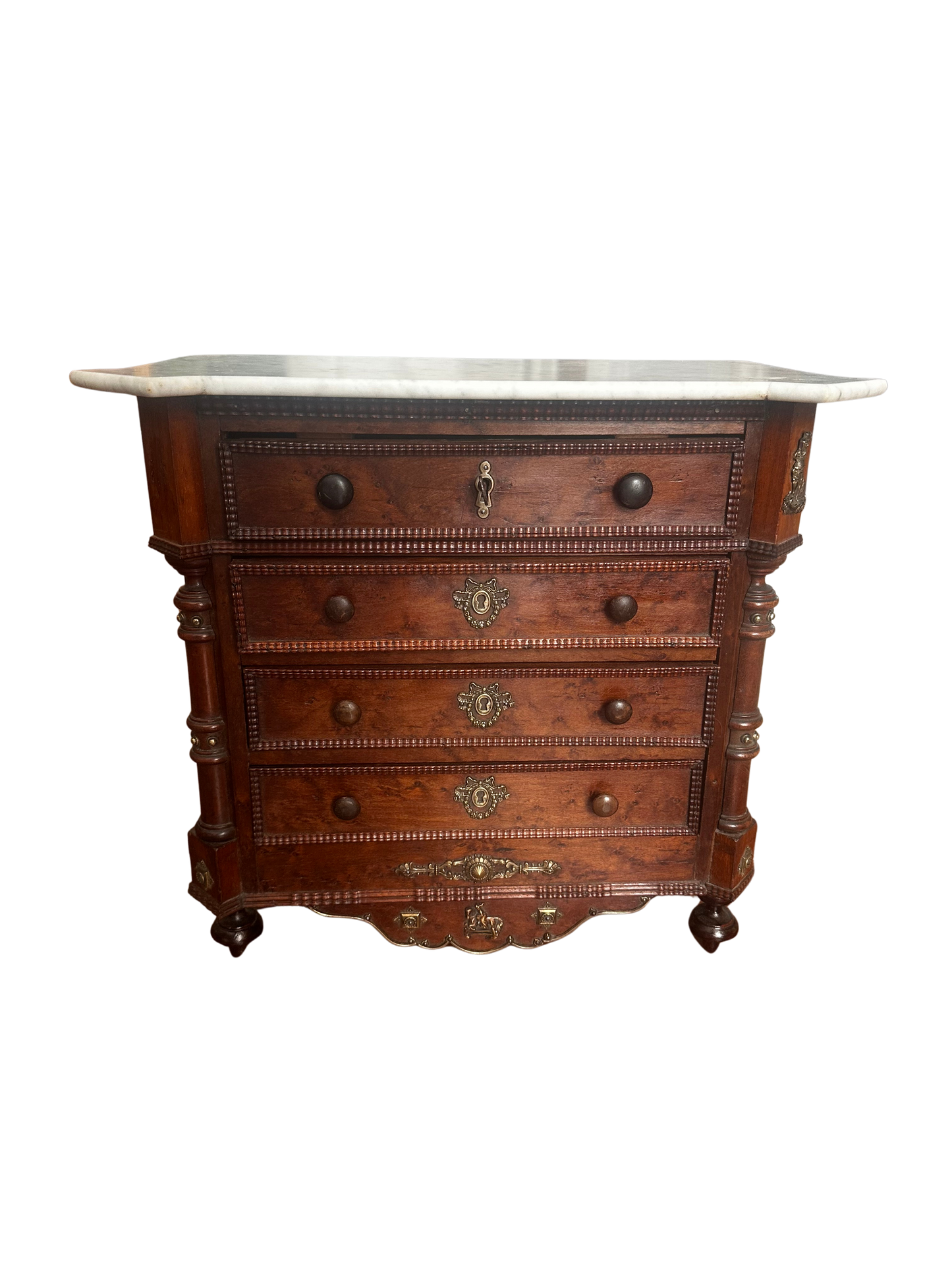
An exceptionally elegant and richly detailed 19th-century miniature commode, masterfully conceived in the tradition of cabinetmaker’s apprentice or salesman samples. This refined table cabinet faithfully translates the architectural sophistication of full-scale French case furniture into an intimate, highly collectible form.
Crowned with a beautifully cut white marble top of soft gray veining, the piece immediately evokes the grandeur of Louis XVI and Second Empire interiors. The façade is articulated with four graduated drawer fronts, each framed by precise beaded moldings and adorned with delicate gilt-metal escutcheons. Turned front columns, accented with subtle brass detailing, lend a sense of vertical rhythm and classical refinement, while the shaped lower apron is enriched with an applied figural mount—an exquisite nod to the decorative language of 19th-century French ornament.
The proportions are particularly compelling: balanced, architectural, and unmistakably intentional. The upper drawer opens to reveal a functional interior compartment, suitable for the storage of jewelry, letters, or personal effects, reinforcing its role as both a practical object and a statement of craftsmanship. The remaining drawers contribute to the visual authenticity of a full commode, enhancing its presence as a scaled interpretation of grand furniture.
Pieces of this nature occupy a unique space between utility and artistry—created either as demonstrations of a craftsman’s skill or as luxury miniature furnishings for refined domestic settings. The inclusion of a marble top, classical detailing, and fully realized form elevates this example well beyond a simple jewelry box into the realm of decorative objet d’art.
Era:
Late 19th century, circa 1870–1900
History:
During the 19th century, miniature furniture forms gained popularity both as cabinetmaker’s demonstrations of skill and as luxurious domestic accessories. In France, particularly during the Napoleon III and Louis XVI revival periods, there was a strong fascination with finely crafted objects that echoed the grandeur of earlier royal styles. Cabinetmakers and workshops often produced scaled versions of commodes, desks, and cabinets either as apprentice exercises, showroom samples, or refined boudoir pieces for storing personal effects.
This piece reflects that tradition—drawing directly from the neoclassical vocabulary of Louis XVI furniture while incorporating the richness and ornament favored in the later 19th century. Its marble top and architectural detailing suggest an intention to impress, aligning it with objects designed to showcase both craftsmanship and taste.
Provenance:
French or Continental European, acquired on the secondary market.
Materials:
Marble top; hardwood body (likely walnut or mahogany veneer over secondary wood); gilt-metal mounts and escutcheons; turned wooden pulls; mixed metal hardware.
Dimensions:
Leave blank
Disclaimers:
Overall condition consistent with age and use. Surface wear, light scratches, and areas of finish rubbing are present throughout. Minor losses and wear to mounts and hardware. The marble top shows natural veining and light surface wear; no major structural damage observed in provided images. Interior of upper drawer shows expected age-related wear. Drawer construction appears typical of the period, with some simplification consistent with miniature or sample pieces. Functionality of all drawers should be confirmed, as some may be partially fitted or primarily decorative. Attributed as a cabinetmaker’s sample or apprentice-form piece based on design and construction, though not definitively documented.
Additional Description:
An exceptionally elegant and richly detailed 19th-century miniature commode, masterfully conceived in the tradition of cabinetmaker’s apprentice or salesman samples. This refined table cabinet faithfully translates the architectural sophistication of full-scale French case furniture into an intimate, highly collectible form.
Crowned with a beautifully cut white marble top of soft gray veining, the piece immediately evokes the grandeur of Louis XVI and Second Empire interiors. The façade is articulated with four graduated drawer fronts, each framed by precise beaded moldings and adorned with delicate gilt-metal escutcheons. Turned front columns, accented with subtle brass detailing, lend a sense of vertical rhythm and classical refinement, while the shaped lower apron is enriched with an applied figural mount—an exquisite nod to the decorative language of 19th-century French ornament.
The proportions are particularly compelling: balanced, architectural, and unmistakably intentional. The upper drawer opens to reveal a functional interior compartment, suitable for the storage of jewelry, letters, or personal effects, reinforcing its role as both a practical object and a statement of craftsmanship. The remaining drawers contribute to the visual authenticity of a full commode, enhancing its presence as a scaled interpretation of grand furniture.
Pieces of this nature occupy a unique space between utility and artistry—created either as demonstrations of a craftsman’s skill or as luxury miniature furnishings for refined domestic settings. The inclusion of a marble top, classical detailing, and fully realized form elevates this example well beyond a simple jewelry box into the realm of decorative objet d’art.
Era:
Late 19th century, circa 1870–1900
History:
During the 19th century, miniature furniture forms gained popularity both as cabinetmaker’s demonstrations of skill and as luxurious domestic accessories. In France, particularly during the Napoleon III and Louis XVI revival periods, there was a strong fascination with finely crafted objects that echoed the grandeur of earlier royal styles. Cabinetmakers and workshops often produced scaled versions of commodes, desks, and cabinets either as apprentice exercises, showroom samples, or refined boudoir pieces for storing personal effects.
This piece reflects that tradition—drawing directly from the neoclassical vocabulary of Louis XVI furniture while incorporating the richness and ornament favored in the later 19th century. Its marble top and architectural detailing suggest an intention to impress, aligning it with objects designed to showcase both craftsmanship and taste.
Provenance:
French or Continental European, acquired on the secondary market.
Materials:
Marble top; hardwood body (likely walnut or mahogany veneer over secondary wood); gilt-metal mounts and escutcheons; turned wooden pulls; mixed metal hardware.
Dimensions:
Leave blank
Disclaimers:
Overall condition consistent with age and use. Surface wear, light scratches, and areas of finish rubbing are present throughout. Minor losses and wear to mounts and hardware. The marble top shows natural veining and light surface wear; no major structural damage observed in provided images. Interior of upper drawer shows expected age-related wear. Drawer construction appears typical of the period, with some simplification consistent with miniature or sample pieces. Functionality of all drawers should be confirmed, as some may be partially fitted or primarily decorative. Attributed as a cabinetmaker’s sample or apprentice-form piece based on design and construction, though not definitively documented.