


Exceptional Napoleon III Burlwood Cave à Liqueur with Gilded Glass Service and Decanters
Exceptional Napoleon III Burlwood Cave à Liqueur with Gilded Glass Service and Decanters
No se pudo cargar la disponibilidad de retiro
Compartir


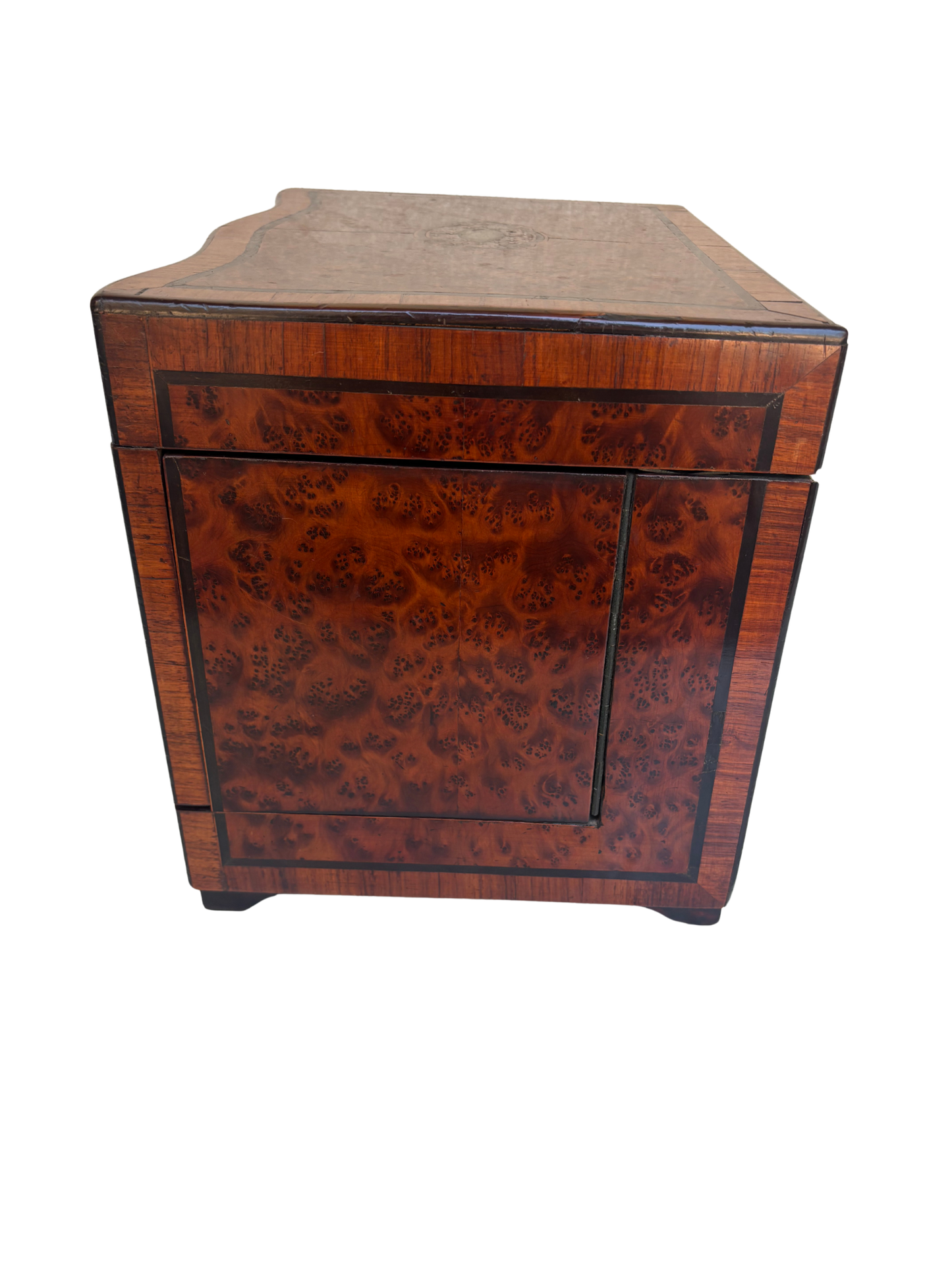
An extraordinarily elegant and richly figured Napoleon III cave à liqueur or tantalus set, housed in a beautifully shaped bombe-form case veneered in highly figured burlwood with contrasting banded inlay and central brass-and-mother-of-pearl style escutcheon decoration. The case opens dramatically to reveal a fitted interior containing an extensive gilded cordial service with matching decanters and stemmed glasses.
The exterior showcases luxurious burl veneer with dense “birdseye” figuring throughout, framed by darker stringing and warm satinwood-toned borders. The serpentine front and gently arched top give the box a refined architectural silhouette typical of high-quality French luxury cabinetmaking from the Second Empire period.
Inside, the fitted service includes:
Two matching glass decanters with original stoppers
Multiple stemmed cordial glasses with extensive gilt decoration
An ornate central gilt-metal carrying handle
Original fitted interior compartments designed to securely house the service
The decanters feature elegant, ribbed necks and bulbous stoppers with delicate gold striping, while the glasses are embellished with hand-applied gilt vine and foliate motifs evocative of Baccarat and Saint-Louis luxury table wares of the 19th century. The entire ensemble presents beautifully as both a functional entertaining piece and a decorative statement object.
Particularly desirable is the completeness and visual impact of the service combined with the unusually rich burl veneer case. Pieces of this scale and decorative quality are increasingly difficult to source, especially with coordinated interior glassware intact.
An extraordinarily elegant and richly figured Napoleon III cave à liqueur or tantalus set, housed in a beautifully shaped bombe-form case veneered in highly figured burlwood with contrasting banded inlay and central brass-and-mother-of-pearl style escutcheon decoration. The case opens dramatically to reveal a fitted interior containing an extensive gilded cordial service with matching decanters and stemmed glasses.
The exterior showcases luxurious burl veneer with dense “birdseye” figuring throughout, framed by darker stringing and warm satinwood-toned borders. The serpentine front and gently arched top give the box a refined architectural silhouette typical of high-quality French luxury cabinetmaking from the Second Empire period.
Inside, the fitted service includes:
Two matching glass decanters with original stoppers
Multiple stemmed cordial glasses with extensive gilt decoration
An ornate central gilt-metal carrying handle
Original fitted interior compartments designed to securely house the service
The decanters feature elegant, ribbed necks and bulbous stoppers with delicate gold striping, while the glasses are embellished with hand-applied gilt vine and foliate motifs evocative of Baccarat and Saint-Louis luxury table wares of the 19th century. The entire ensemble presents beautifully as both a functional entertaining piece and a decorative statement object.
Particularly desirable is the completeness and visual impact of the service combined with the unusually rich burl veneer case. Pieces of this scale and decorative quality are increasingly difficult to source, especially with coordinated interior glassware intact.
10.25"h x 13"w x 9.5"d
10.25"h x 13"w x 9.5"d
Caves à liqueur became highly fashionable among the French bourgeoisie and aristocracy during the 19th century, particularly under Napoleon III. Designed for refined entertaining, these portable liquor cabinets allowed hosts to elegantly serve cordials and after-dinner drinks in salons, libraries, and drawing rooms.
Luxury examples were crafted by skilled Parisian ébénistes and often fitted with crystal stemware from prestigious French glasshouses. The bombe-form case seen here reflects the continued influence of Louis XV Rococo design revived during the Second Empire period.
Such sets were considered both practical and status-oriented objects, frequently displayed prominently within richly decorated interiors.
Caves à liqueur became highly fashionable among the French bourgeoisie and aristocracy during the 19th century, particularly under Napoleon III. Designed for refined entertaining, these portable liquor cabinets allowed hosts to elegantly serve cordials and after-dinner drinks in salons, libraries, and drawing rooms.
Luxury examples were crafted by skilled Parisian ébénistes and often fitted with crystal stemware from prestigious French glasshouses. The bombe-form case seen here reflects the continued influence of Louis XV Rococo design revived during the Second Empire period.
Such sets were considered both practical and status-oriented objects, frequently displayed prominently within richly decorated interiors.
Napoleon III Period Mid to Late 19th Century circa 1860–1885
Napoleon III Period Mid to Late 19th Century circa 1860–1885
Burlwood veneer
Ebonized or darkwood stringing
Brass hardware
Glass decanters and stemware
Hand-applied gilt decoration
Fitted wooden interior
Gilt metal mounts and carrying handle
Burlwood veneer
Ebonized or darkwood stringing
Brass hardware
Glass decanters and stemware
Hand-applied gilt decoration
Fitted wooden interior
Gilt metal mounts and carrying handle
French or Continental European origin; acquired from an antique collection
French or Continental European origin; acquired from an antique collection
Age-related wear throughout consistent with antique use.
Some rubbing, loss, or wear to gilding on glasses and decanters.
Minor veneer wear, surface scratches, and finish inconsistencies present.
Interior may have small losses or historical restorations.
Completeness of the set appears very good, though exact original inventory cannot be guaranteed.
Key present; locking functionality not tested.
Glassware should be handled delicately due to age.
Age-related wear throughout consistent with antique use.
Some rubbing, loss, or wear to gilding on glasses and decanters.
Minor veneer wear, surface scratches, and finish inconsistencies present.
Interior may have small losses or historical restorations.
Completeness of the set appears very good, though exact original inventory cannot be guaranteed.
Key present; locking functionality not tested.
Glassware should be handled delicately due to age.