


Fine Victorian Burled Walnut Vanity / Dressing Case with Silverplate Fittings, Secret Compartments, Hidden Documents, and Engraved Cartouche Dated 1891
Fine Victorian Burled Walnut Vanity / Dressing Case with Silverplate Fittings, Secret Compartments, Hidden Documents, and Engraved Cartouche Dated 1891
No se pudo cargar la disponibilidad de retiro
Compartir


An exceptional late 19th-century Victorian vanity or dressing case executed in richly figured burled walnut veneer with dramatic swirling grain throughout. The exterior retains its original engraved circular cartouche monogrammed “M. Harrison” and dated “1891,” along with an engraved escutcheon and working lock with key. The lock plate bears an oval “O&S” mark over an “L,” likely identifying the lock or hardware manufacturer rather than the maker of the dressing case itself.
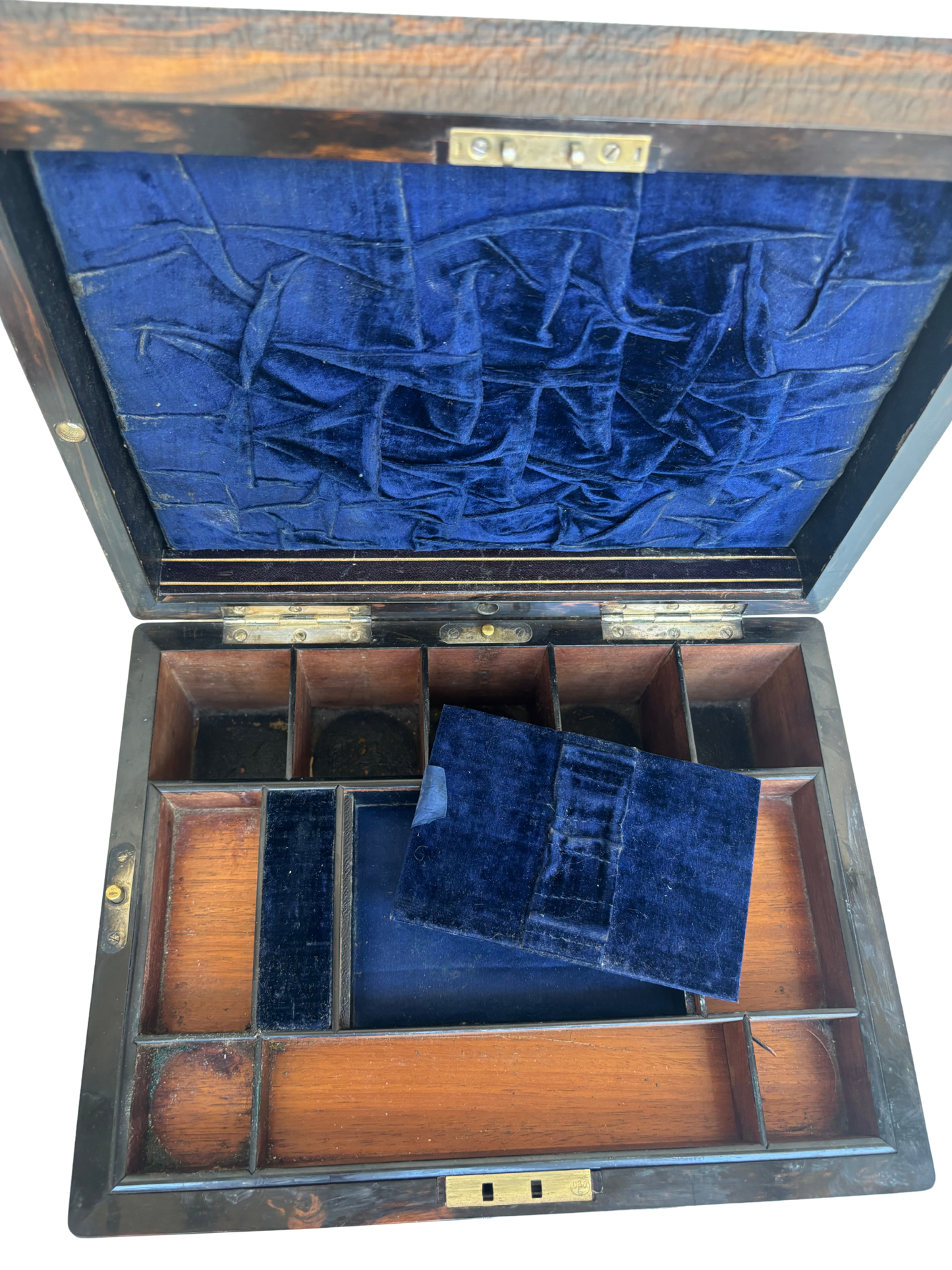
The interior opens to reveal a luxurious fitted arrangement lined in deep cobalt-blue velvet and black leather, housing numerous silverplate-topped toiletry jars, lidded compartments, and fitted accessory trays. The silverplate fittings are elaborately engraved with scrolling Victorian ornament and latticework decoration.
The lid interior contains gathered leather letter/document pockets for correspondence or personal papers, while the lower section conceals additional hidden compartments and lift-out fitted trays. Also retained within the case is a small English-made retractable gentleman’s accessory, likely a cigar piercer or cigar punch, marked with a “BBB” triangle stamp and “Made in England.” The accessory features a plunger-operated mechanism that extends a pointed implement from the body when depressed.
Remarkably, the case still contained hidden paperwork tucked within the interior compartments, including jewelry receipts and documents from J.H. Gillgrass Ltd. Jewellers of Leeds, dated 1977, offering an evocative glimpse into the later life and continued use of the case nearly a century after its creation. These surviving personal ephemera greatly enhance the historical character and storytelling quality of the piece.
The craftsmanship and refined fitted interior indicate a high-quality personal luxury object intended for affluent travel or sophisticated domestic use. The burled walnut veneer displays particularly striking movement with warm honey, caramel, and deep brown tonal variation across the surface. The overall presentation is elegant, architectural, and deeply evocative of late Victorian gentleman’s or lady’s personal dressing accoutrements.
An exceptional late 19th-century Victorian vanity or dressing case executed in richly figured burled walnut veneer with dramatic swirling grain throughout. The exterior retains its original engraved circular cartouche monogrammed “M. Harrison” and dated “1891,” along with an engraved escutcheon and working lock with key. The lock plate bears an oval “O&S” mark over an “L,” likely identifying the lock or hardware manufacturer rather than the maker of the dressing case itself.
The interior opens to reveal a luxurious fitted arrangement lined in deep cobalt-blue velvet and black leather, housing numerous silverplate-topped toiletry jars, lidded compartments, and fitted accessory trays. The silverplate fittings are elaborately engraved with scrolling Victorian ornament and latticework decoration.
The lid interior contains gathered leather letter/document pockets for correspondence or personal papers, while the lower section conceals additional hidden compartments and lift-out fitted trays. Also retained within the case is a small English-made retractable gentleman’s accessory, likely a cigar piercer or cigar punch, marked with a “BBB” triangle stamp and “Made in England.” The accessory features a plunger-operated mechanism that extends a pointed implement from the body when depressed.
Remarkably, the case still contained hidden paperwork tucked within the interior compartments, including jewelry receipts and documents from J.H. Gillgrass Ltd. Jewellers of Leeds, dated 1977, offering an evocative glimpse into the later life and continued use of the case nearly a century after its creation. These surviving personal ephemera greatly enhance the historical character and storytelling quality of the piece.
The craftsmanship and refined fitted interior indicate a high-quality personal luxury object intended for affluent travel or sophisticated domestic use. The burled walnut veneer displays particularly striking movement with warm honey, caramel, and deep brown tonal variation across the surface. The overall presentation is elegant, architectural, and deeply evocative of late Victorian gentleman’s or lady’s personal dressing accoutrements.
7.25"h x 12"w x 9"d
7.25"h x 12"w x 9"d
Luxury dressing cases and vanity boxes were produced for wealthy travelers and upper-class households during the 19th century. These elaborate fitted cases functioned as portable grooming and dressing stations, containing toiletry jars, grooming accessories, correspondence compartments, hidden storage areas, and occasionally gentleman’s smoking or personal accessories.
Highly figured walnut veneers were prized during the Victorian period for their visual richness and luxurious appearance. Personalized examples with engraved presentation plaques often commemorated weddings, important life events, or were commissioned as bespoke personal possessions. Surviving examples retaining personal documents or ephemera are especially desirable, as they provide tangible evidence of the object’s long-term ownership and use across generations.
JH Gillgrass appears to have operated in Leeds from at least the late 19th century to later 20th century. Suggests this box stayed in active use for decades.
Luxury dressing cases and vanity boxes were produced for wealthy travelers and upper-class households during the 19th century. These elaborate fitted cases functioned as portable grooming and dressing stations, containing toiletry jars, grooming accessories, correspondence compartments, hidden storage areas, and occasionally gentleman’s smoking or personal accessories.
Highly figured walnut veneers were prized during the Victorian period for their visual richness and luxurious appearance. Personalized examples with engraved presentation plaques often commemorated weddings, important life events, or were commissioned as bespoke personal possessions. Surviving examples retaining personal documents or ephemera are especially desirable, as they provide tangible evidence of the object’s long-term ownership and use across generations.
JH Gillgrass appears to have operated in Leeds from at least the late 19th century to later 20th century. Suggests this box stayed in active use for decades.
Late Victorian period, dated 1891
Late Victorian period, dated 1891
Burled walnut veneer, hardwood secondary woods, velvet lining, leather document pockets, silverplate mounts and lids, brass lock hardware, glass toiletry jars, engraved metal fittings, paper ephemera.
Burled walnut veneer, hardwood secondary woods, velvet lining, leather document pockets, silverplate mounts and lids, brass lock hardware, glass toiletry jars, engraved metal fittings, paper ephemera.
English, late Victorian period, personalized for “M. Harrison” and dated 1891. Later associated with owners connected to Leeds, England, evidenced by retained 1977 jewelry receipts and papers from J.H. Gillgrass Ltd. Jewelers.
English, late Victorian period, personalized for “M. Harrison” and dated 1891. Later associated with owners connected to Leeds, England, evidenced by retained 1977 jewelry receipts and papers from J.H. Gillgrass Ltd. Jewelers.
Antique condition with age-related wear throughout including surface scratches, finish wear, minor veneer wear, oxidation and tarnish to silverplate elements, and wear to velvet and leather interiors. Leather pocket section shows visible age wear and separation at edges. Minor chipping to some of the glass pieces. Lock and key are present; functionality not guaranteed. Hidden compartments and fitted sections remain an especially desirable surviving feature. Retained paper ephemera show expected age-related creasing, discoloration, and wear.
Antique condition with age-related wear throughout including surface scratches, finish wear, minor veneer wear, oxidation and tarnish to silverplate elements, and wear to velvet and leather interiors. Leather pocket section shows visible age wear and separation at edges. Minor chipping to some of the glass pieces. Lock and key are present; functionality not guaranteed. Hidden compartments and fitted sections remain an especially desirable surviving feature. Retained paper ephemera show expected age-related creasing, discoloration, and wear.