
Framed Needlepoint Panel, "Monkey and Tree" Design, Dated 1926
Framed Needlepoint Panel, "Monkey and Tree" Design, Dated 1926
No se pudo cargar la disponibilidad de retiro
Compartir
Item: Framed Needlepoint Panel, "Monkey & Tree" Design, Dated 1926
Additional Description
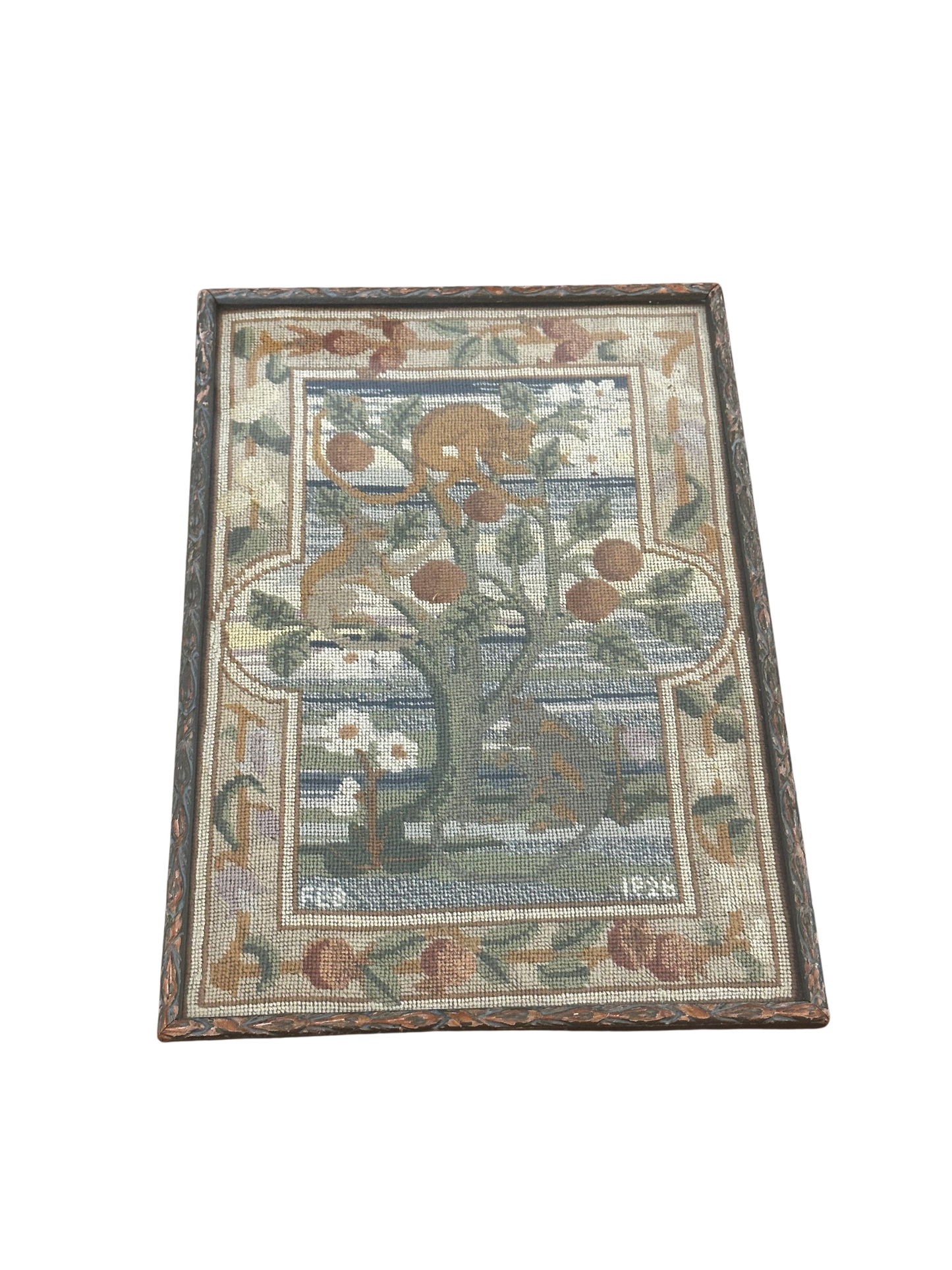
Charming hand-worked needlepoint (often called canvaswork or petit point) depicting a stylized monkey perched among fruiting branches, surrounded by floral and foliate motifs within an architectural border. Executed in muted Arts & Crafts-era colors of sage green, dusty blue, rust, cream, and soft lavender. Housed in a carved and stained wooden frame with decorative leaf-carved border.
The reverse bears a handwritten inscription reading:
"3 Monkey & Tree"
"Canvas work"
"Design R.C.B."
"Worked F.E.B."
"1926"
The inscription suggests one individual designed the pattern while another completed the needlework, a common practice among embroidery guilds, schools, and domestic needlework circles of the early 20th century.
Era
Dated 1926.
History
Decorative needlework experienced a significant revival during the late Victorian, Arts & Crafts, and early 20th-century periods. Influenced by medieval textiles, historic tapestries, and exotic decorative arts, designers frequently incorporated whimsical animals, fruiting trees, and stylized botanical forms into embroidery patterns.
The monkey motif was particularly popular in decorative arts from the 18th century onward, inspired by European fascination with chinoiserie and exotic imagery. This example combines that playful subject matter with the restrained palette and geometric organization favored during the Arts & Crafts and interwar periods.
Provenance
Private collection. Reverse inscription records completion in 1926 and identifies the designer and stitcher by initials.
Materials
Wool and/or cotton needlework threads
Canvas ground
Wood frame
Glass glazing
Paper backing
Dimensions
TBD
Disclaimers
Age-related toning and fading to textile consistent with nearly a century of display. Minor wear to frame and backing paper. Colors remain pleasing and harmonious. Not examined outside of frame. Reverse paper backing and hanging wire appear to be period or near-period replacements.
Item: Framed Needlepoint Panel, "Monkey & Tree" Design, Dated 1926
Additional Description
Charming hand-worked needlepoint (often called canvaswork or petit point) depicting a stylized monkey perched among fruiting branches, surrounded by floral and foliate motifs within an architectural border. Executed in muted Arts & Crafts-era colors of sage green, dusty blue, rust, cream, and soft lavender. Housed in a carved and stained wooden frame with decorative leaf-carved border.
The reverse bears a handwritten inscription reading:
"3 Monkey & Tree"
"Canvas work"
"Design R.C.B."
"Worked F.E.B."
"1926"
The inscription suggests one individual designed the pattern while another completed the needlework, a common practice among embroidery guilds, schools, and domestic needlework circles of the early 20th century.
Era
Dated 1926.
History
Decorative needlework experienced a significant revival during the late Victorian, Arts & Crafts, and early 20th-century periods. Influenced by medieval textiles, historic tapestries, and exotic decorative arts, designers frequently incorporated whimsical animals, fruiting trees, and stylized botanical forms into embroidery patterns.
The monkey motif was particularly popular in decorative arts from the 18th century onward, inspired by European fascination with chinoiserie and exotic imagery. This example combines that playful subject matter with the restrained palette and geometric organization favored during the Arts & Crafts and interwar periods.
Provenance
Private collection. Reverse inscription records completion in 1926 and identifies the designer and stitcher by initials.
Materials
Wool and/or cotton needlework threads
Canvas ground
Wood frame
Glass glazing
Paper backing
Dimensions
TBD
Disclaimers
Age-related toning and fading to textile consistent with nearly a century of display. Minor wear to frame and backing paper. Colors remain pleasing and harmonious. Not examined outside of frame. Reverse paper backing and hanging wire appear to be period or near-period replacements.