

French Neoclassical Lion Head Brass Stand
French Neoclassical Lion Head Brass Stand
No se pudo cargar la disponibilidad de retiro
Compartir
Item:
Additional Description:
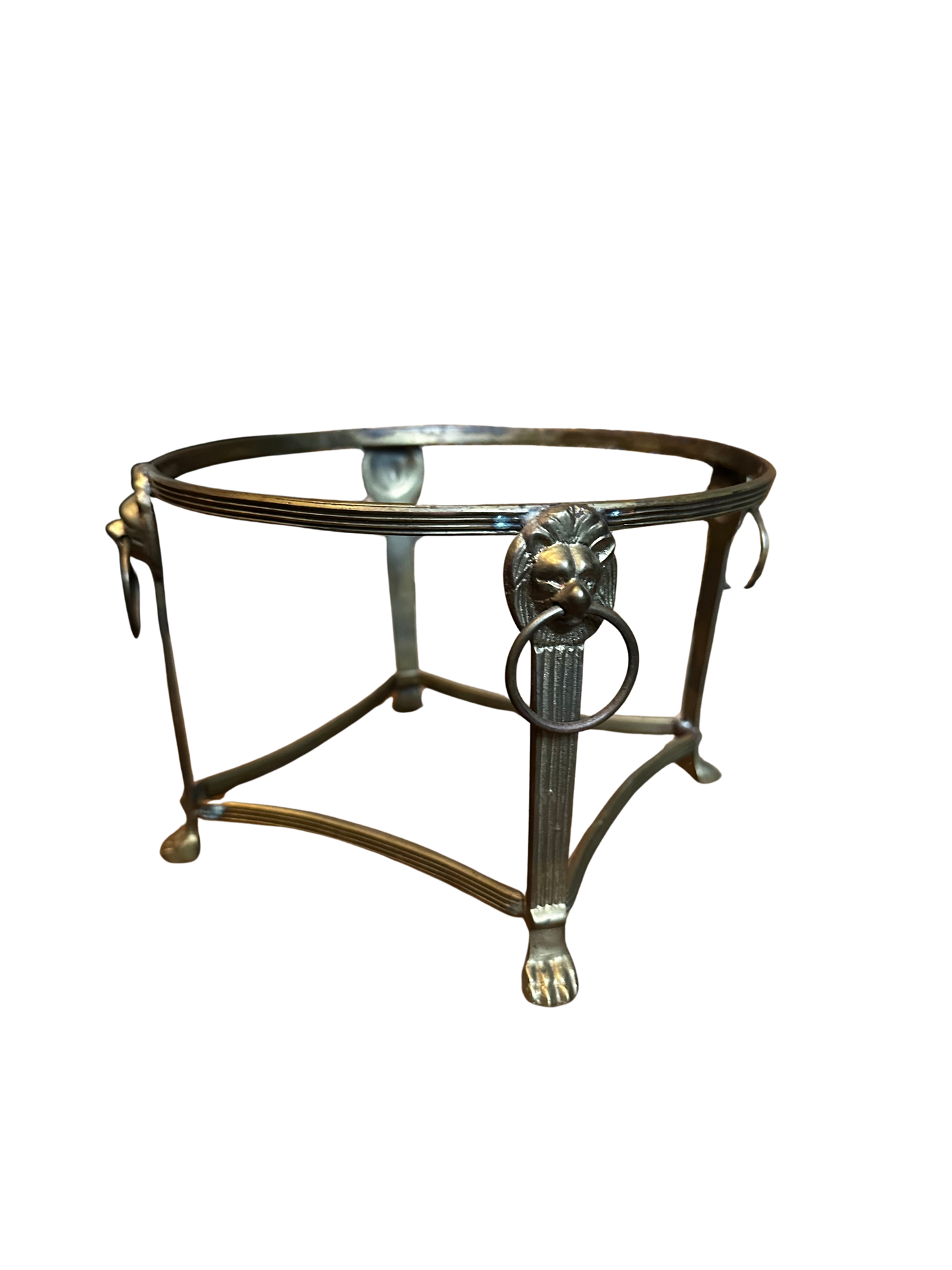
An elegant French Neoclassical-style brass jardinière or cachepot stand featuring four tapered supports terminating in stylized paw feet and crowned with finely cast lion head mascarons holding suspended ring pulls. The circular upper band is decorated with delicate linear reeding, while the open-form structure creates an airy architectural silhouette evocative of Directoire and Empire period design influences.
The lion heads lend the piece a restrained yet regal character associated with late 18th- and early 19th-century French decorative arts, while the ring pulls reference classical furniture mounts and bronze ormolu ornamentation seen on luxury furnishings of the period. The stand was likely designed to cradle a ceramic jardinière, planter, wine cooler, or decorative bowl.
Its sculptural openwork form makes it highly versatile for display use in both traditional and eclectic interiors. The aged brass surface has developed a mellow patina that enhances the antique character of the piece.
Era:
Early to mid-20th century, in the French Neoclassical / Empire Revival taste.
History:
Decorative metal stands inspired by French Empire and Neoclassical forms became highly popular in the late 19th and early 20th centuries. Designers frequently incorporated lion head mounts, paw feet, and ring pulls derived from ancient Roman and Napoleonic decorative vocabulary.
Such stands were commonly used to elevate porcelain cachepots, jardinieres, wine coolers, or decorative vessels while protecting fine furniture surfaces. Their architectural restraint allowed them to complement both classical and eclectic interiors.
Provenance:
Likely French or Continental European origin; acquired through the secondary antiques market.
Materials:
Cast brass, brass rod construction.
Dimensions:
5” H x 8” Diameter
Disclaimers:
Wear consistent with age and use, including surface scratches, oxidation, patina variation, minor bends, solder joins, and finish wear. Areas of discoloration and age-related tarnishing present throughout. No insert or liner included.
Item:
Additional Description:
An elegant French Neoclassical-style brass jardinière or cachepot stand featuring four tapered supports terminating in stylized paw feet and crowned with finely cast lion head mascarons holding suspended ring pulls. The circular upper band is decorated with delicate linear reeding, while the open-form structure creates an airy architectural silhouette evocative of Directoire and Empire period design influences.
The lion heads lend the piece a restrained yet regal character associated with late 18th- and early 19th-century French decorative arts, while the ring pulls reference classical furniture mounts and bronze ormolu ornamentation seen on luxury furnishings of the period. The stand was likely designed to cradle a ceramic jardinière, planter, wine cooler, or decorative bowl.
Its sculptural openwork form makes it highly versatile for display use in both traditional and eclectic interiors. The aged brass surface has developed a mellow patina that enhances the antique character of the piece.
Era:
Early to mid-20th century, in the French Neoclassical / Empire Revival taste.
History:
Decorative metal stands inspired by French Empire and Neoclassical forms became highly popular in the late 19th and early 20th centuries. Designers frequently incorporated lion head mounts, paw feet, and ring pulls derived from ancient Roman and Napoleonic decorative vocabulary.
Such stands were commonly used to elevate porcelain cachepots, jardinieres, wine coolers, or decorative vessels while protecting fine furniture surfaces. Their architectural restraint allowed them to complement both classical and eclectic interiors.
Provenance:
Likely French or Continental European origin; acquired through the secondary antiques market.
Materials:
Cast brass, brass rod construction.
Dimensions:
5” H x 8” Diameter
Disclaimers:
Wear consistent with age and use, including surface scratches, oxidation, patina variation, minor bends, solder joins, and finish wear. Areas of discoloration and age-related tarnishing present throughout. No insert or liner included.