


French Rococo Revival Giltwood Riser / Plateau, 19th Century
French Rococo Revival Giltwood Riser / Plateau, 19th Century
No se pudo cargar la disponibilidad de retiro
Compartir
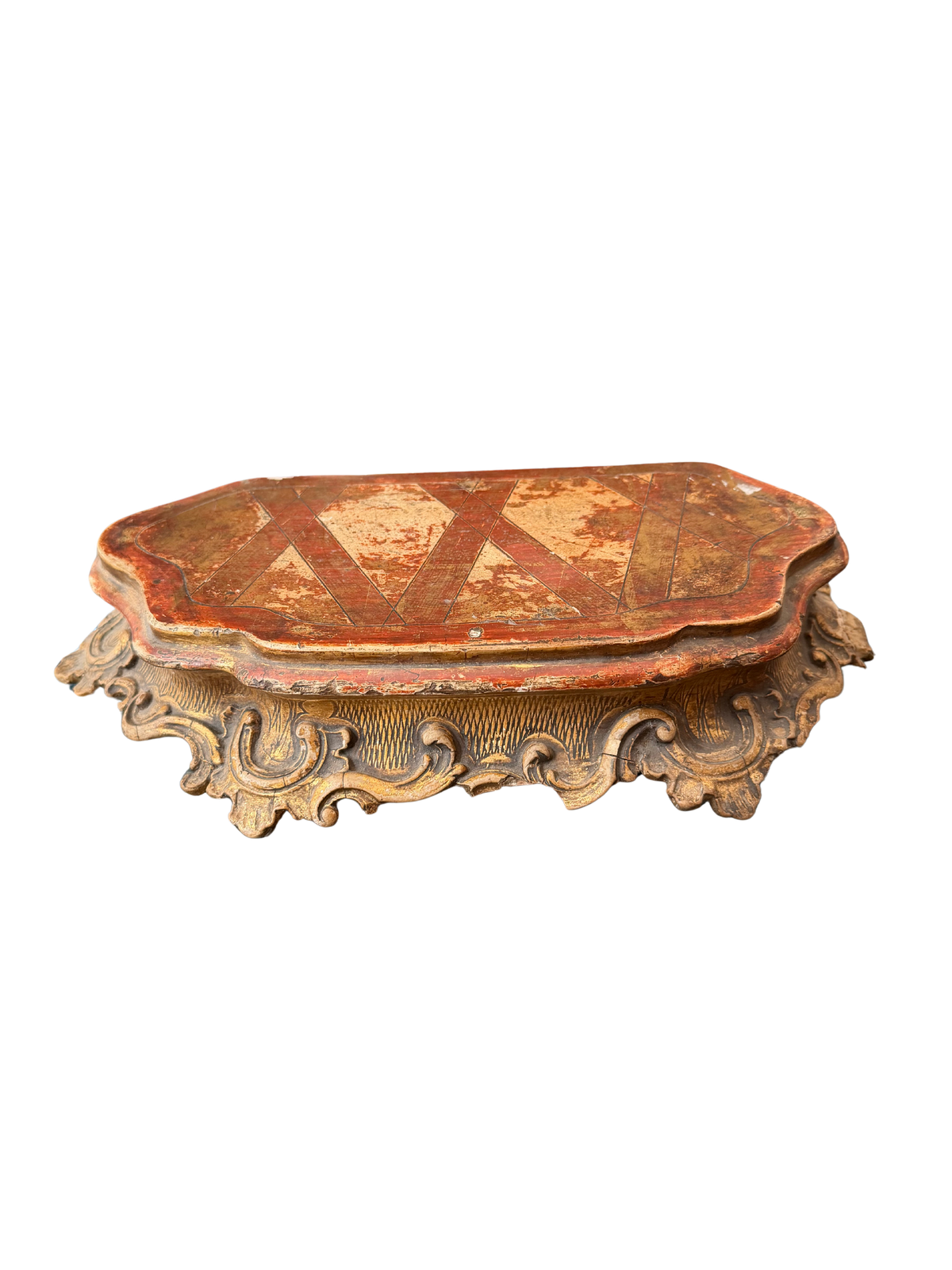
A wonderfully decorative French giltwood presentation riser or plateau in the Rococo Revival taste, with a shaped rectangular top above a deeply carved scrolling apron.
The top retains an old painted and gilded surface with a geometric linear design arranged in broad interlocking bands. Beneath, the apron is richly carved with C-scrolls, foliate motifs, shell-like forms, and textured grounds, all highlighted with remnants of gilding and an aged gray-brown painted finish.
The shaped profile, low architectural form, and richly carved edge suggest the piece was intended as a display platform or socle for elevating a decorative object within an interior—potentially a clock, urn, sculpture, vase, or table centerpiece.
The underside reveals traditional wood construction with a hollowed interior, applied carved elements, old nails, and substantial hand-worked timber. The surviving surface is especially appealing, with extensive age, rubbing, exposed bole, and traces of original gilding.
A highly decorative piece that works beautifully today as a riser for sculpture, a display plateau for objets d’art, or a layered tabletop accent.
Era
19th Century
Rococo Revival / Louis XV Revival
Likely French
History
Decorative risers and plateaux were widely used in nineteenth-century European interiors to elevate important objects and create visual hierarchy on mantels, consoles, commodes, and tables.
In France, Rococo Revival examples frequently borrowed from eighteenth-century Louis XV ornament, incorporating scrolling foliage, shellwork, asymmetrical curves, and richly gilded surfaces.
Pieces like this were often made as supporting elements for clocks, garnitures, sculpture, porcelain, or other luxury objects and were intended to visually integrate the displayed object into the surrounding decorative scheme.
Provenance
Sourced in France.
Maker unknown.
Materials
Carved wood
Gesso
Gilt and painted surface
Hand-applied decorative finish
Traditional nailed construction
Dimensions
Width: ___"
Depth: ___"
Height: ___"
Condition / Disclaimers
Antique condition with significant age-related wear, consistent with its decorative use and nineteenth-century construction.
The top surface shows extensive rubbing, losses, abrasions, scratches, discoloration, and areas of exposed underlying ground and wood. The painted and gilded geometric decoration is heavily worn but remains legible.
The carved apron retains substantial original decorative surface, with losses to gilding, exposed bole, scattered chips, cracks, abrasions, and small areas of loss to carved detail.
Old nails, construction irregularities, minor separations, and historic repairs are visible. The underside shows age-related wear and surface loss.
Some projecting carved elements appear fragile and should be handled carefully.
The extensive wear and patina are part of the piece’s antique character and decorative appeal. Please review all photographs carefully, as they form an important part of the condition description.
A wonderfully decorative French giltwood presentation riser or plateau in the Rococo Revival taste, with a shaped rectangular top above a deeply carved scrolling apron.
The top retains an old painted and gilded surface with a geometric linear design arranged in broad interlocking bands. Beneath, the apron is richly carved with C-scrolls, foliate motifs, shell-like forms, and textured grounds, all highlighted with remnants of gilding and an aged gray-brown painted finish.
The shaped profile, low architectural form, and richly carved edge suggest the piece was intended as a display platform or socle for elevating a decorative object within an interior—potentially a clock, urn, sculpture, vase, or table centerpiece.
The underside reveals traditional wood construction with a hollowed interior, applied carved elements, old nails, and substantial hand-worked timber. The surviving surface is especially appealing, with extensive age, rubbing, exposed bole, and traces of original gilding.
A highly decorative piece that works beautifully today as a riser for sculpture, a display plateau for objets d’art, or a layered tabletop accent.
Era
19th Century
Rococo Revival / Louis XV Revival
Likely French
History
Decorative risers and plateaux were widely used in nineteenth-century European interiors to elevate important objects and create visual hierarchy on mantels, consoles, commodes, and tables.
In France, Rococo Revival examples frequently borrowed from eighteenth-century Louis XV ornament, incorporating scrolling foliage, shellwork, asymmetrical curves, and richly gilded surfaces.
Pieces like this were often made as supporting elements for clocks, garnitures, sculpture, porcelain, or other luxury objects and were intended to visually integrate the displayed object into the surrounding decorative scheme.
Provenance
Sourced in France.
Maker unknown.
Materials
Carved wood
Gesso
Gilt and painted surface
Hand-applied decorative finish
Traditional nailed construction
Dimensions
Width: ___"
Depth: ___"
Height: ___"
Condition / Disclaimers
Antique condition with significant age-related wear, consistent with its decorative use and nineteenth-century construction.
The top surface shows extensive rubbing, losses, abrasions, scratches, discoloration, and areas of exposed underlying ground and wood. The painted and gilded geometric decoration is heavily worn but remains legible.
The carved apron retains substantial original decorative surface, with losses to gilding, exposed bole, scattered chips, cracks, abrasions, and small areas of loss to carved detail.
Old nails, construction irregularities, minor separations, and historic repairs are visible. The underside shows age-related wear and surface loss.
Some projecting carved elements appear fragile and should be handled carefully.
The extensive wear and patina are part of the piece’s antique character and decorative appeal. Please review all photographs carefully, as they form an important part of the condition description.