

Goddess Juno Engraving with Peacock and Child (1767) - Domenic Cunego
Goddess Juno Engraving with Peacock and Child (1767) - Domenic Cunego
No se pudo cargar la disponibilidad de retiro
Compartir
18th C English School Prints - Domenic Cunego - Juno
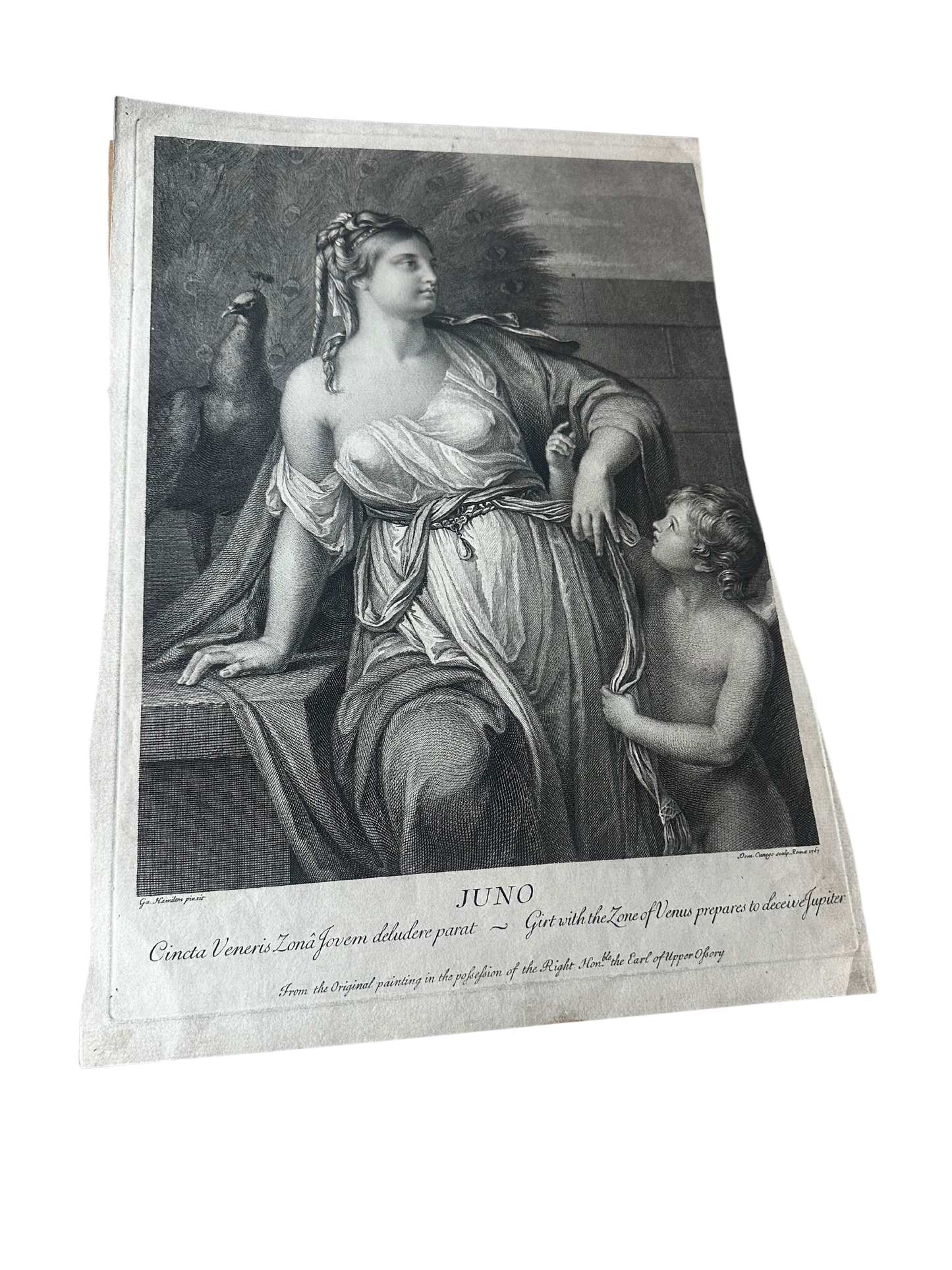
Goddess Juno with Peacock and Child
18th C (1767)
16.5" x 11.75"
Copperplate engraving
Juno (Roman goddess, Greek: Hera)
Seated on a rocky outcrop, partly draped.
A peacock, Juno’s sacred animal, is clearly visible beside her.
The child may represent Hebe (her daughter, goddess of youth), or may simply be an allegorical putto symbolizing divinity or majesty.
The branch could symbolize power, peace, or sovereignty.
These attributes—especially the peacock—are unmistakable identifiers of Juno, queen of the gods and goddess of marriage and statehood in Roman mythology.
Girt with the Zone of Venus prepares to deceive Jupiter - referencing the myth in which she borrows Venus’s enchanted girdle to win Jupiter’s affection—thus the “Zone of Venus.”
Painter: Ga. Hamilton pinxit – Refers to Gavin Hamilton (1723–1798), a Scottish neoclassical painter and archaeologist.
Engraver: Dom. Cunego sculp. Romae 1767 – Refers to Domenico Cunego (1727–1803), a prominent Italian engraver based in Rome and later in Verona. He was especially well known for reproducing famous paintings, frescoes, and classical sculptures in fine engraving.
From the Original painting in the possession of the Right Hon.ble the Earl of Upper Ossory. The mention of the Earl of Upper Ossory suggests the engraving was part of a nobleman’s commissioned or collected works, quite possibly part of the Grand Tour collecting trend of the 18th century.
18th C English School Prints - Domenic Cunego - Juno
Goddess Juno with Peacock and Child
18th C (1767)
16.5" x 11.75"
Copperplate engraving
Juno (Roman goddess, Greek: Hera)
Seated on a rocky outcrop, partly draped.
A peacock, Juno’s sacred animal, is clearly visible beside her.
The child may represent Hebe (her daughter, goddess of youth), or may simply be an allegorical putto symbolizing divinity or majesty.
The branch could symbolize power, peace, or sovereignty.
These attributes—especially the peacock—are unmistakable identifiers of Juno, queen of the gods and goddess of marriage and statehood in Roman mythology.
Girt with the Zone of Venus prepares to deceive Jupiter - referencing the myth in which she borrows Venus’s enchanted girdle to win Jupiter’s affection—thus the “Zone of Venus.”
Painter: Ga. Hamilton pinxit – Refers to Gavin Hamilton (1723–1798), a Scottish neoclassical painter and archaeologist.
Engraver: Dom. Cunego sculp. Romae 1767 – Refers to Domenico Cunego (1727–1803), a prominent Italian engraver based in Rome and later in Verona. He was especially well known for reproducing famous paintings, frescoes, and classical sculptures in fine engraving.
From the Original painting in the possession of the Right Hon.ble the Earl of Upper Ossory. The mention of the Earl of Upper Ossory suggests the engraving was part of a nobleman’s commissioned or collected works, quite possibly part of the Grand Tour collecting trend of the 18th century.