



Hand-Painted KPM-Style Porcelain Portrait Plaque of a Woman with Daisies, after Jules Frederic Ballavoine
Hand-Painted KPM-Style Porcelain Portrait Plaque of a Woman with Daisies, after Jules Frederic Ballavoine
No se pudo cargar la disponibilidad de retiro
Compartir


A finely executed hand-painted porcelain plaque depicting a classical female bust-length portrait holding a bouquet of white daisies, after Jules Frederic Ballavoine (French, 1842-1914). The figure is shown in profile with softly modeled skin tones, delicate facial features, and curled hair tied with a ribbon. She wears a deep red draped garment with a translucent white wrap falling from the shoulder.
The painting demonstrates strong academic technique, including subtle shading, smooth enamel transitions, and careful floral detailing with raised enamel accents in the daisy centers.
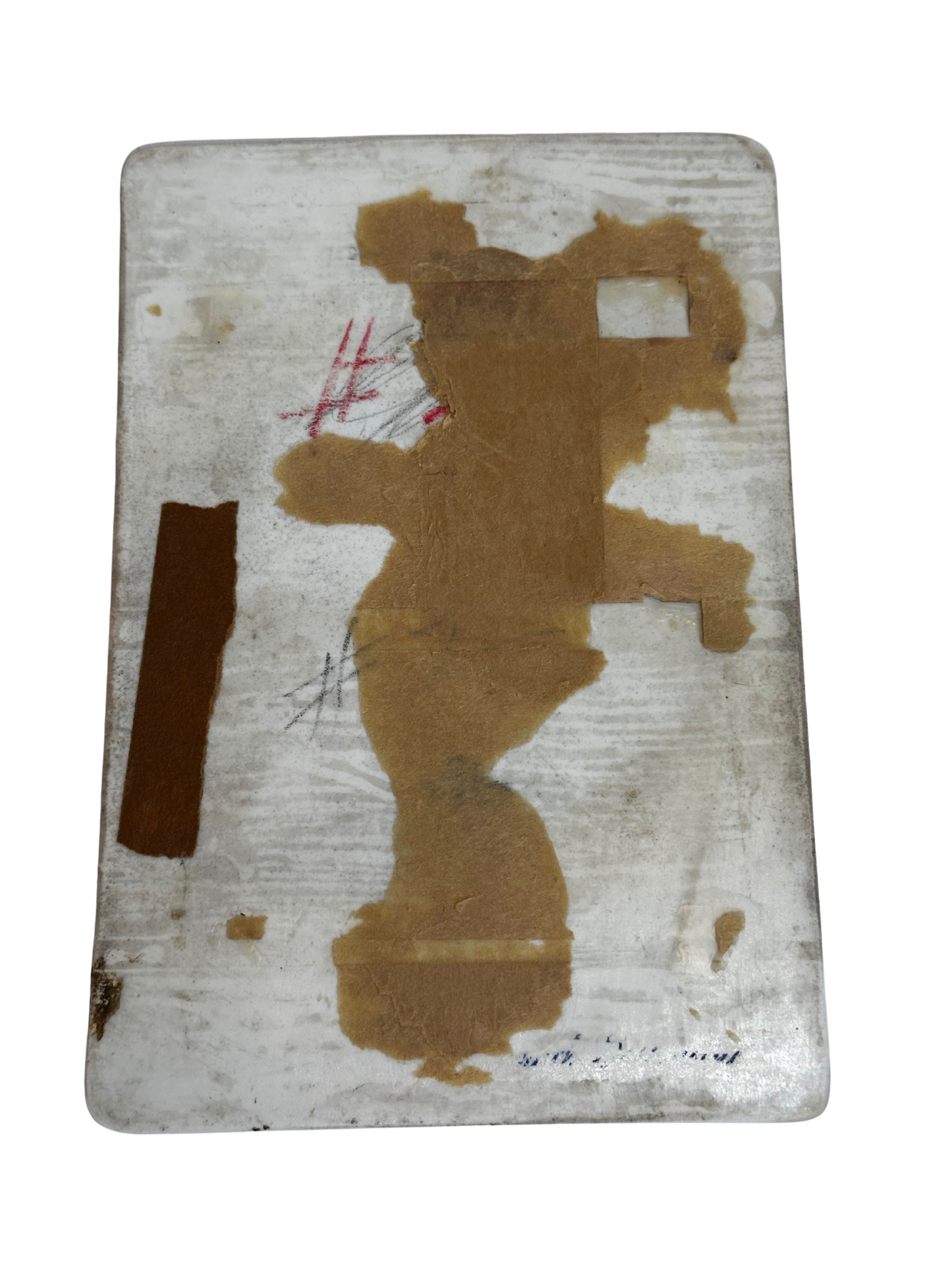
The plaque is signed in the lower left corner, appearing to read “Leib or Lieh…” (or similar). The reverse shows mounting residue from prior framing, paper remnants, and studio pencil marks typical of porcelain plaques that were once framed or set into decorative mounts.
The plaque has a gently rounded rectangular form with slightly beveled edges, consistent with late-19th-century European porcelain plaque production.
A finely executed hand-painted porcelain plaque depicting a classical female bust-length portrait holding a bouquet of white daisies, after Jules Frederic Ballavoine (French, 1842-1914). The figure is shown in profile with softly modeled skin tones, delicate facial features, and curled hair tied with a ribbon. She wears a deep red draped garment with a translucent white wrap falling from the shoulder.
The painting demonstrates strong academic technique, including subtle shading, smooth enamel transitions, and careful floral detailing with raised enamel accents in the daisy centers.
The plaque is signed in the lower left corner, appearing to read “Leib or Lieh…” (or similar). The reverse shows mounting residue from prior framing, paper remnants, and studio pencil marks typical of porcelain plaques that were once framed or set into decorative mounts.
The plaque has a gently rounded rectangular form with slightly beveled edges, consistent with late-19th-century European porcelain plaque production.
7.25"h x 5"w
7.25"h x 5"w
Hand-painted porcelain plaques were widely produced in Europe during the second half of the 19th century, particularly in Germany, Austria, and France. Artists trained in academic painting traditions often worked as porcelain painters, reproducing portrait studies and allegorical female figures that were popular in middle- and upper-class interiors.
Portrait plaques of idealized women holding flowers were especially common decorative subjects during the Victorian and Belle Époque periods, reflecting the influence of academic salon painting.
Unlike factory-marked plaques such as those produced by KPM Berlin, many plaques were painted by independent studio artists and signed only with the painter’s name.
Hand-painted porcelain plaques were widely produced in Europe during the second half of the 19th century, particularly in Germany, Austria, and France. Artists trained in academic painting traditions often worked as porcelain painters, reproducing portrait studies and allegorical female figures that were popular in middle- and upper-class interiors.
Portrait plaques of idealized women holding flowers were especially common decorative subjects during the Victorian and Belle Époque periods, reflecting the influence of academic salon painting.
Unlike factory-marked plaques such as those produced by KPM Berlin, many plaques were painted by independent studio artists and signed only with the painter’s name.
Late 19th century (circa 1880–1900)
Late 19th century (circa 1880–1900)
Hand-painted porcelain plaque
Enamel paint
Hand-painted porcelain plaque
Enamel paint
European origin (likely German or Austrian)
European origin (likely German or Austrian)
Surface wear and light scratches visible under angled light.
Residue from prior mounting visible on the reverse.
Minor edge wear consistent with age.
No visible cracks or structural damage observed in photos.
Surface wear and light scratches visible under angled light.
Residue from prior mounting visible on the reverse.
Minor edge wear consistent with age.
No visible cracks or structural damage observed in photos.