

Monumental French Napoleon III Style Giltwood and Composition Mirror with Rocaille Crest
Monumental French Napoleon III Style Giltwood and Composition Mirror with Rocaille Crest
No se pudo cargar la disponibilidad de retiro
Compartir
Additional Description:
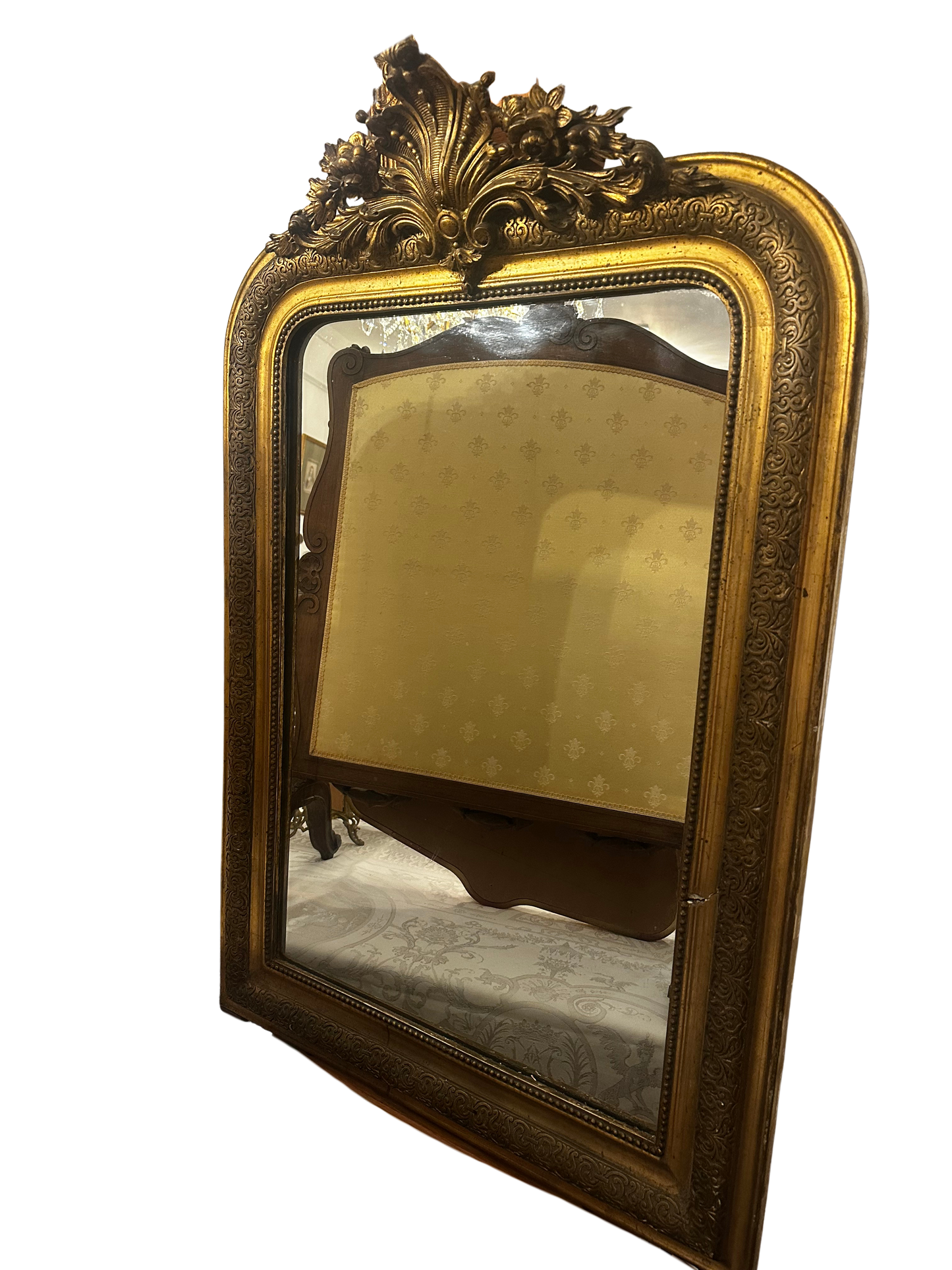
A striking large-scale French mirror in the Napoleon III / Second Empire taste, featuring a tall arched rectangular form surmounted by an exuberant crest of scrolling acanthus, florals, and rocaille ornament. The frame presents a richly layered surface with an inner beaded border, a broad band of repeating foliate scrollwork, and a warm gilt finish that gives the piece strong decorative presence. The crest is especially dramatic, with deeply modeled relief and asymmetrical movement typical of 19th-century French revival design.
This mirror reads as a statement piece intended for use over a mantel, commode, or console, though it is now mounted on a later custom easel support for floor or tabletop display. The reverse shows old wide plank boards consistent with age, while the front retains attractive patina and surface variation to the gilding. The overall look is very much in line with French decorative mirrors made in the later 19th century, particularly those produced during the continued popularity of Louis XV-inspired and Rococo Revival interiors.
Its scale, strong silhouette, and elaborate crest make it highly desirable as a decorative anchor in a traditional, maximalist, or layered European interior.
Era:
19th century, likely late Napoleon III / Second Empire period, circa 1860–1885
History:
During the reign of Napoleon III and throughout the Second Empire, French decorators and makers embraced richly ornamental revival styles, especially interpretations of Louis XV and Rococo forms. Mirrors became important architectural furnishings, used to amplify light and project luxury in salons, bedrooms, and reception rooms. Frames of this type were often made with a wooden structure enhanced by molded composition ornament and gilded finishes, allowing for deeply carved visual effect at a more practical cost than fully hand-carved solid wood examples.
The scrolling foliate ground and expressive crest seen here are hallmarks of the period’s love of opulence and theatricality. Such mirrors remain popular today for their ability to add height, warmth, and old-world glamour to an interior.
Provenance:
Likely French in origin. Acquisition details not provided.
Materials:
Mirror plate, wood frame, composition ornament, gilded finish, plank wood backing, later wood easel support
Dimensions:
Leave blank
Disclaimers:
Visible age-related wear throughout, including rubbing, losses, craquelure, and surface inconsistencies to the gilded finish. There is a notable break/crack with loss to the proper right side of the frame molding. Scattered minor nicks, abrasions, and wear to high points. Mirror plate shows light surface wear and age consistent with use. The rear easel/display structure appears to be a later custom addition and not original to the mirror. Construction and attribution are based on visual assessment from photographs only.
Additional Description:
A striking large-scale French mirror in the Napoleon III / Second Empire taste, featuring a tall arched rectangular form surmounted by an exuberant crest of scrolling acanthus, florals, and rocaille ornament. The frame presents a richly layered surface with an inner beaded border, a broad band of repeating foliate scrollwork, and a warm gilt finish that gives the piece strong decorative presence. The crest is especially dramatic, with deeply modeled relief and asymmetrical movement typical of 19th-century French revival design.
This mirror reads as a statement piece intended for use over a mantel, commode, or console, though it is now mounted on a later custom easel support for floor or tabletop display. The reverse shows old wide plank boards consistent with age, while the front retains attractive patina and surface variation to the gilding. The overall look is very much in line with French decorative mirrors made in the later 19th century, particularly those produced during the continued popularity of Louis XV-inspired and Rococo Revival interiors.
Its scale, strong silhouette, and elaborate crest make it highly desirable as a decorative anchor in a traditional, maximalist, or layered European interior.
Era:
19th century, likely late Napoleon III / Second Empire period, circa 1860–1885
History:
During the reign of Napoleon III and throughout the Second Empire, French decorators and makers embraced richly ornamental revival styles, especially interpretations of Louis XV and Rococo forms. Mirrors became important architectural furnishings, used to amplify light and project luxury in salons, bedrooms, and reception rooms. Frames of this type were often made with a wooden structure enhanced by molded composition ornament and gilded finishes, allowing for deeply carved visual effect at a more practical cost than fully hand-carved solid wood examples.
The scrolling foliate ground and expressive crest seen here are hallmarks of the period’s love of opulence and theatricality. Such mirrors remain popular today for their ability to add height, warmth, and old-world glamour to an interior.
Provenance:
Likely French in origin. Acquisition details not provided.
Materials:
Mirror plate, wood frame, composition ornament, gilded finish, plank wood backing, later wood easel support
Dimensions:
Leave blank
Disclaimers:
Visible age-related wear throughout, including rubbing, losses, craquelure, and surface inconsistencies to the gilded finish. There is a notable break/crack with loss to the proper right side of the frame molding. Scattered minor nicks, abrasions, and wear to high points. Mirror plate shows light surface wear and age consistent with use. The rear easel/display structure appears to be a later custom addition and not original to the mirror. Construction and attribution are based on visual assessment from photographs only.