


Oil on Canvas of Atmospheric Fountain Scene with Reclining Nude by Gyula Éder (1875-1945)
Oil on Canvas of Atmospheric Fountain Scene with Reclining Nude by Gyula Éder (1875-1945)
No se pudo cargar la disponibilidad de retiro
Compartir
Additional Description:
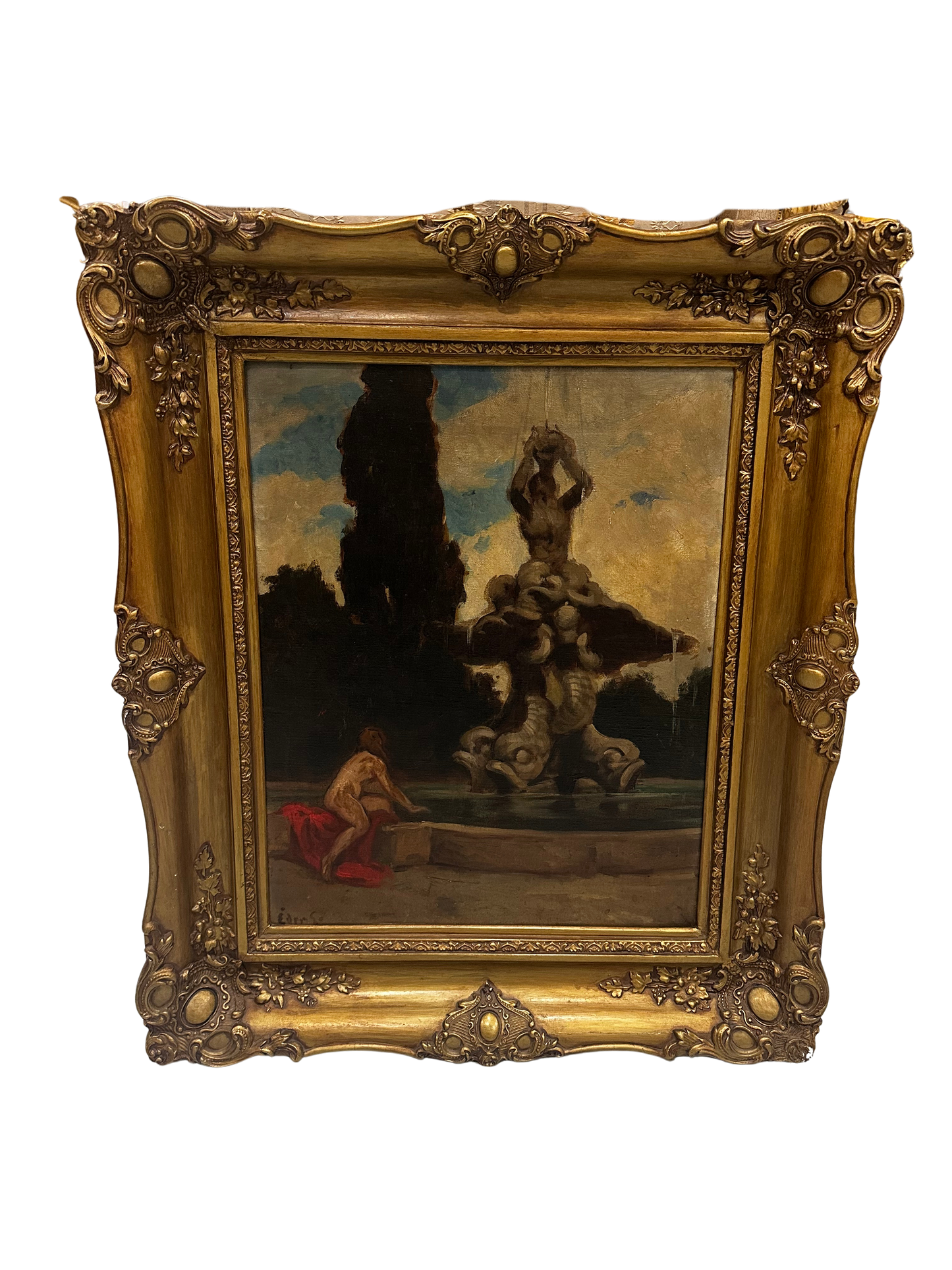
A moody and highly atmospheric oil on canvas painting depicting a female nude seated beside an elaborate sculptural fountain within a shadowed park or garden setting. The composition is dominated by dramatic tonal contrasts, with deep cypress-like forms rising behind a monumental Baroque-style fountain and a vivid crimson drapery accenting the otherwise muted palette. The loose yet confident handling of paint, particularly in the fountain forms and sky, gives the work an impressionistic and almost symbolist quality.
The work is signed lower left “Eder,” consistent with Hungarian painter Gyula Éder (1875–1945). Éder was known for painterly figural compositions and atmospheric scenes, often influenced by late academic and impressionist traditions of Central Europe in the early 20th century.
The canvas retains several intriguing period labels and marks verso. One torn paper label appears to be in Hungarian and includes the wording “Olfestm. Castell,” likely shorthand for Olajfestmény (“oil painting”) and possibly referencing a gallery, collection, or exhibition notation. Another label bears the printed Hungarian text “Beérkezett” and “Folyó szám,” translating roughly to “Received” and “Entry Number,” suggesting the painting may have passed through a Hungarian exhibition, salon, customs office, or institutional inventory system. A handwritten date reading “1914” is visible on one label, potentially indicating the year of entry, exhibition, or acquisition.
The reverse also bears a circular canvas supplier stamp. While partially obscured, it appears to be a Hungarian or Central European artists’ supplier mark featuring a crowned crest or shield motif. The wording is difficult to fully decipher from the current photographs, though it is consistent with early 20th-century Hungarian canvas manufacturer or color merchant stamps frequently found on Budapest-school paintings of the period.
The painting remains housed in an ornate giltwood and composition frame with scrolling Rococo-inspired ornamentation, likely early to mid-20th century and possibly original to the work. The canvas appears to retain its original stretcher and has not been visibly relined from the photographs provided.
Era:
Early 20th Century, likely circa 1910–1925
History:
Gyula Éder was a Hungarian painter active during the late Austro-Hungarian and interwar periods. Hungarian painters of this era often blended academic training with impressionistic brushwork and symbolist atmosphere, particularly in figural and garden scenes. This painting’s evocative mood, softened contours, and dramatic fountain architecture strongly reflect Continental European salon painting traditions of the early 20th century.
The surviving Hungarian labels suggest the work may have remained within Hungary for much of its early history before export. The notation “1914” is especially compelling, potentially placing the work directly within the final years of the Austro-Hungarian Empire.
Provenance:
Hungary or Central Europe; later private collection. Retains original Hungarian-language labels and canvas supplier stamp verso.
Materials:
Oil on canvas; wood stretcher; giltwood and composition frame; paper exhibition/inventory labels.
Dimensions:
Sight: approx. 19” h x 15” w
Overall: approx. 27.5” h
Disclaimers:
Surface grime, craquelure, and age-related wear present throughout consistent with age. Some abrasions and minor paint instability visible. Labels verso are fragmented and partially illegible. Frame with scattered wear, losses, and restorations to composition ornament. Canvas stamp partially obscured and not fully decipherable from current photographs. Attribution based on visible signature and auction-house identification.
Additional Description:
A moody and highly atmospheric oil on canvas painting depicting a female nude seated beside an elaborate sculptural fountain within a shadowed park or garden setting. The composition is dominated by dramatic tonal contrasts, with deep cypress-like forms rising behind a monumental Baroque-style fountain and a vivid crimson drapery accenting the otherwise muted palette. The loose yet confident handling of paint, particularly in the fountain forms and sky, gives the work an impressionistic and almost symbolist quality.
The work is signed lower left “Eder,” consistent with Hungarian painter Gyula Éder (1875–1945). Éder was known for painterly figural compositions and atmospheric scenes, often influenced by late academic and impressionist traditions of Central Europe in the early 20th century.
The canvas retains several intriguing period labels and marks verso. One torn paper label appears to be in Hungarian and includes the wording “Olfestm. Castell,” likely shorthand for Olajfestmény (“oil painting”) and possibly referencing a gallery, collection, or exhibition notation. Another label bears the printed Hungarian text “Beérkezett” and “Folyó szám,” translating roughly to “Received” and “Entry Number,” suggesting the painting may have passed through a Hungarian exhibition, salon, customs office, or institutional inventory system. A handwritten date reading “1914” is visible on one label, potentially indicating the year of entry, exhibition, or acquisition.
The reverse also bears a circular canvas supplier stamp. While partially obscured, it appears to be a Hungarian or Central European artists’ supplier mark featuring a crowned crest or shield motif. The wording is difficult to fully decipher from the current photographs, though it is consistent with early 20th-century Hungarian canvas manufacturer or color merchant stamps frequently found on Budapest-school paintings of the period.
The painting remains housed in an ornate giltwood and composition frame with scrolling Rococo-inspired ornamentation, likely early to mid-20th century and possibly original to the work. The canvas appears to retain its original stretcher and has not been visibly relined from the photographs provided.
Era:
Early 20th Century, likely circa 1910–1925
History:
Gyula Éder was a Hungarian painter active during the late Austro-Hungarian and interwar periods. Hungarian painters of this era often blended academic training with impressionistic brushwork and symbolist atmosphere, particularly in figural and garden scenes. This painting’s evocative mood, softened contours, and dramatic fountain architecture strongly reflect Continental European salon painting traditions of the early 20th century.
The surviving Hungarian labels suggest the work may have remained within Hungary for much of its early history before export. The notation “1914” is especially compelling, potentially placing the work directly within the final years of the Austro-Hungarian Empire.
Provenance:
Hungary or Central Europe; later private collection. Retains original Hungarian-language labels and canvas supplier stamp verso.
Materials:
Oil on canvas; wood stretcher; giltwood and composition frame; paper exhibition/inventory labels.
Dimensions:
Sight: approx. 19” h x 15” w
Overall: approx. 27.5” h
Disclaimers:
Surface grime, craquelure, and age-related wear present throughout consistent with age. Some abrasions and minor paint instability visible. Labels verso are fragmented and partially illegible. Frame with scattered wear, losses, and restorations to composition ornament. Canvas stamp partially obscured and not fully decipherable from current photographs. Attribution based on visible signature and auction-house identification.