

Old Master Engraving after Paolo Veronese — Allegorical Classical Scene (Circular Composition)
Old Master Engraving after Paolo Veronese — Allegorical Classical Scene (Circular Composition)
No se pudo cargar la disponibilidad de retiro
Compartir
Additional Description:
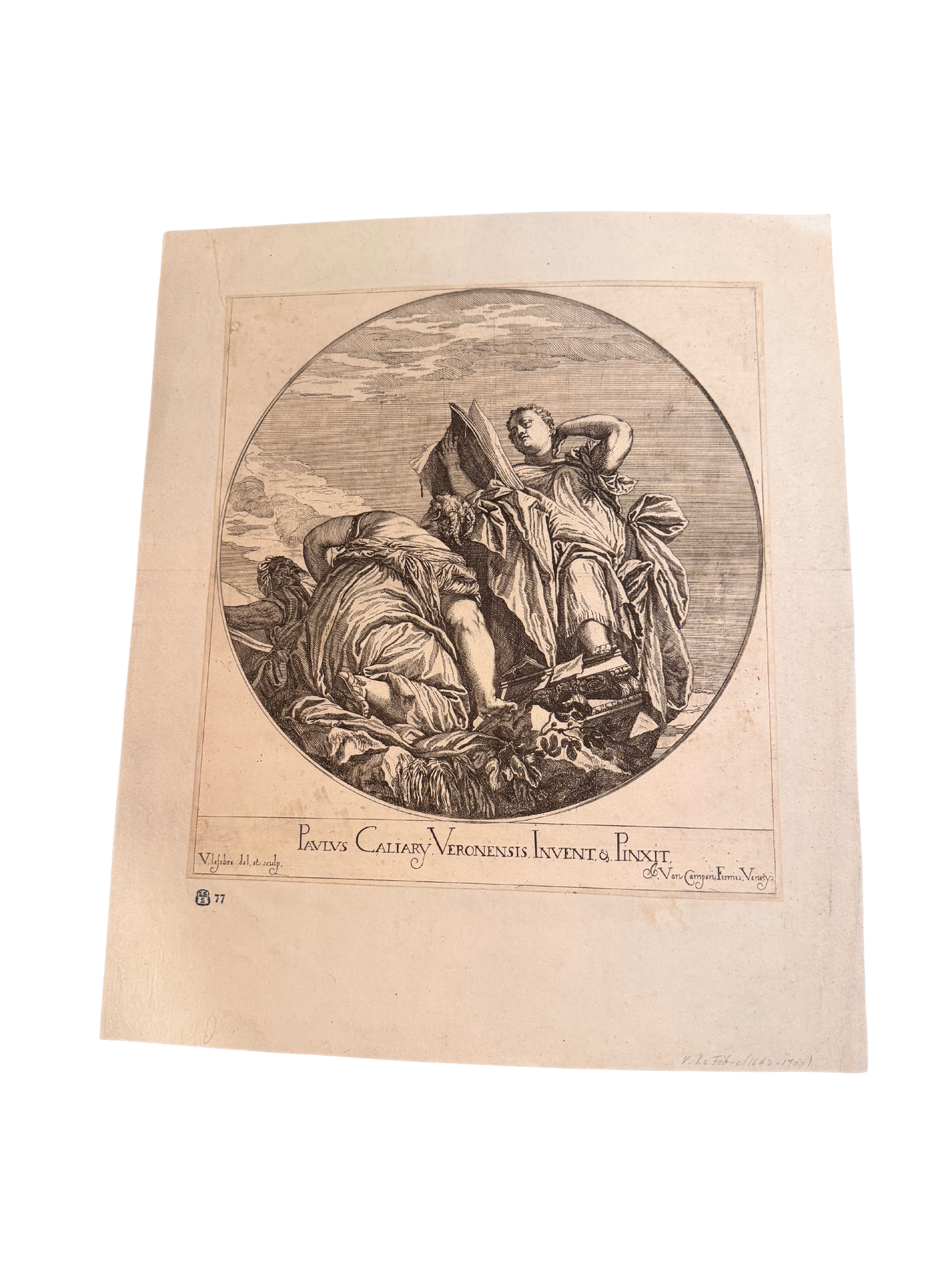
Large engraved print depicting a dramatic allegorical classical scene with two monumental draped figures arranged in a circular composition. One figure reclines while another stands reading from an open book, resting a foot on a pedestal decorated with classical ornament, likely depicting personifications of Virtues, Muses, or Classical Arts and suggesting wisdom, learning, or poetry.
The inscription below the image reads:
“Paulus Caliari Veronensis Invent. & Pinxit”
(“Paolo Caliari of Verona invented and painted [the original]” — referring to Paolo Veronese).
At the lower left appears:
“V. Lefebre del. et sculp.”
indicating the drawing and engraving were executed by an engraver named Lefebre (Lefèvre / Lefebure).
At the lower right:
“Van Campen formis Venetiis”
indicating publication in Venice by the Van Campen press/publisher.
The composition is printed within a square plate mark with a circular image field — a format typical of late 17th–18th century reproductive engravings after Venetian masters.
The sheet shows visible plate marks, laid paper texture, and age-appropriate toning, confirming it is a period engraving rather than a modern reproduction.
A later pencil notation appears at the lower margin referencing “Le Febre (1642–1700?)”, likely a collector or dealer attribution note rather than original inscription.
This engraving was likely originally issued as part of a portfolio or illustrated art publication reproducing works of Paolo Veronese.
Era:
Late 17th to early 18th century engraving (after a 16th-century painting by Paolo Veronese)
History:
Paolo Veronese (Paulus Caliari, 1528–1588) was one of the great painters of the Venetian Renaissance, known for monumental compositions, theatrical figures, and rich classical symbolism.
During the late 1600s and 1700s, European publishers produced engraved reproductions of famous Renaissance paintings for collectors, academies, and travelers on the Grand Tour. Venice was a major center for this printmaking activity.
Engraved by Valentin Lefebre (1637–1677 or c.1700), French engraver and painter, active mainly in Venice. Known for reproducing works by Venetian masters.
Publishers such as Johannes Van Campen (18th c Venetian publisher/printer) in Venice issued engravings after Venetian masters, helping disseminate Renaissance compositions across Europe.
Circular compositions like this were often derived from ceiling paintings, allegorical cycles, or decorative programs translated into collectible prints.
Provenance:
Likely Italian (Venice), published by Van Campen
From an antique print or engraving collection
Materials:
Laid paper
Copperplate engraving ink
Intaglio printmaking process
Dimensions:
17.75" x 15"
Disclaimers:
Age-appropriate toning, foxing, and handling wear visible.
Minor margin marks and a later pencil notation in the lower margin.
Paper shows expected waviness and aging consistent with early prints.
Unframed.
Additional Description:
Large engraved print depicting a dramatic allegorical classical scene with two monumental draped figures arranged in a circular composition. One figure reclines while another stands reading from an open book, resting a foot on a pedestal decorated with classical ornament, likely depicting personifications of Virtues, Muses, or Classical Arts and suggesting wisdom, learning, or poetry.
The inscription below the image reads:
“Paulus Caliari Veronensis Invent. & Pinxit”
(“Paolo Caliari of Verona invented and painted [the original]” — referring to Paolo Veronese).
At the lower left appears:
“V. Lefebre del. et sculp.”
indicating the drawing and engraving were executed by an engraver named Lefebre (Lefèvre / Lefebure).
At the lower right:
“Van Campen formis Venetiis”
indicating publication in Venice by the Van Campen press/publisher.
The composition is printed within a square plate mark with a circular image field — a format typical of late 17th–18th century reproductive engravings after Venetian masters.
The sheet shows visible plate marks, laid paper texture, and age-appropriate toning, confirming it is a period engraving rather than a modern reproduction.
A later pencil notation appears at the lower margin referencing “Le Febre (1642–1700?)”, likely a collector or dealer attribution note rather than original inscription.
This engraving was likely originally issued as part of a portfolio or illustrated art publication reproducing works of Paolo Veronese.
Era:
Late 17th to early 18th century engraving (after a 16th-century painting by Paolo Veronese)
History:
Paolo Veronese (Paulus Caliari, 1528–1588) was one of the great painters of the Venetian Renaissance, known for monumental compositions, theatrical figures, and rich classical symbolism.
During the late 1600s and 1700s, European publishers produced engraved reproductions of famous Renaissance paintings for collectors, academies, and travelers on the Grand Tour. Venice was a major center for this printmaking activity.
Engraved by Valentin Lefebre (1637–1677 or c.1700), French engraver and painter, active mainly in Venice. Known for reproducing works by Venetian masters.
Publishers such as Johannes Van Campen (18th c Venetian publisher/printer) in Venice issued engravings after Venetian masters, helping disseminate Renaissance compositions across Europe.
Circular compositions like this were often derived from ceiling paintings, allegorical cycles, or decorative programs translated into collectible prints.
Provenance:
Likely Italian (Venice), published by Van Campen
From an antique print or engraving collection
Materials:
Laid paper
Copperplate engraving ink
Intaglio printmaking process
Dimensions:
17.75" x 15"
Disclaimers:
Age-appropriate toning, foxing, and handling wear visible.
Minor margin marks and a later pencil notation in the lower margin.
Paper shows expected waviness and aging consistent with early prints.
Unframed.