


Pair of English Victorian Cast Brass Fireplace Firedogs with Flame Finials, Circa 1880–1900
Pair of English Victorian Cast Brass Fireplace Firedogs with Flame Finials, Circa 1880–1900
No se pudo cargar la disponibilidad de retiro
Compartir


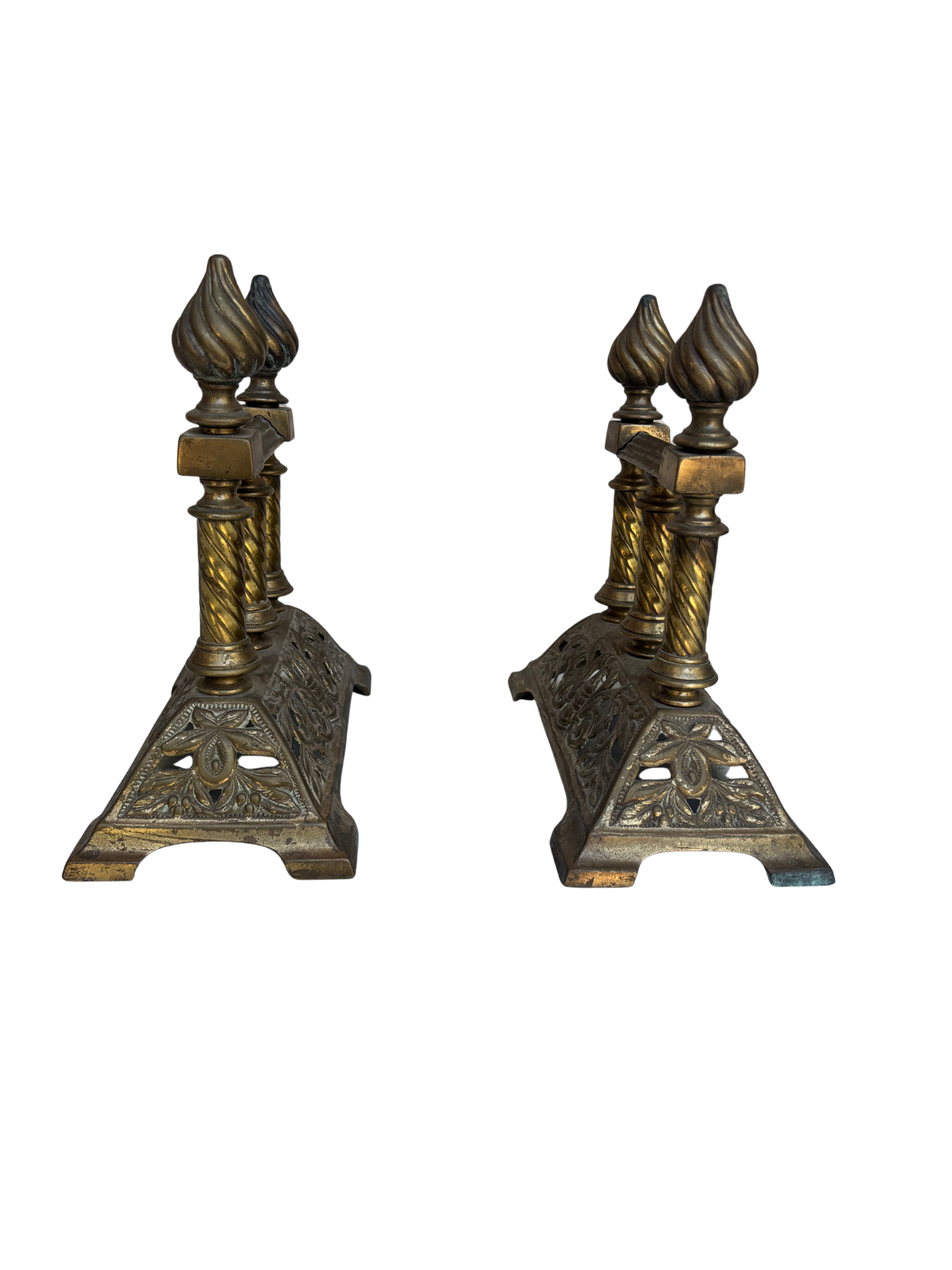
A decorative pair of late 19th-century English Victorian fireplace firedogs or andiron fronts, cast in brass with richly modeled architectural and foliate ornament.
Each is formed with a broad molded base decorated in relief with scrolling foliage and stylized floral motifs. Rising above are three slender columns with spirally fluted shafts, the outer pair surmounted by bold flame-form finials. A horizontal rail joins the columns, creating an architectural composition reminiscent of the Gothic and Renaissance Revival vocabulary popular in late Victorian decorative arts.
The warm, aged brass surface retains areas of darker oxidation and rubbed golden highlights, emphasizing the depth of the cast decoration.
Originally positioned as a pair at either side of a fireplace, firedogs developed from functional supports used in conjunction with hearth grates and log irons. This pair is particularly attractive today as decorative fireplace furniture, whether incorporated into a working hearth arrangement or displayed independently.
A decorative pair of late 19th-century English Victorian fireplace firedogs or andiron fronts, cast in brass with richly modeled architectural and foliate ornament.
Each is formed with a broad molded base decorated in relief with scrolling foliage and stylized floral motifs. Rising above are three slender columns with spirally fluted shafts, the outer pair surmounted by bold flame-form finials. A horizontal rail joins the columns, creating an architectural composition reminiscent of the Gothic and Renaissance Revival vocabulary popular in late Victorian decorative arts.
The warm, aged brass surface retains areas of darker oxidation and rubbed golden highlights, emphasizing the depth of the cast decoration.
Originally positioned as a pair at either side of a fireplace, firedogs developed from functional supports used in conjunction with hearth grates and log irons. This pair is particularly attractive today as decorative fireplace furniture, whether incorporated into a working hearth arrangement or displayed independently.
9.5"h x 9.25"w x 4.5"d
9.5"h x 9.25"w x 4.5"d
Firedogs—also known as andirons—have been used in European fireplaces for centuries. Early examples incorporated projecting iron bars that supported burning logs above the hearth, improving airflow beneath the fire.
By the 19th century, particularly during the Victorian era, the visible fronts of firedogs became increasingly elaborate decorative objects. Brass and bronze examples were produced in a wide variety of historicist styles, drawing inspiration from Gothic, Renaissance, Jacobean, and Classical architecture.
The present pair reflects this late Victorian taste for revival ornament through its scrolling relief decoration, spirally twisted columns, and prominent flame finials. Comparable Victorian firedogs are known with three-column arrangements and decorative finials, demonstrating how manufacturers transformed otherwise utilitarian fireplace equipment into conspicuous elements of the furnished interior.
Pairs such as these would have been placed symmetrically at the front of a fireplace and were intended to complement elaborate cast-iron grates, brass fenders, and other hearth furniture.
Firedogs—also known as andirons—have been used in European fireplaces for centuries. Early examples incorporated projecting iron bars that supported burning logs above the hearth, improving airflow beneath the fire.
By the 19th century, particularly during the Victorian era, the visible fronts of firedogs became increasingly elaborate decorative objects. Brass and bronze examples were produced in a wide variety of historicist styles, drawing inspiration from Gothic, Renaissance, Jacobean, and Classical architecture.
The present pair reflects this late Victorian taste for revival ornament through its scrolling relief decoration, spirally twisted columns, and prominent flame finials. Comparable Victorian firedogs are known with three-column arrangements and decorative finials, demonstrating how manufacturers transformed otherwise utilitarian fireplace equipment into conspicuous elements of the furnished interior.
Pairs such as these would have been placed symmetrically at the front of a fireplace and were intended to complement elaborate cast-iron grates, brass fenders, and other hearth furniture.
English Victorian, circa 1880–1900
English Victorian, circa 1880–1900
Cast brass or bronze-finished base metal
Cast brass or bronze-finished base metal
Private collection. No maker's mark or manufacturer's inscription observed in the photographs provided.
Private collection. No maker's mark or manufacturer's inscription observed in the photographs provided.
Antique condition consistent with age and use. Both firedogs exhibit naturally developed patina, oxidation, tarnishing, rubbed areas, surface marks, scratches, and discoloration throughout.
The raised ornament retains attractive variation between darker recessed areas and brighter high points. Minor casting irregularities, small bends, abrasions, and age-related wear may be present.
The photographs show short rear projections but not substantial iron log-support bars. These may therefore represent decorative firedog fronts, or the original rear support components may have been altered, shortened, or removed at some point in their history. They are being offered primarily as decorative antique fireplace elements rather than represented as complete functional log-supporting andirons.
Please review all photographs carefully, as they form an important part of the condition description.
Antique condition consistent with age and use. Both firedogs exhibit naturally developed patina, oxidation, tarnishing, rubbed areas, surface marks, scratches, and discoloration throughout.
The raised ornament retains attractive variation between darker recessed areas and brighter high points. Minor casting irregularities, small bends, abrasions, and age-related wear may be present.
The photographs show short rear projections but not substantial iron log-support bars. These may therefore represent decorative firedog fronts, or the original rear support components may have been altered, shortened, or removed at some point in their history. They are being offered primarily as decorative antique fireplace elements rather than represented as complete functional log-supporting andirons.
Please review all photographs carefully, as they form an important part of the condition description.