

Pair of French Louis XVI Revival Gilt Brass and Copper Footed Plateaus / Display Risers with Laurel Garland, 19th Century
Pair of French Louis XVI Revival Gilt Brass and Copper Footed Plateaus / Display Risers with Laurel Garland, 19th Century
No se pudo cargar la disponibilidad de retiro
Compartir
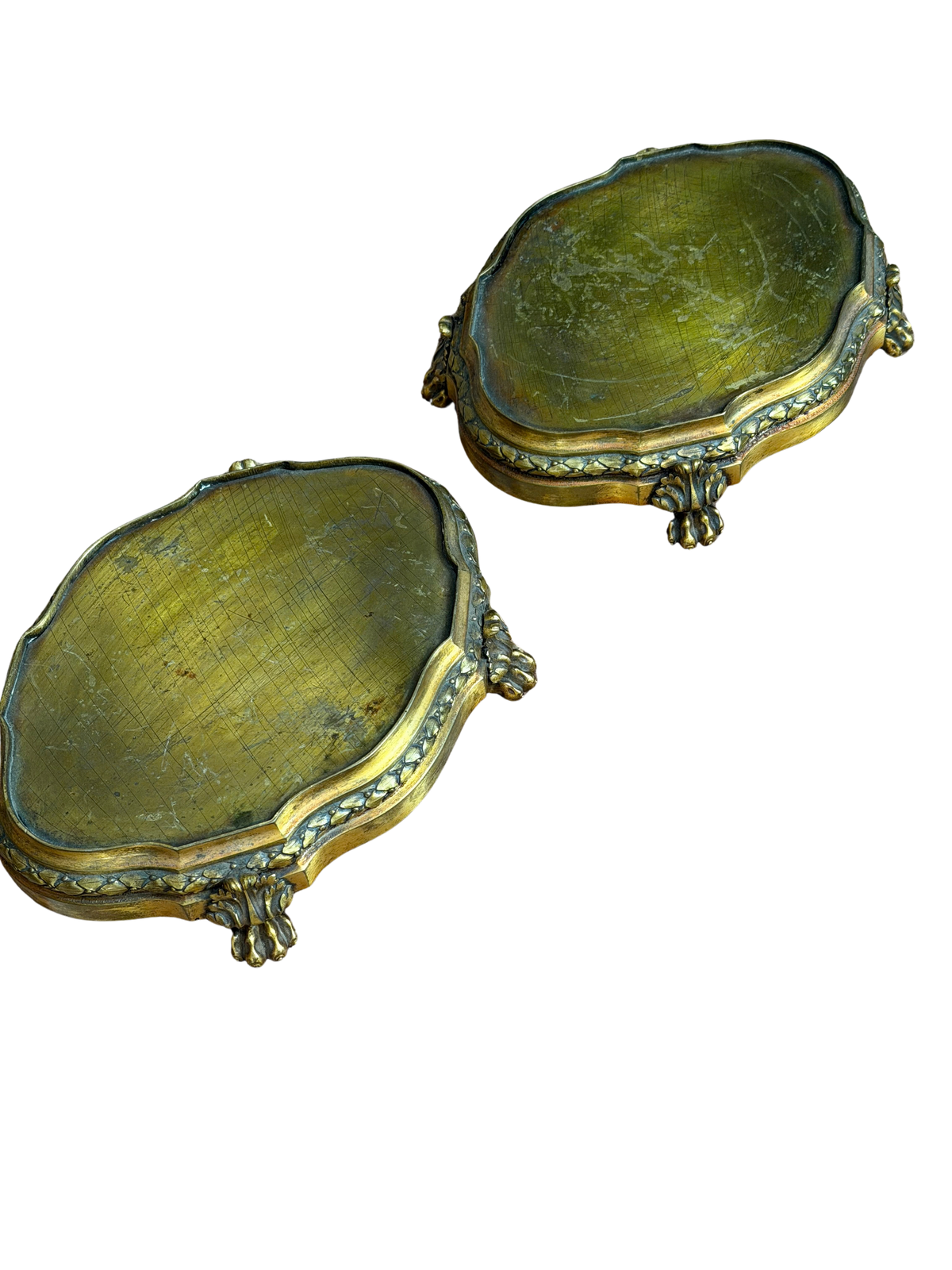
An elegant French Louis XVI Revival footed plateau or display riser, constructed in gilt brass with a copper or copper-alloy platform and richly decorated in the neoclassical taste.
The shaped oval top is framed by a low molded rim and retains a beautifully aged gilt surface with extensive historic wear from use. Beneath the platform, the apron is wrapped with a continuous laurel-leaf garland, while the corners are supported by sculptural foliate mounts terminating in paw- or hoof-like feet.
The combination of laurel ornament, scrolling foliage, shaped outline, and symmetrical construction reflects the decorative vocabulary associated with the Louis XVI style, later revived throughout the 19th century.
The underside reveals a reddish-brown metal plate consistent with copper or a copper-rich alloy, while the more heavily cast ornamental frame and feet appear most consistent with gilt brass.
The platform would have been intended to elevate and visually frame a decorative object such as a small urn, cassolette, clock, bust, perfume bottle, or other cabinet piece.
Era
French Louis XVI Revival
19th Century, circa 1850–1890
History
Small decorative plateaux and socles were commonly used in 19th-century French interiors to raise and visually enhance clocks, urns, sculpture, and other objets d’art.
The continuous laurel garland is a particularly characteristic neoclassical motif. Derived from ancient Greek and Roman imagery associated with honor and triumph, laurel became an important element of Louis XVI decorative design and was widely used on furniture mounts, clocks, cassolettes, and architectural bronzes.
During the 19th century, French decorative arts frequently revived these earlier 18th-century court styles, often combining cast gilt brass ornament with sheet copper or other copper-alloy structural elements.
Provenance
Sourced in France.
No maker’s mark is visible in the photographs provided.
Materials
- Gilt brass frame and cast ornament
- Copper or copper-alloy top / underside plate
- Cast laurel-leaf garland
- Cast foliate corner mounts
- Applied metal feet
- Aged gilt surface
Dimensions
Overall: 8.25 in. x 6.5 in. x 2 in. high
Top platform: 7.25 in. x 5.25 in.
Condition
Good antique condition with substantial age-related wear consistent with historic use.
The top platform shows extensive scratching, scuffing, discoloration, and wear to the gilt surface. The brass ornament has mellowed with age and exhibits rubbing, oxidation, darkening, and patination.
The underside copper or copper-alloy plate shows oxidation and surface variation consistent with age. The decorative mounts and four feet remain present.
Please review all photographs carefully for exact condition.
Disclaimers
This is an antique decorative object and retains visible evidence of age and use, including scratches, oxidation, rubbing, and variation to the gilt finish.
The metal has not been aggressively polished so as to preserve the aged surface and historic patina.
An elegant French Louis XVI Revival footed plateau or display riser, constructed in gilt brass with a copper or copper-alloy platform and richly decorated in the neoclassical taste.
The shaped oval top is framed by a low molded rim and retains a beautifully aged gilt surface with extensive historic wear from use. Beneath the platform, the apron is wrapped with a continuous laurel-leaf garland, while the corners are supported by sculptural foliate mounts terminating in paw- or hoof-like feet.
The combination of laurel ornament, scrolling foliage, shaped outline, and symmetrical construction reflects the decorative vocabulary associated with the Louis XVI style, later revived throughout the 19th century.
The underside reveals a reddish-brown metal plate consistent with copper or a copper-rich alloy, while the more heavily cast ornamental frame and feet appear most consistent with gilt brass.
The platform would have been intended to elevate and visually frame a decorative object such as a small urn, cassolette, clock, bust, perfume bottle, or other cabinet piece.
Era
French Louis XVI Revival
19th Century, circa 1850–1890
History
Small decorative plateaux and socles were commonly used in 19th-century French interiors to raise and visually enhance clocks, urns, sculpture, and other objets d’art.
The continuous laurel garland is a particularly characteristic neoclassical motif. Derived from ancient Greek and Roman imagery associated with honor and triumph, laurel became an important element of Louis XVI decorative design and was widely used on furniture mounts, clocks, cassolettes, and architectural bronzes.
During the 19th century, French decorative arts frequently revived these earlier 18th-century court styles, often combining cast gilt brass ornament with sheet copper or other copper-alloy structural elements.
Provenance
Sourced in France.
No maker’s mark is visible in the photographs provided.
Materials
- Gilt brass frame and cast ornament
- Copper or copper-alloy top / underside plate
- Cast laurel-leaf garland
- Cast foliate corner mounts
- Applied metal feet
- Aged gilt surface
Dimensions
Overall: 8.25 in. x 6.5 in. x 2 in. high
Top platform: 7.25 in. x 5.25 in.
Condition
Good antique condition with substantial age-related wear consistent with historic use.
The top platform shows extensive scratching, scuffing, discoloration, and wear to the gilt surface. The brass ornament has mellowed with age and exhibits rubbing, oxidation, darkening, and patination.
The underside copper or copper-alloy plate shows oxidation and surface variation consistent with age. The decorative mounts and four feet remain present.
Please review all photographs carefully for exact condition.
Disclaimers
This is an antique decorative object and retains visible evidence of age and use, including scratches, oxidation, rubbing, and variation to the gilt finish.
The metal has not been aggressively polished so as to preserve the aged surface and historic patina.