

Pair of French Neoclassical Brass and Cameo Candlesticks, circa 1880–1900
Pair of French Neoclassical Brass and Cameo Candlesticks, circa 1880–1900
No se pudo cargar la disponibilidad de retiro
Compartir
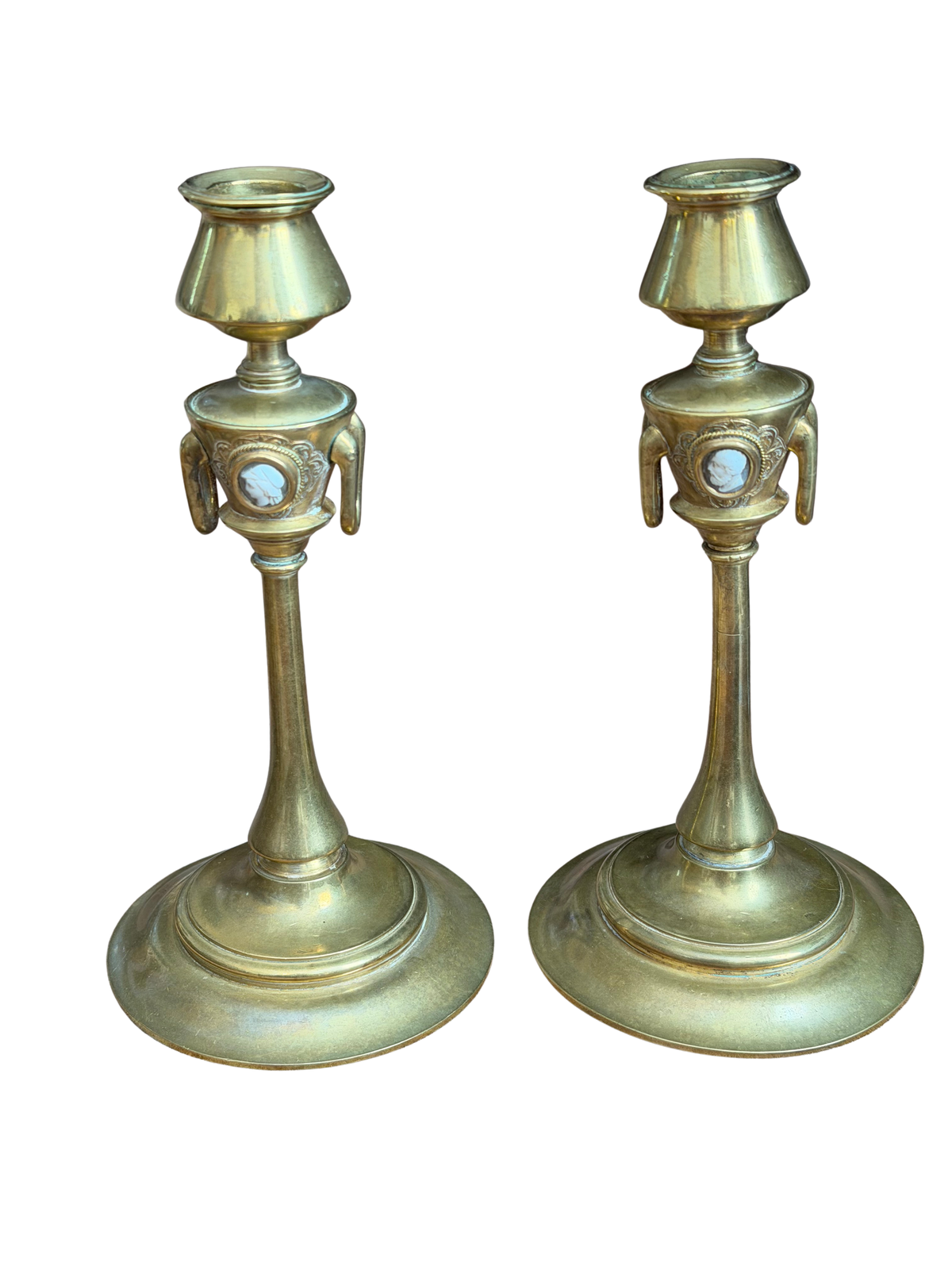
A handsome matched pair of late nineteenth-century French brass candlesticks in the Neoclassical / Empire Revival taste, each centered by an urn-form capital decorated with an applied classical portrait cameo.
The candlesticks rise from broad circular stepped bases into tall, gently tapering stems supporting amphora-inspired bodies. Each body is flanked by a pair of elongated loop handles and ornamented with engraved and chased foliate decoration surrounding a small oval cameo medallion.
The cameos appear to be white molded reliefs set against darker grounds, likely biscuit porcelain or a similar ceramic composition. One depicts a helmeted classical female profile, likely Minerva/Athena, while the companion medallion depicts a classical male profile. Together they evoke the archaeological and Classical Revival imagery that remained fashionable throughout nineteenth-century European decorative arts.
Above each urn-form body is a substantial brass candle cup with a flared silhouette and molded rim. The restrained brass construction combined with the diminutive portrait medallions gives the pair an appealing Grand Tour / Empire Revival character without the heavier ornament frequently seen on later historicist candlesticks.
A particularly attractive pair for a mantel, console, library, or dining table.
Era
French Neoclassical / Empire Revival
Late 19th Century, circa 1880–1900
History
Classical antiquity remained an important source of inspiration in French decorative arts throughout the nineteenth century. Following the archaeological discoveries of the eighteenth century and the popularity of the Grand Tour, ancient Greek and Roman forms—including amphorae, portrait medallions, laurel ornament, and mythological figures—were repeatedly reinterpreted for fashionable European interiors.
By the later nineteenth century, designers frequently combined Empire and Neoclassical forms with small cameo-style portrait plaques, recalling ancient carved gems and eighteenth-century collections of classical antiquities.
The helmeted female portrait on one candlestick is consistent with representations of Minerva, the Roman equivalent of Athena, identifiable by her helmet and classical profile. The male portrait on the companion candlestick is more difficult to identify securely from the surviving imagery and is best described conservatively as a classical male profile rather than assigning a specific mythological or historical figure.
Provenance
Sourced in France.
Maker presently unidentified; no visible maker’s mark is apparent in the photographs provided.
Materials
Brass
Applied white relief portrait medallions, likely biscuit porcelain or ceramic
Dark contrasting cameo grounds
Chased / engraved decorative details
Dimensions
Height: ___"
Base Diameter: ___"
Sold as a pair.
Condition / Disclaimers
Good antique condition with wear consistent with age and use.
The brass retains an attractive naturally aged surface with scattered tarnish, oxidation, spotting, rubbing, and areas of darker patination. Minor surface scratches, marks, and small variations between the two candlesticks are present.
The bases and stems show minor age-related irregularities and evidence of traditional assembled construction. Some verdigris and oxidation are visible around joints and recessed areas.
The applied cameo medallions remain present on both candlesticks. Minor discoloration, surface marks, and age-related imperfections may be present to the reliefs and surrounding mounts.
One or both candle sockets may show old wax residue and interior oxidation from historic use.
Please review all photographs carefully, as they form an important part of the condition description.
A handsome matched pair of late nineteenth-century French brass candlesticks in the Neoclassical / Empire Revival taste, each centered by an urn-form capital decorated with an applied classical portrait cameo.
The candlesticks rise from broad circular stepped bases into tall, gently tapering stems supporting amphora-inspired bodies. Each body is flanked by a pair of elongated loop handles and ornamented with engraved and chased foliate decoration surrounding a small oval cameo medallion.
The cameos appear to be white molded reliefs set against darker grounds, likely biscuit porcelain or a similar ceramic composition. One depicts a helmeted classical female profile, likely Minerva/Athena, while the companion medallion depicts a classical male profile. Together they evoke the archaeological and Classical Revival imagery that remained fashionable throughout nineteenth-century European decorative arts.
Above each urn-form body is a substantial brass candle cup with a flared silhouette and molded rim. The restrained brass construction combined with the diminutive portrait medallions gives the pair an appealing Grand Tour / Empire Revival character without the heavier ornament frequently seen on later historicist candlesticks.
A particularly attractive pair for a mantel, console, library, or dining table.
Era
French Neoclassical / Empire Revival
Late 19th Century, circa 1880–1900
History
Classical antiquity remained an important source of inspiration in French decorative arts throughout the nineteenth century. Following the archaeological discoveries of the eighteenth century and the popularity of the Grand Tour, ancient Greek and Roman forms—including amphorae, portrait medallions, laurel ornament, and mythological figures—were repeatedly reinterpreted for fashionable European interiors.
By the later nineteenth century, designers frequently combined Empire and Neoclassical forms with small cameo-style portrait plaques, recalling ancient carved gems and eighteenth-century collections of classical antiquities.
The helmeted female portrait on one candlestick is consistent with representations of Minerva, the Roman equivalent of Athena, identifiable by her helmet and classical profile. The male portrait on the companion candlestick is more difficult to identify securely from the surviving imagery and is best described conservatively as a classical male profile rather than assigning a specific mythological or historical figure.
Provenance
Sourced in France.
Maker presently unidentified; no visible maker’s mark is apparent in the photographs provided.
Materials
Brass
Applied white relief portrait medallions, likely biscuit porcelain or ceramic
Dark contrasting cameo grounds
Chased / engraved decorative details
Dimensions
Height: ___"
Base Diameter: ___"
Sold as a pair.
Condition / Disclaimers
Good antique condition with wear consistent with age and use.
The brass retains an attractive naturally aged surface with scattered tarnish, oxidation, spotting, rubbing, and areas of darker patination. Minor surface scratches, marks, and small variations between the two candlesticks are present.
The bases and stems show minor age-related irregularities and evidence of traditional assembled construction. Some verdigris and oxidation are visible around joints and recessed areas.
The applied cameo medallions remain present on both candlesticks. Minor discoloration, surface marks, and age-related imperfections may be present to the reliefs and surrounding mounts.
One or both candle sockets may show old wax residue and interior oxidation from historic use.
Please review all photographs carefully, as they form an important part of the condition description.