


Rare 1568 Henri Estienne Annotationes in Sophoclem & Euripidem, Geneva — 16th-Century Classical Scholarship in Gilt Calf
Rare 1568 Henri Estienne Annotationes in Sophoclem & Euripidem, Geneva — 16th-Century Classical Scholarship in Gilt Calf
No se pudo cargar la disponibilidad de retiro
Compartir


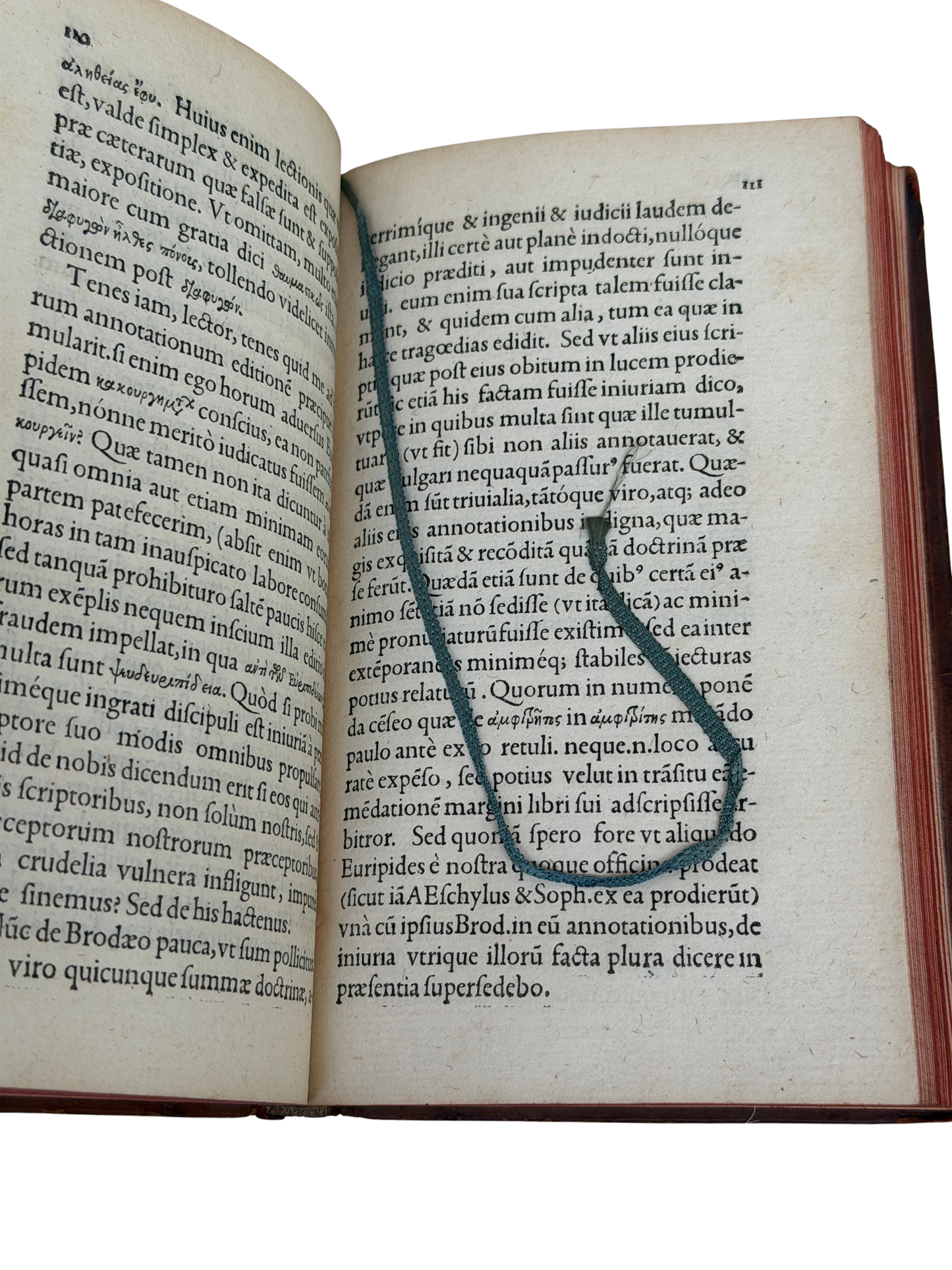
A beautifully preserved Renaissance scholarly volume by the celebrated French humanist, classical scholar, and printer Henri Estienne II (Henricus Stephanus), published in Geneva in 1568. The work contains Estienne’s critical annotations on the Greek tragedies of Sophocles and Euripides, together with his studies of tragic Greek orthography and Sophocles’ imitation of Homer.
Printed more than 450 years ago, the volume retains an exceptionally decorative historic leather binding with raised bands, gilt tooling, and red-stained page edges.
The Latin title reads:
Henrici Stephani Annotationes in Sophoclem & Euripidem: quibus variae lectiones examinantur, & pro mendosis emendatae substituuntur. Eiusdem Tractatus de orthographia quorundam vocabulorum Sophocli cum caeteris tragicis communium. Eiusdem Dissertatio de Sophoclea imitatione Homeri.
The title page bears the distinctive Estienne printer’s device, depicting the celebrated olive tree associated with the Estienne printing house, together with the date M.D.LXVIII — 1568.
This is the separately issued octavo volume of Henri Estienne’s annotations that accompanied his important 1568 edition of Sophocles. Bibliographic records describe the volume as comprising [16], 207, [1] pages, with the final page blank. The Folger Shakespeare Library records the same edition as printed in Geneva by Henri Estienne in 1568.
The text is primarily in Latin with extensive passages and references in Greek, reflecting Estienne’s extraordinary command of the classical languages and his role in the development of Renaissance Greek scholarship.
The binding appears to be a historic full calf binding, likely somewhat later than the printing, with a richly gilt spine divided into decorative compartments by raised bands. Each compartment features ornamental gilt tooling surrounding stylized floral devices. The page edges are stained red.
A beautifully preserved Renaissance scholarly volume by the celebrated French humanist, classical scholar, and printer Henri Estienne II (Henricus Stephanus), published in Geneva in 1568. The work contains Estienne’s critical annotations on the Greek tragedies of Sophocles and Euripides, together with his studies of tragic Greek orthography and Sophocles’ imitation of Homer.
Printed more than 450 years ago, the volume retains an exceptionally decorative historic leather binding with raised bands, gilt tooling, and red-stained page edges.
The Latin title reads:
Henrici Stephani Annotationes in Sophoclem & Euripidem: quibus variae lectiones examinantur, & pro mendosis emendatae substituuntur. Eiusdem Tractatus de orthographia quorundam vocabulorum Sophocli cum caeteris tragicis communium. Eiusdem Dissertatio de Sophoclea imitatione Homeri.
The title page bears the distinctive Estienne printer’s device, depicting the celebrated olive tree associated with the Estienne printing house, together with the date M.D.LXVIII — 1568.
This is the separately issued octavo volume of Henri Estienne’s annotations that accompanied his important 1568 edition of Sophocles. Bibliographic records describe the volume as comprising [16], 207, [1] pages, with the final page blank. The Folger Shakespeare Library records the same edition as printed in Geneva by Henri Estienne in 1568.
The text is primarily in Latin with extensive passages and references in Greek, reflecting Estienne’s extraordinary command of the classical languages and his role in the development of Renaissance Greek scholarship.
The binding appears to be a historic full calf binding, likely somewhat later than the printing, with a richly gilt spine divided into decorative compartments by raised bands. Each compartment features ornamental gilt tooling surrounding stylized floral devices. The page edges are stained red.
6.5"h x 4.25"w x 0.5"d
6.5"h x 4.25"w x 0.5"d
Henri Estienne II, also known by the Latinized name Henricus Stephanus, was one of the great scholar-printers of Renaissance Europe and a member of the influential Estienne printing dynasty.
Working primarily from Geneva, Estienne combined the roles of printer, editor, linguist, and classical scholar. His editions of Greek and Latin authors were prized not simply as printed texts but as works of serious textual scholarship. He compared manuscripts and earlier editions, identified corrupt readings, proposed corrections, and developed an extraordinary reputation for Greek philology.
This particular work examines textual variants in Sophocles and Euripides, replacing readings Estienne considered corrupt with his own proposed corrections. It additionally includes a treatise on the orthography of Greek vocabulary used by Sophocles and the other tragedians, as well as a dissertation examining Sophocles’ literary imitation of Homer.
The Bibliothèque nationale de France identifies the work as printed in Geneva by Henri Estienne in 1568 and records it as an octavo volume with preliminary leaves and 207 numbered pages.
The annotations were associated with Estienne’s substantial 1568 edition of the tragedies of Sophocles but were deliberately printed as a separate volume. The Folger Shakespeare Library specifically notes that Estienne’s commentary on Sophocles and Euripides mentioned in the larger edition was issued separately.
As a result, this small volume represents a distinct scholarly component of one of the important Renaissance editions of Greek tragedy rather than simply a detached section of a larger book.
Henri Estienne II, also known by the Latinized name Henricus Stephanus, was one of the great scholar-printers of Renaissance Europe and a member of the influential Estienne printing dynasty.
Working primarily from Geneva, Estienne combined the roles of printer, editor, linguist, and classical scholar. His editions of Greek and Latin authors were prized not simply as printed texts but as works of serious textual scholarship. He compared manuscripts and earlier editions, identified corrupt readings, proposed corrections, and developed an extraordinary reputation for Greek philology.
This particular work examines textual variants in Sophocles and Euripides, replacing readings Estienne considered corrupt with his own proposed corrections. It additionally includes a treatise on the orthography of Greek vocabulary used by Sophocles and the other tragedians, as well as a dissertation examining Sophocles’ literary imitation of Homer.
The Bibliothèque nationale de France identifies the work as printed in Geneva by Henri Estienne in 1568 and records it as an octavo volume with preliminary leaves and 207 numbered pages.
The annotations were associated with Estienne’s substantial 1568 edition of the tragedies of Sophocles but were deliberately printed as a separate volume. The Folger Shakespeare Library specifically notes that Estienne’s commentary on Sophocles and Euripides mentioned in the larger edition was issued separately.
As a result, this small volume represents a distinct scholarly component of one of the important Renaissance editions of Greek tragedy rather than simply a detached section of a larger book.
Renaissance / Late 16th Century Published: 1568 Geneva, Switzerland The binding may date somewhat later than the text block and appears consistent with a 17th- to 18th-century European binding. Dating of the binding should therefore remain approximate unless examined in person.
Renaissance / Late 16th Century Published: 1568 Geneva, Switzerland The binding may date somewhat later than the text block and appears consistent with a 17th- to 18th-century European binding. Dating of the binding should therefore remain approximate unless examined in person.
Handmade laid paper
Letterpress printing in Latin and Greek type
Full leather / calf binding
Raised spine bands
Gilt spine ornamentation
Red-stained page edges
Estienne printer’s device to title page
Handmade laid paper
Letterpress printing in Latin and Greek type
Full leather / calf binding
Raised spine bands
Gilt spine ornamentation
Red-stained page edges
Estienne printer’s device to title page
No definitive individual provenance has yet been identified for this particular copy.
An early ownership or collector’s mark appears on an interior leaf in the form of two small circular ink impressions or stamps. Their exact origin has not been established and they are retained as part of the volume’s historic provenance.
Institutional copies of this same edition survive in significant rare-book collections including the Bibliothèque nationale de France, Folger Shakespeare Library, and Bayerische Staatsbibliothek, underscoring its recognized bibliographic importance.
No definitive individual provenance has yet been identified for this particular copy.
An early ownership or collector’s mark appears on an interior leaf in the form of two small circular ink impressions or stamps. Their exact origin has not been established and they are retained as part of the volume’s historic provenance.
Institutional copies of this same edition survive in significant rare-book collections including the Bibliothèque nationale de France, Folger Shakespeare Library, and Bayerische Staatsbibliothek, underscoring its recognized bibliographic importance.
This volume is approximately 458 years old and displays age and wear commensurate with its extraordinary history. Visible condition includes rubbing, scuffing, scratches, abrasions, and losses to the leather binding; wear at the corners and edges; losses and deterioration around the spine bands and head and tail of the spine; fading and losses to the gilt decoration; and surface wear to the boards. The spine-title label, if originally present, appears to be absent. Pages display expected toning, foxing, spotting, occasional staining, handling marks, and other age-related variation. Historic ownership marks or stamps are present. The red page edges show wear and fading. The binding appears historic but may postdate the original 1568 printing. No claim is made that the present binding is contemporary with publication. Completeness has not been independently collated leaf by leaf against the bibliographic formula and should not be assumed beyond what is visible in the photographs. Institutional descriptions record the complete edition as [16], 207, [1] pages. All antique books are sold as historical objects and may contain additional minor imperfections consistent with age, use, historic rebinding, or prior restoration.
This volume is approximately 458 years old and displays age and wear commensurate with its extraordinary history. Visible condition includes rubbing, scuffing, scratches, abrasions, and losses to the leather binding; wear at the corners and edges; losses and deterioration around the spine bands and head and tail of the spine; fading and losses to the gilt decoration; and surface wear to the boards. The spine-title label, if originally present, appears to be absent. Pages display expected toning, foxing, spotting, occasional staining, handling marks, and other age-related variation. Historic ownership marks or stamps are present. The red page edges show wear and fading. The binding appears historic but may postdate the original 1568 printing. No claim is made that the present binding is contemporary with publication. Completeness has not been independently collated leaf by leaf against the bibliographic formula and should not be assumed beyond what is visible in the photographs. Institutional descriptions record the complete edition as [16], 207, [1] pages. All antique books are sold as historical objects and may contain additional minor imperfections consistent with age, use, historic rebinding, or prior restoration.