

Regency-Era Gentleman Miniature Portrait in Ebonized Frame
Regency-Era Gentleman Miniature Portrait in Ebonized Frame
No se pudo cargar la disponibilidad de retiro
Compartir
Additional Description:
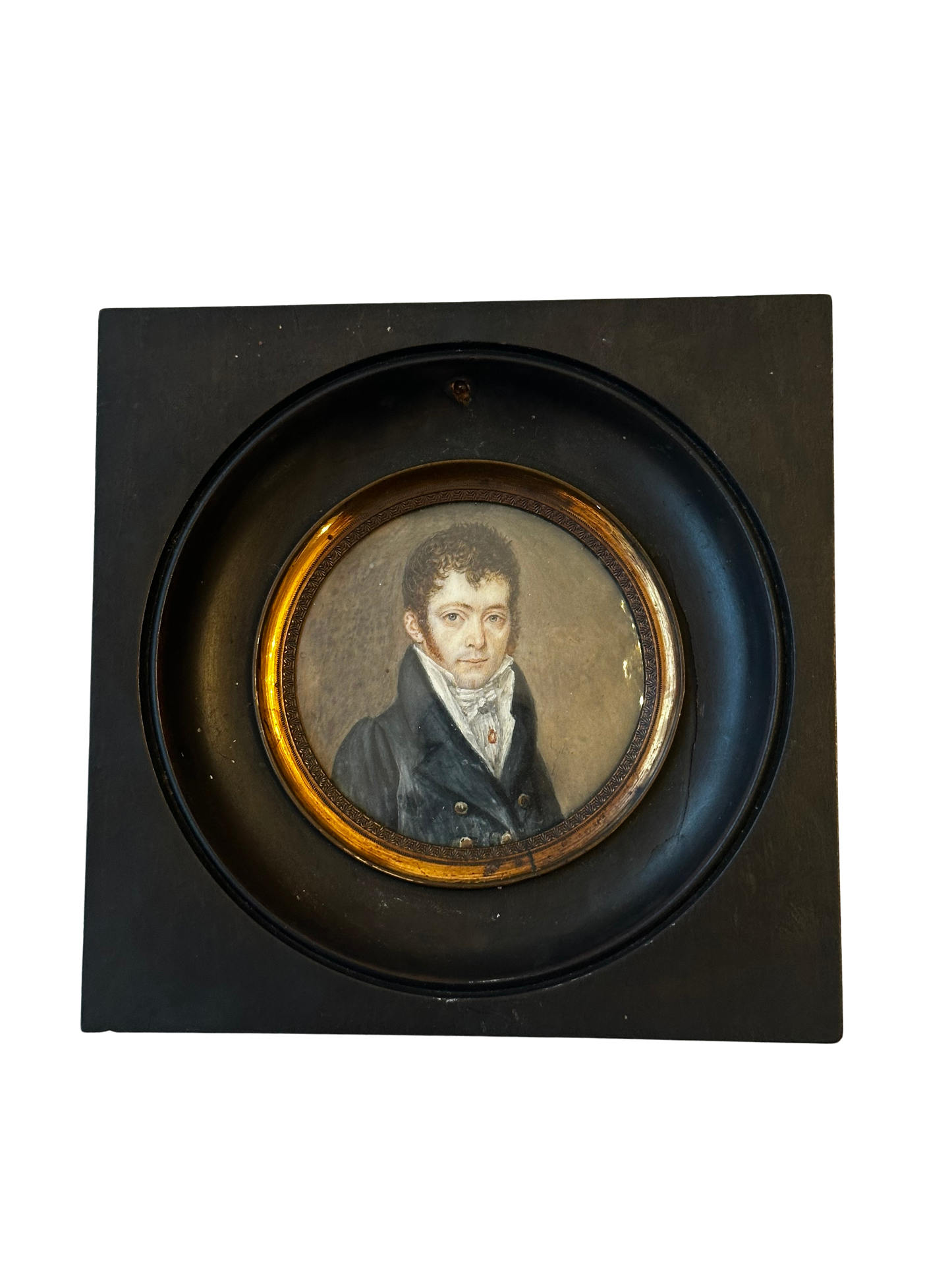
A finely executed miniature portrait of a young gentleman, shown bust-length in early 19th-century dress, wearing a dark double-breasted coat with brass-tone buttons, a high white cravat, and a small red jewel or fob at the chest. The sitter’s curling hair, elongated sideburns, and high collar are strongly characteristic of the Regency period. The painting appears to be executed in watercolor or gouache on a very thin translucent wafer, likely ivory, horn, or another delicate organic support, as shown by the way light passes through the panel in your photographs. The portrait is mounted within a later square ebonized frame with a gilt inner surround and domed glass. The painting itself has appealing delicacy in the face and costume, with stronger detail than is often found in decorative later reproductions, suggesting it began life as a true miniature rather than a printed transfer. The simple neutral ground keeps the focus on the sitter and gives the work a very intimate, personal quality typical of Georgian and Regency portrait miniatures.
Era:
Portrait likely early 19th century, circa 1810–1830; frame possibly later 19th century with subsequent wear and losses
History:
Portrait miniatures were cherished personal objects in the late 18th and early 19th centuries, often commissioned as keepsakes, betrothal tokens, or family memorial portraits. During the Regency period, male sitters were commonly shown in dark tailored coats, crisp cravats, and styled hair with pronounced side whiskers, just as seen here. Miniatures of this type were originally housed in lockets, small cases, or intimate tabletop frames, and many were later remounted into Victorian or decorative frames as collecting tastes changed. The translucency of the support is especially notable, as miniature painters often worked on very thin organic surfaces to achieve luminous flesh tones and refined detail.
Provenance:
Likely European, probably English or Continental, in the Regency taste. Exact origin and artist presently unidentified.
Materials:
Watercolor and/or gouache miniature on thin translucent organic wafer support, possibly ivory or horn; domed glass; gilt inner bezel; ebonized wood frame; metal hanging loop
Dimensions:
Leave blank
Disclaimers:
Support should be described cautiously as possibly ivory unless confirmed in hand by a specialist. The miniature shows age-related wear, surface dirt, and some visible losses or abrasions at the edges. The frame has significant condition issues including cracking, losses, finish wear, and damage to one corner on the reverse. Backing appears later and the portrait may have been remounted from an earlier setting. No artist signature visible in the provided photos. Attribution should remain as “Regency-era miniature portrait of a gentleman” rather than naming a specific sitter.
Additional Description:
A finely executed miniature portrait of a young gentleman, shown bust-length in early 19th-century dress, wearing a dark double-breasted coat with brass-tone buttons, a high white cravat, and a small red jewel or fob at the chest. The sitter’s curling hair, elongated sideburns, and high collar are strongly characteristic of the Regency period. The painting appears to be executed in watercolor or gouache on a very thin translucent wafer, likely ivory, horn, or another delicate organic support, as shown by the way light passes through the panel in your photographs. The portrait is mounted within a later square ebonized frame with a gilt inner surround and domed glass. The painting itself has appealing delicacy in the face and costume, with stronger detail than is often found in decorative later reproductions, suggesting it began life as a true miniature rather than a printed transfer. The simple neutral ground keeps the focus on the sitter and gives the work a very intimate, personal quality typical of Georgian and Regency portrait miniatures.
Era:
Portrait likely early 19th century, circa 1810–1830; frame possibly later 19th century with subsequent wear and losses
History:
Portrait miniatures were cherished personal objects in the late 18th and early 19th centuries, often commissioned as keepsakes, betrothal tokens, or family memorial portraits. During the Regency period, male sitters were commonly shown in dark tailored coats, crisp cravats, and styled hair with pronounced side whiskers, just as seen here. Miniatures of this type were originally housed in lockets, small cases, or intimate tabletop frames, and many were later remounted into Victorian or decorative frames as collecting tastes changed. The translucency of the support is especially notable, as miniature painters often worked on very thin organic surfaces to achieve luminous flesh tones and refined detail.
Provenance:
Likely European, probably English or Continental, in the Regency taste. Exact origin and artist presently unidentified.
Materials:
Watercolor and/or gouache miniature on thin translucent organic wafer support, possibly ivory or horn; domed glass; gilt inner bezel; ebonized wood frame; metal hanging loop
Dimensions:
Leave blank
Disclaimers:
Support should be described cautiously as possibly ivory unless confirmed in hand by a specialist. The miniature shows age-related wear, surface dirt, and some visible losses or abrasions at the edges. The frame has significant condition issues including cracking, losses, finish wear, and damage to one corner on the reverse. Backing appears later and the portrait may have been remounted from an earlier setting. No artist signature visible in the provided photos. Attribution should remain as “Regency-era miniature portrait of a gentleman” rather than naming a specific sitter.