


Second Empire Commemorative Medal - Napoleon III and Empress Eugenie, Exposition Universelle 1867
Second Empire Commemorative Medal - Napoleon III and Empress Eugenie, Exposition Universelle 1867
No se pudo cargar la disponibilidad de retiro
Compartir


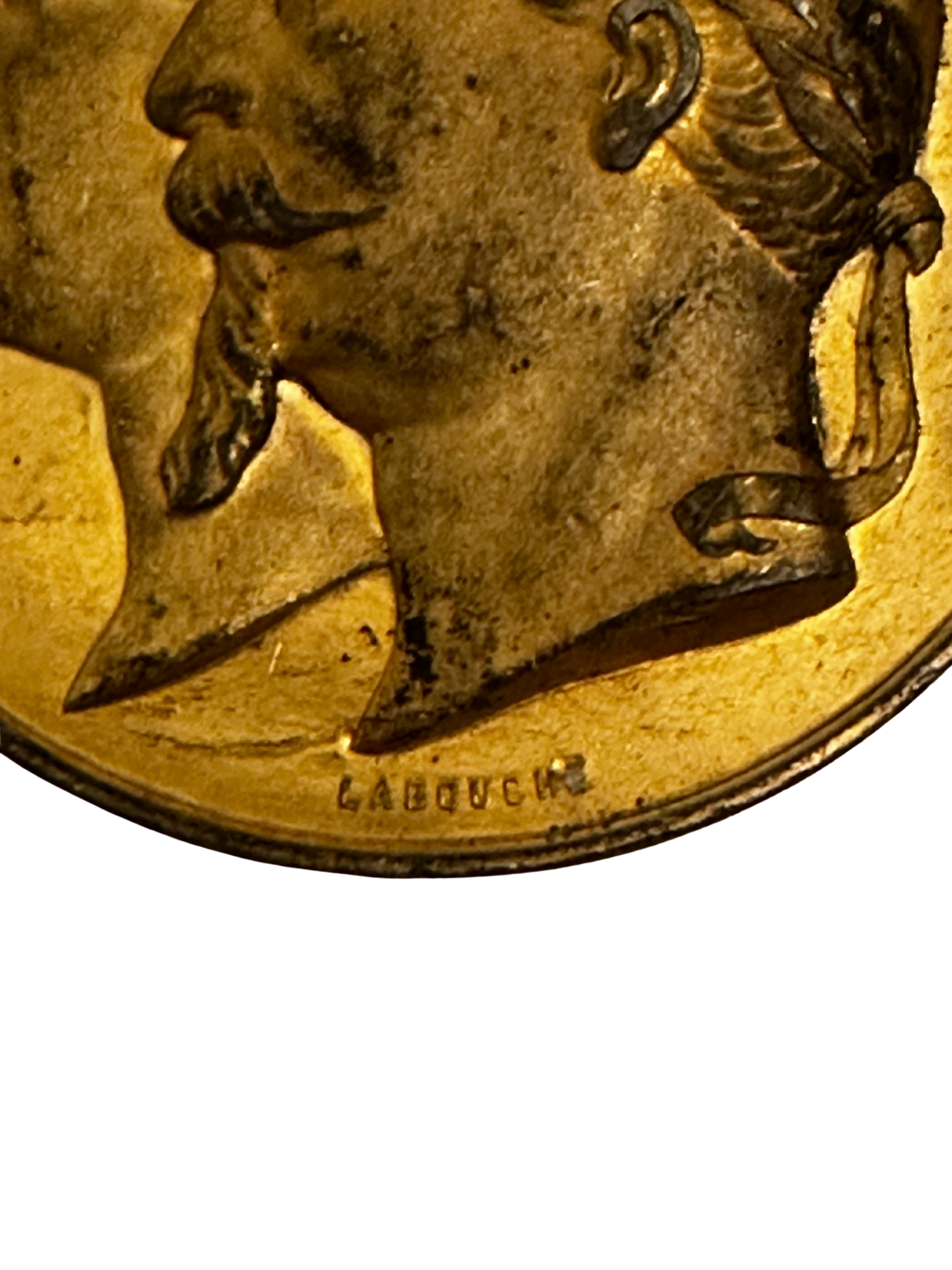
A French commemorative medal featuring conjoined profile portraits of Emperor Napoleon III wearing a laurel wreath and Empress Eugenie wearing a diadem, executed in classical medallic style. The obverse is signed "Labouche", identifying the engraver/medallist.
The reverse depicts a stylized architectural pavilion with flags flying above a fenced exhibition structure, inscribed "Exposition Universelle 1867", referencing the Paris World's Fair held during the Second French Empire.
The medal is struck in bronze with a warm aged patina and crisp relief detail.
A French commemorative medal featuring conjoined profile portraits of Emperor Napoleon III wearing a laurel wreath and Empress Eugenie wearing a diadem, executed in classical medallic style. The obverse is signed "Labouche", identifying the engraver/medallist.
The reverse depicts a stylized architectural pavilion with flags flying above a fenced exhibition structure, inscribed "Exposition Universelle 1867", referencing the Paris World's Fair held during the Second French Empire.
The medal is struck in bronze with a warm aged patina and crisp relief detail.
2"diam
2"diam
The Paris Exposition Universelle of 1867 was one of the most important international exhibitions of the 19th century. Organized under Napoleon III, the event showcased industrial progress, art, architecture, and technological innovation from around the world.
World's fairs during this period often produced commemorative medals for visitors, participants, and collectors. These medals helped promote the cultural prestige of France during the Second Empire.
Napoleon III (1808-1873), nephew of Napoleon Bonaparte, ruled France from 1852-1870 alongisde Empress Eugenie. Their portrais were frequently used on official and commemorative objects of the era. Medals from the 1867 exposition remain collectible artifacts tied to both French imperial history and development of international exhibitions.
Likely Alphee Dubois or similar medallist working for the Paris Mint, but Labouche refers to the publisher or engraver mostly likely Labouches Freres, a well-known French printing and medal-publsihing house based in Toulouse in 19th century known for producing commemorative medals and educational charts during Second Empire and early Third Republic.
The Paris Exposition Universelle of 1867 was one of the most important international exhibitions of the 19th century. Organized under Napoleon III, the event showcased industrial progress, art, architecture, and technological innovation from around the world.
World's fairs during this period often produced commemorative medals for visitors, participants, and collectors. These medals helped promote the cultural prestige of France during the Second Empire.
Napoleon III (1808-1873), nephew of Napoleon Bonaparte, ruled France from 1852-1870 alongisde Empress Eugenie. Their portrais were frequently used on official and commemorative objects of the era. Medals from the 1867 exposition remain collectible artifacts tied to both French imperial history and development of international exhibitions.
Likely Alphee Dubois or similar medallist working for the Paris Mint, but Labouche refers to the publisher or engraver mostly likely Labouches Freres, a well-known French printing and medal-publsihing house based in Toulouse in 19th century known for producing commemorative medals and educational charts during Second Empire and early Third Republic.
Second French Empire (1867)
Second French Empire (1867)
Gilt Bronze
Gilt Bronze
France
France
Surface wear and oxidation consistent with age. Patina and spotting visible across both sides.
Surface wear and oxidation consistent with age. Patina and spotting visible across both sides.