


Victorian Flow Blue Miniature Master Salt Cellar
Victorian Flow Blue Miniature Master Salt Cellar
No se pudo cargar la disponibilidad de retiro
Compartir
Additional Description:
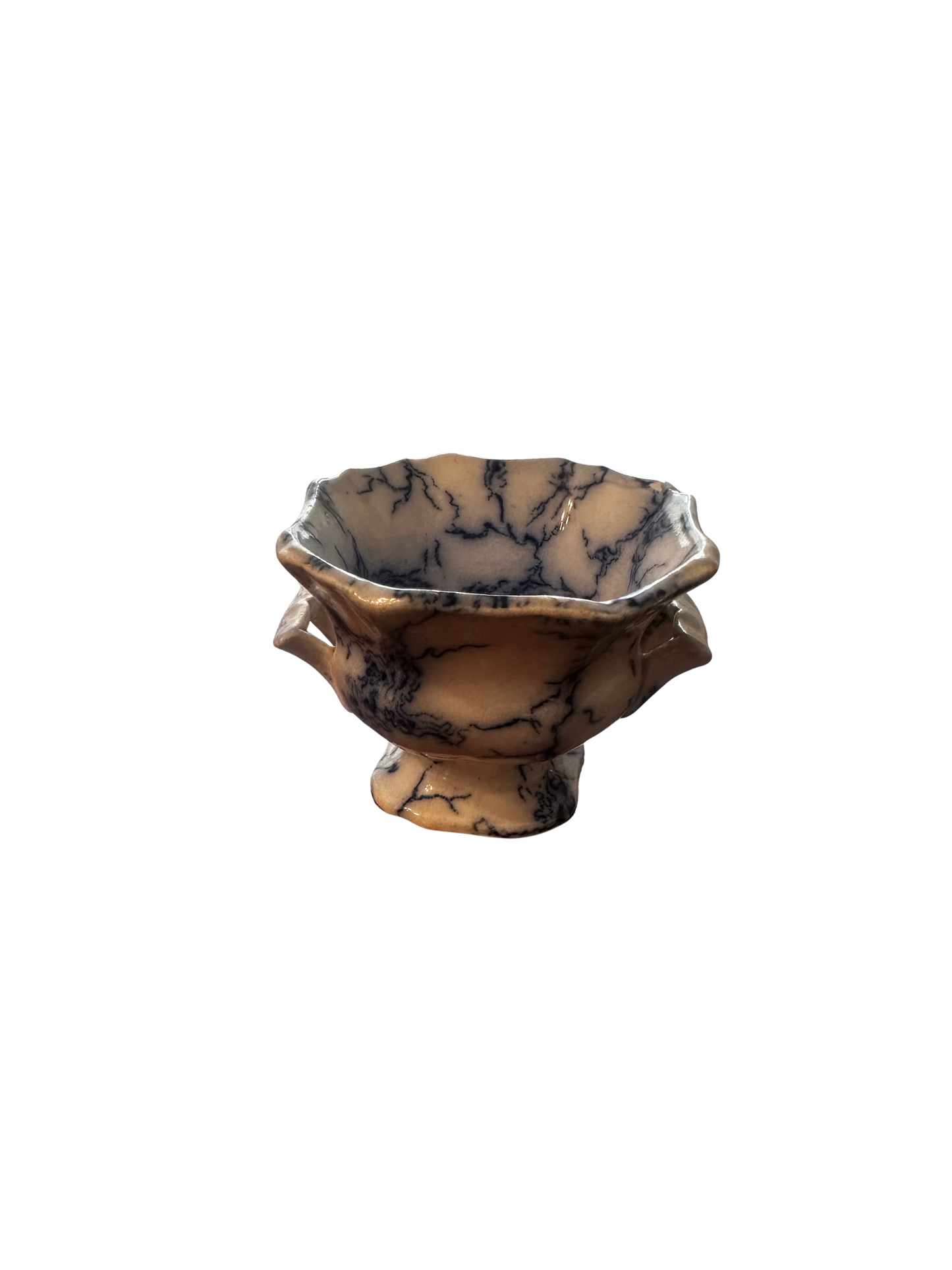
A charming Victorian miniature master salt cellar in richly mottled flow blue earthenware, likely produced in Staffordshire, England during the late 19th century. The piece features a delicately scalloped and undulating rim above a rounded bowl supported by a pedestal foot, with two small applied side lug handles adding sculptural charm and balance to the form.
The vessel is decorated in an atmospheric cobalt “flow blue” pattern, where the pigment intentionally blurred during firing to create soft marbled veining and cloud-like botanical forms across the surface. This dreamy aesthetic became highly fashionable during the Victorian period and remains especially sought after by collectors today.
Its small scale strongly suggests use as a master salt cellar or open salt, intended to sit on the dining table for communal use before the widespread adoption of individual salt dishes. The elegant pedestal form and decorative treatment elevate what would have been an everyday table accessory into a highly ornamental dining object.
The unglazed foot and soft earthenware body are consistent with English Staffordshire production of the late 19th century.
Era:
Late Victorian period, circa 1870–1900.
History:
Before modern salt shakers became standard, table salts and master salts were an important part of formal dining culture. Victorian Staffordshire potteries produced decorative open salts in a variety of fashionable ceramic styles, including the highly desirable flow blue technique. The intentionally blurred cobalt decoration became especially popular in Britain and America during the second half of the 19th century.
Provenance:
Likely Staffordshire, England.
Materials:
Glazed earthenware ceramic with cobalt flow blue decoration.
Dimensions:
[Insert dimensions]
Disclaimers:
Wear consistent with age including glaze irregularities, kiln imperfections, minor surface wear, and roughness to the unglazed foot rim. No visible maker’s mark present. Please review photographs carefully for overall condition details.
Additional Description:
A charming Victorian miniature master salt cellar in richly mottled flow blue earthenware, likely produced in Staffordshire, England during the late 19th century. The piece features a delicately scalloped and undulating rim above a rounded bowl supported by a pedestal foot, with two small applied side lug handles adding sculptural charm and balance to the form.
The vessel is decorated in an atmospheric cobalt “flow blue” pattern, where the pigment intentionally blurred during firing to create soft marbled veining and cloud-like botanical forms across the surface. This dreamy aesthetic became highly fashionable during the Victorian period and remains especially sought after by collectors today.
Its small scale strongly suggests use as a master salt cellar or open salt, intended to sit on the dining table for communal use before the widespread adoption of individual salt dishes. The elegant pedestal form and decorative treatment elevate what would have been an everyday table accessory into a highly ornamental dining object.
The unglazed foot and soft earthenware body are consistent with English Staffordshire production of the late 19th century.
Era:
Late Victorian period, circa 1870–1900.
History:
Before modern salt shakers became standard, table salts and master salts were an important part of formal dining culture. Victorian Staffordshire potteries produced decorative open salts in a variety of fashionable ceramic styles, including the highly desirable flow blue technique. The intentionally blurred cobalt decoration became especially popular in Britain and America during the second half of the 19th century.
Provenance:
Likely Staffordshire, England.
Materials:
Glazed earthenware ceramic with cobalt flow blue decoration.
Dimensions:
[Insert dimensions]
Disclaimers:
Wear consistent with age including glaze irregularities, kiln imperfections, minor surface wear, and roughness to the unglazed foot rim. No visible maker’s mark present. Please review photographs carefully for overall condition details.