


Victorian Gothic Revival Carved Walnut Griffin Corner Chair Back / Architectural Furniture Fragment
Victorian Gothic Revival Carved Walnut Griffin Corner Chair Back / Architectural Furniture Fragment
No se pudo cargar la disponibilidad de retiro
Compartir
Additional Description:
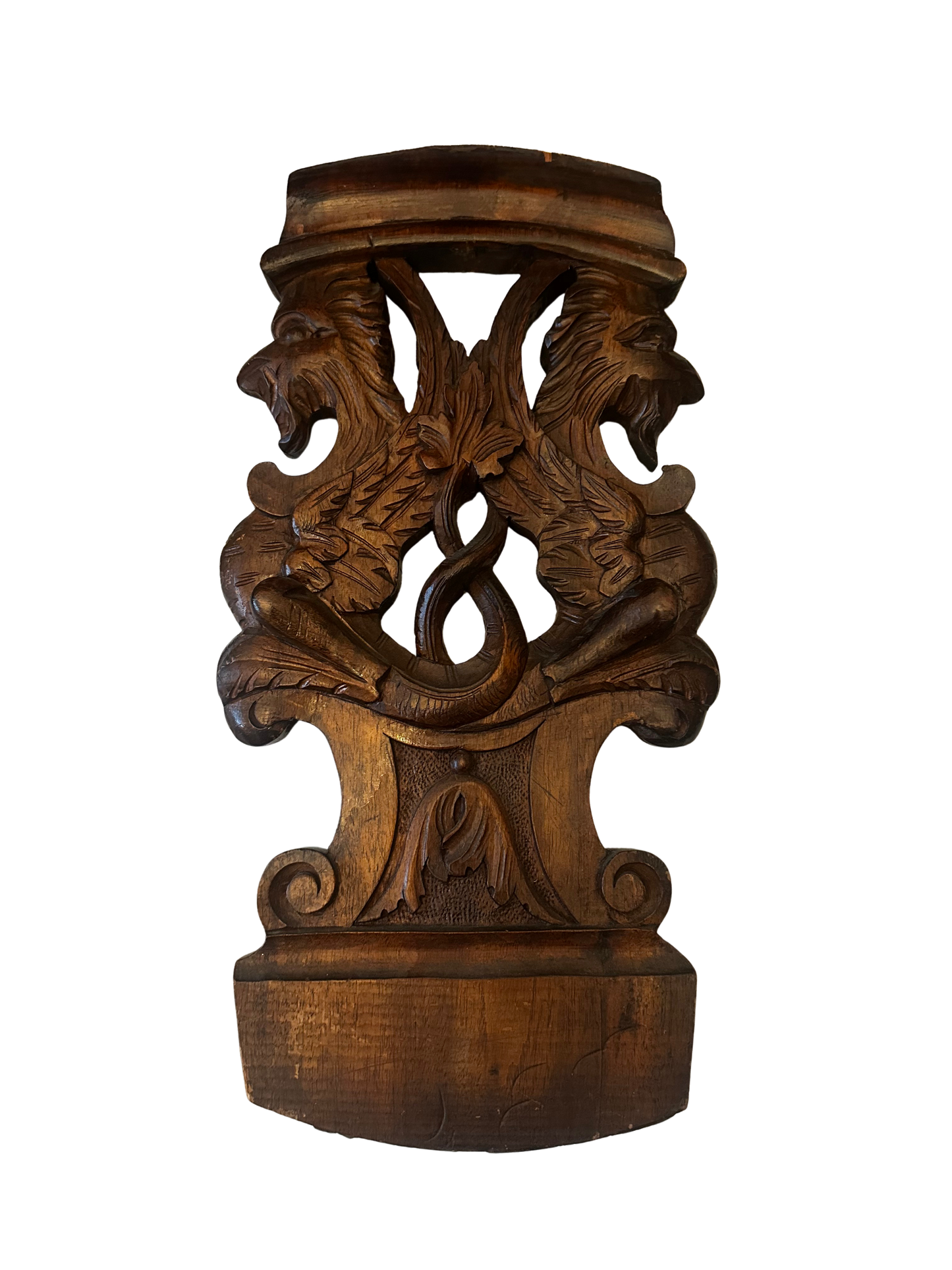
A striking Victorian Gothic Revival carved wooden furniture fragment depicting a pair of heraldic griffins or fantastical beasts flanking intertwined foliate forms and a central serpentine motif. Executed in richly carved dark-stained wood, the composition displays strong architectural symmetry with deeply incised feathering, scrolling foliage, stylized flame motifs, and expressive beast heads with open mouths.
The carving likely originated as the upper crest or back splat from a highly ornamental Victorian corner chair, hall chair, throne chair, or ecclesiastical-inspired seating form. The dramatic heraldic imagery and Gothic Revival styling strongly align with late 19th-century fascination with medievalism and romantic historic revival furniture.
The reverse reveals hand-carved tooling marks and shaping consistent with period craftsmanship rather than later machine-only production. The thick lower section and visible mounting aperture suggest it was originally tenoned or fitted into a larger furniture framework. The substantial scale and sculptural quality allow it to function beautifully today as standalone wall art or architectural décor.
The intertwined serpent-like central element combined with heraldic beasts gives the piece an almost neo-medieval or fantastical aesthetic reminiscent of Black Forest carving and Gothic Revival interiors popular in England and Continental Europe during the Victorian period.
Era:
Late 19th century, circa 1860–1890.
History:
During the Victorian era, Gothic Revival furniture became highly fashionable throughout England and Europe, inspired by medieval architecture, heraldry, and ecclesiastical ornament. Furniture makers frequently incorporated mythological beasts, griffins, dragons, and foliate carvings into hall chairs, corner chairs, and decorative seating intended for dramatic interiors.
Fragments such as this often survive after larger furniture forms were damaged or dismantled, and today are appreciated both as sculptural carvings and as authentic remnants of Victorian decorative arts.
Provenance:
Likely English or Continental European origin.
Materials:
Hand-carved walnut or dark-stained hardwood.
Dimensions:
15.5” H x 8” W x 1” D.
Disclaimers:
Antique condition with age-related wear including scratches, edge wear, small losses, surface abrasions, and evidence of former attachment to a larger furniture structure. Minor chips and wear to projecting carved elements consistent with age and use.
Additional Description:
A striking Victorian Gothic Revival carved wooden furniture fragment depicting a pair of heraldic griffins or fantastical beasts flanking intertwined foliate forms and a central serpentine motif. Executed in richly carved dark-stained wood, the composition displays strong architectural symmetry with deeply incised feathering, scrolling foliage, stylized flame motifs, and expressive beast heads with open mouths.
The carving likely originated as the upper crest or back splat from a highly ornamental Victorian corner chair, hall chair, throne chair, or ecclesiastical-inspired seating form. The dramatic heraldic imagery and Gothic Revival styling strongly align with late 19th-century fascination with medievalism and romantic historic revival furniture.
The reverse reveals hand-carved tooling marks and shaping consistent with period craftsmanship rather than later machine-only production. The thick lower section and visible mounting aperture suggest it was originally tenoned or fitted into a larger furniture framework. The substantial scale and sculptural quality allow it to function beautifully today as standalone wall art or architectural décor.
The intertwined serpent-like central element combined with heraldic beasts gives the piece an almost neo-medieval or fantastical aesthetic reminiscent of Black Forest carving and Gothic Revival interiors popular in England and Continental Europe during the Victorian period.
Era:
Late 19th century, circa 1860–1890.
History:
During the Victorian era, Gothic Revival furniture became highly fashionable throughout England and Europe, inspired by medieval architecture, heraldry, and ecclesiastical ornament. Furniture makers frequently incorporated mythological beasts, griffins, dragons, and foliate carvings into hall chairs, corner chairs, and decorative seating intended for dramatic interiors.
Fragments such as this often survive after larger furniture forms were damaged or dismantled, and today are appreciated both as sculptural carvings and as authentic remnants of Victorian decorative arts.
Provenance:
Likely English or Continental European origin.
Materials:
Hand-carved walnut or dark-stained hardwood.
Dimensions:
15.5” H x 8” W x 1” D.
Disclaimers:
Antique condition with age-related wear including scratches, edge wear, small losses, surface abrasions, and evidence of former attachment to a larger furniture structure. Minor chips and wear to projecting carved elements consistent with age and use.