

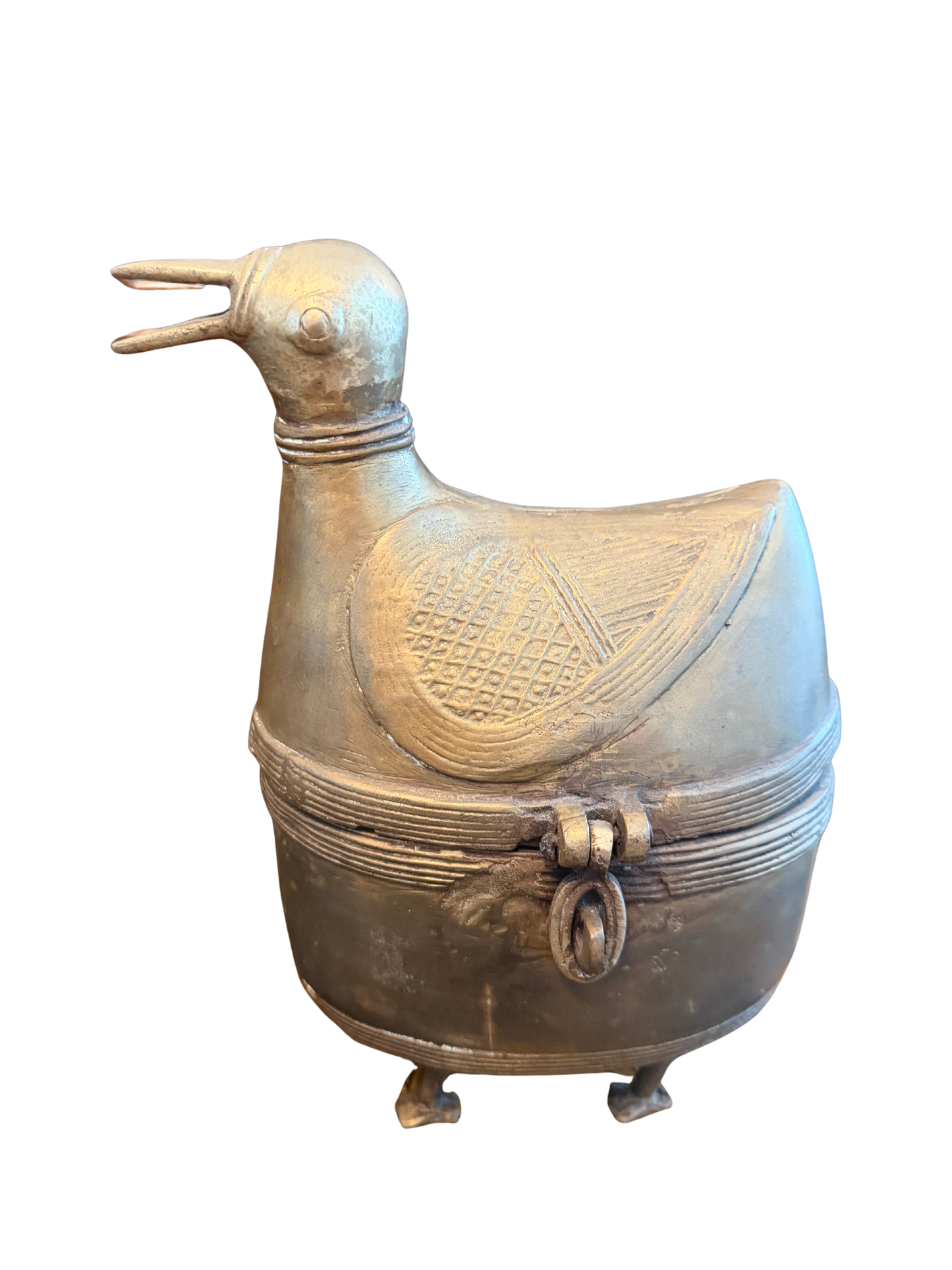
Vintage Indian Dhokra (Dokra) Hand-Cast Brass Quacking Duck-Form Casket
Vintage Indian Dhokra (Dokra) Hand-Cast Brass Quacking Duck-Form Casket
No se pudo cargar la disponibilidad de retiro
Compartir
Additional Description
A substantial hand-cast brass bird-form casket crafted in the traditional Dhokra (Dokra) lost-wax casting technique. The stylized bird features a long beak, circular eyes, incised concentric neck bands, and geometric wing decoration. The hollow body forms a lidded storage compartment with an integral hinge and loop clasp designed to accept a removable locking pin or wire closure.
Unlike many smaller tourist examples, this is a generously sized and notably heavy example with pleasing sculptural proportions and a rich naturally aged brass patina. The primitive modeling, individually finished surfaces, and slight casting irregularities are characteristic of authentic handcrafted Dhokra metalwork.
Era
Mid to Late 20th Century, circa 1960–1990
History
Dhokra (also spelled Dokra) metalwork is one of India's oldest surviving craft traditions, practiced by artisan communities across West Bengal, Odisha, Chhattisgarh, and Jharkhand. The technique utilizes the ancient lost-wax casting process, a method with roots dating back more than 4,000 years to the Indus Valley Civilization.
Each piece is individually modeled in beeswax, encased in clay, and fired so the wax melts away before molten brass is poured into the cavity. Because the mold is destroyed during casting, every Dhokra object is unique. Animal-form vessels—including birds, horses, elephants, and peacocks—became especially popular during the twentieth century, serving both decorative and functional purposes while preserving centuries-old artistic traditions.
Provenance
Private collection.
Materials
Hand-cast brass
Traditional lost-wax (cire perdue) casting
Hinged construction
Hand-finished surface
Dimensions
Height: approximately 8 inches
Other dimensions: Please add.
Disclaimers
Presents with an attractive aged brass patina.
Surface wear, oxidation, casting irregularities, and minor abrasions consistent with age and handcrafted manufacture.
Hinged lid operates properly.
Loop clasp remains intact; no locking pin is present.
Interior exhibits expected casting texture and wear from use.
No maker's marks observed.
Additional Description
A substantial hand-cast brass bird-form casket crafted in the traditional Dhokra (Dokra) lost-wax casting technique. The stylized bird features a long beak, circular eyes, incised concentric neck bands, and geometric wing decoration. The hollow body forms a lidded storage compartment with an integral hinge and loop clasp designed to accept a removable locking pin or wire closure.
Unlike many smaller tourist examples, this is a generously sized and notably heavy example with pleasing sculptural proportions and a rich naturally aged brass patina. The primitive modeling, individually finished surfaces, and slight casting irregularities are characteristic of authentic handcrafted Dhokra metalwork.
Era
Mid to Late 20th Century, circa 1960–1990
History
Dhokra (also spelled Dokra) metalwork is one of India's oldest surviving craft traditions, practiced by artisan communities across West Bengal, Odisha, Chhattisgarh, and Jharkhand. The technique utilizes the ancient lost-wax casting process, a method with roots dating back more than 4,000 years to the Indus Valley Civilization.
Each piece is individually modeled in beeswax, encased in clay, and fired so the wax melts away before molten brass is poured into the cavity. Because the mold is destroyed during casting, every Dhokra object is unique. Animal-form vessels—including birds, horses, elephants, and peacocks—became especially popular during the twentieth century, serving both decorative and functional purposes while preserving centuries-old artistic traditions.
Provenance
Private collection.
Materials
Hand-cast brass
Traditional lost-wax (cire perdue) casting
Hinged construction
Hand-finished surface
Dimensions
Height: approximately 8 inches
Other dimensions: Please add.
Disclaimers
Presents with an attractive aged brass patina.
Surface wear, oxidation, casting irregularities, and minor abrasions consistent with age and handcrafted manufacture.
Hinged lid operates properly.
Loop clasp remains intact; no locking pin is present.
Interior exhibits expected casting texture and wear from use.
No maker's marks observed.