

1847 French *Amélie ou Le Triomphe de la piété* by Madame L. Bernier — Third Edition, Ornate Blue and Gilt Romantic Cartonnage Binding, Illustrated, Alfred Mame of Tours
1847 French *Amélie ou Le Triomphe de la piété* by Madame L. Bernier — Third Edition, Ornate Blue and Gilt Romantic Cartonnage Binding, Illustrated, Alfred Mame of Tours
Couldn't load pickup availability
Share
Item Title: 1847 French *Amélie ou Le Triomphe de la piété* by Madame L. Bernier — Third Edition, Ornate Blue & Gilt Romantic Cartonnage Binding, Illustrated, Alfred Mame of Tours
Additional Description:
An exquisite mid-19th-century French literary volume, *Amélie ou Le Triomphe de la piété* (*Amélie, or The Triumph of Piety*), written by Madame L. Bernier and published in Tours, France, by the celebrated publishing house Alfred Mame et Cie in 1847.
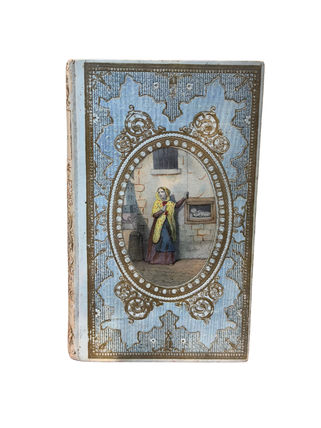
This beautiful third edition is especially distinguished by its elaborate French Romantic cartonnage binding, featuring an ivory-cream ground richly embellished with embossed gilt ornament, delicate pale blue detailing, and an exceptionally charming central pictorial medallion.
The front cover presents a striking arrangement of scrolling foliate ornament, architectural flourishes, delicate geometric patterns, and elaborate Rococo-inspired cartouches. The design is dominated by a large oval medallion framed within an ornate gilt border resembling a series of raised pearls.
Within the medallion is a delicately colored illustration depicting a woman standing beside a small wall-mounted cradle or enclosed infant's bed. Dressed in a long gown and a yellow shawl with red floral accents, she holds a suspended cord while gazing toward the infant resting within the enclosure. The intimate domestic composition evokes the themes of motherhood, charity, devotion, and religious virtue central to the book's narrative.
The illustration incorporates soft shades of yellow, blue, rose, and brown, beautifully complementing the surrounding gilt decoration.
The spine is equally attractive, featuring an elaborate arrangement of gilded foliate scrollwork, floral motifs, and architectural ornament. The title *Amélie* appears within a reserved panel, with the publisher's name, Mame et Cie of Tours, positioned toward the lower portion.
The reverse cover retains a coordinating design of intricate gold scrollwork and delicate blue decoration, centered upon a charming oval vignette depicting a small bird hovering above a flowering branch.
Internally, the volume features elegantly printed French text and finely engraved illustrations. The illustrated title page includes an evocative domestic scene of an ill child attended by several figures, accompanied by decorative calligraphy and the publisher's imprint.
The formal title page identifies the author as Madame L. Bernier, also credited with *Blanche ou l'Éducation du cœur*, and confirms the work as the third edition, published in 1847.
A beautiful surviving example of French Romantic-era publishing, combining sentimental literature, religious moral instruction, finely engraved illustrations, and the exquisite decorative artistry of mid-19th-century French bookbinding.
An especially attractive addition to a collection of antique French literature, illustrated books, Romantic cartonnages, or decorative historic bindings.
Era:
**Publication date:** 1847 — confirmed by title page.
**Edition:** Third edition (*Troisième édition*).
**Period:** French July Monarchy, during the reign of King Louis-Philippe I.
**Binding style:** French Romantic cartonnage (*cartonnage romantique*), with polychrome decoration and a central pictorial medallion.
**Place of publication:** Tours, France.
**Publisher:** Ad. Mame et Cie, Imprimeurs-Libraires.
**Author:** Madame L. Bernier.
**Full title:** *Amélie ou Le Triomphe de la piété*.
**Language:** French.
The book is an early printing of a work already in circulation by 1844. Its elaborate publisher-style binding belongs to the French Romantic decorative tradition that flourished during the middle decades of the 19th century.
The precise date of the binding itself has not been independently established, although its decoration is stylistically consistent with the period.
History:
During the first half of the 19th century, France experienced an extraordinary flourishing of illustrated literature and decorative bookbinding, particularly within the publishing industry of Tours.
Among the most influential firms was the publishing house of Alfred Mame, which became internationally recognized for producing beautifully illustrated religious, educational, historical, and literary books.
Mame's publications frequently combined engaging moral narratives with exceptionally ornate bindings, transforming books intended for young readers into decorative objects suitable for presentation and display.
The French Romantic cartonnage tradition flourished particularly during the 1840s through the 1860s, when advances in decorative bookbinding allowed publishers to produce elaborately embossed covers featuring gold ornamentation, colored designs, and central illustrations.
These luxurious bindings often incorporated motifs inspired by Rococo, Gothic, and Renaissance ornament, reflecting the broader historicist tastes of the period.
*Amélie ou Le Triomphe de la piété*, written by Madame L. Bernier, belongs to the tradition of French moral and religious literature intended to encourage virtue, compassion, charitable behavior, and Christian devotion.
Such narratives were especially popular among families and educational institutions seeking literature that combined entertainment with moral instruction.
The work's 1847 publication places it during the final years of the July Monarchy, a period characterized by the expansion of literacy, the growth of commercial publishing, and increasing demand for illustrated books.
The present volume's beautifully colored pictorial medallion and lavish gilt decoration embody the decorative ambition of French publishers during this era.
Its surviving Romantic cartonnage binding is of particular interest to collectors of 19th-century French illustrated books, representing an important intersection of literature, printing, and decorative craftsmanship.
Provenance:
Private collection.
Published in Tours, France, by Ad. Mame et Cie in 1847.
The title page confirms the volume as the third edition.
No identifiable ownership inscription, bookplate, school prize label, or library stamp is apparent in the supplied photographs.
Earlier ownership history is unknown.
Materials:
- Printed paper leaves
- Decorated publisher-style cartonnage boards
- Ivory-cream covering with embossed or impressed surface texture
- Metallic gilt ornamental decoration
- Pale blue printed or applied decorative detailing
- Central oval pictorial medallion with color decoration
- Coordinated decorative spine and rear board
- Engraved illustrations and ornamental typography
- Traditional sewn book construction, subject to verification
**Publisher:** Ad. Mame et Cie, Tours.
**Publication year:** 1847.
**Binding:** French Romantic cartonnage with pictorial medallion.
**Illustrations:** Engraved illustrations, including an illustrated title page. The precise number of plates remains to be confirmed.
Dimensions:
Exact measurements to be confirmed.
A small-to-medium-format 19th-century French volume, consistent with the illustrated books issued by Mame during the Romantic period.
Based on its proportions relative to the hand, approximate dimensions are:
- **Height:** 7–8 inches
- **Width:** 4.5–5.5 inches
- **Spine thickness:** Approximately 0.75–1 inch
These are visual estimates only. Exact measurements and the page count should be confirmed before publication.
Disclaimers/Condition:
The book retains its exceptionally attractive cream, pale blue, and gilt Romantic cartonnage binding, with much of the elaborate decorative ornament remaining beautifully defined.
The front cover displays attractive gilding and intricate embossed detail, with minor rubbing, scattered discoloration, and localized age-related wear.
The central illustrated medallion retains much of its original visual appeal, with delicate color and clearly legible details. Minor age-related surface marks and toning are visible.
The spine shows more pronounced wear, including rubbing along the joints, minor fraying, and small areas of loss or abrasion at the upper and lower extremities. The title and decorative ornament remain substantially legible.
The rear cover retains its coordinated gilt and pale blue decoration, including the attractive central bird-and-floral vignette. Minor surface marks, rubbing, and age-related discoloration are present.
The board corners and edges display wear consistent with the book's considerable age.
The interior pages exhibit scattered foxing, light staining, and general age-related toning. The title page and illustrated pages shown remain clearly legible.
An illustrated page retains what appears to be a protective tissue guard, which exhibits age-related discoloration and wrinkling.
The binding appears to retain its historic structure, although the strength of the hinges, stitching, and completeness of the text and illustrations have not been independently verified.
No significant modern alterations are immediately apparent in the supplied photographs, although restoration or historic repairs cannot be excluded without examination.
As an antique book published in 1847, the volume displays wear and imperfections consistent with nearly 180 years of age and handling.