


18th C Engraving - Campanella - The Nest
18th C Engraving - Campanella - The Nest
Couldn't load pickup availability
Share
Prints of Classical Sculpture & Architecture - Campanella - The Nest
Tree of Male Bodies
18th C
15.75" x 10.75"
Engraved on laid paper
Angelo Campanella (c. 1746–1811) as the engraver. It is almost certainly from the same suite or publication as your torso engraving — both are studies of classical fragments or sculptural ensembles, likely produced for scholarly or artistic use in the late 18th century.
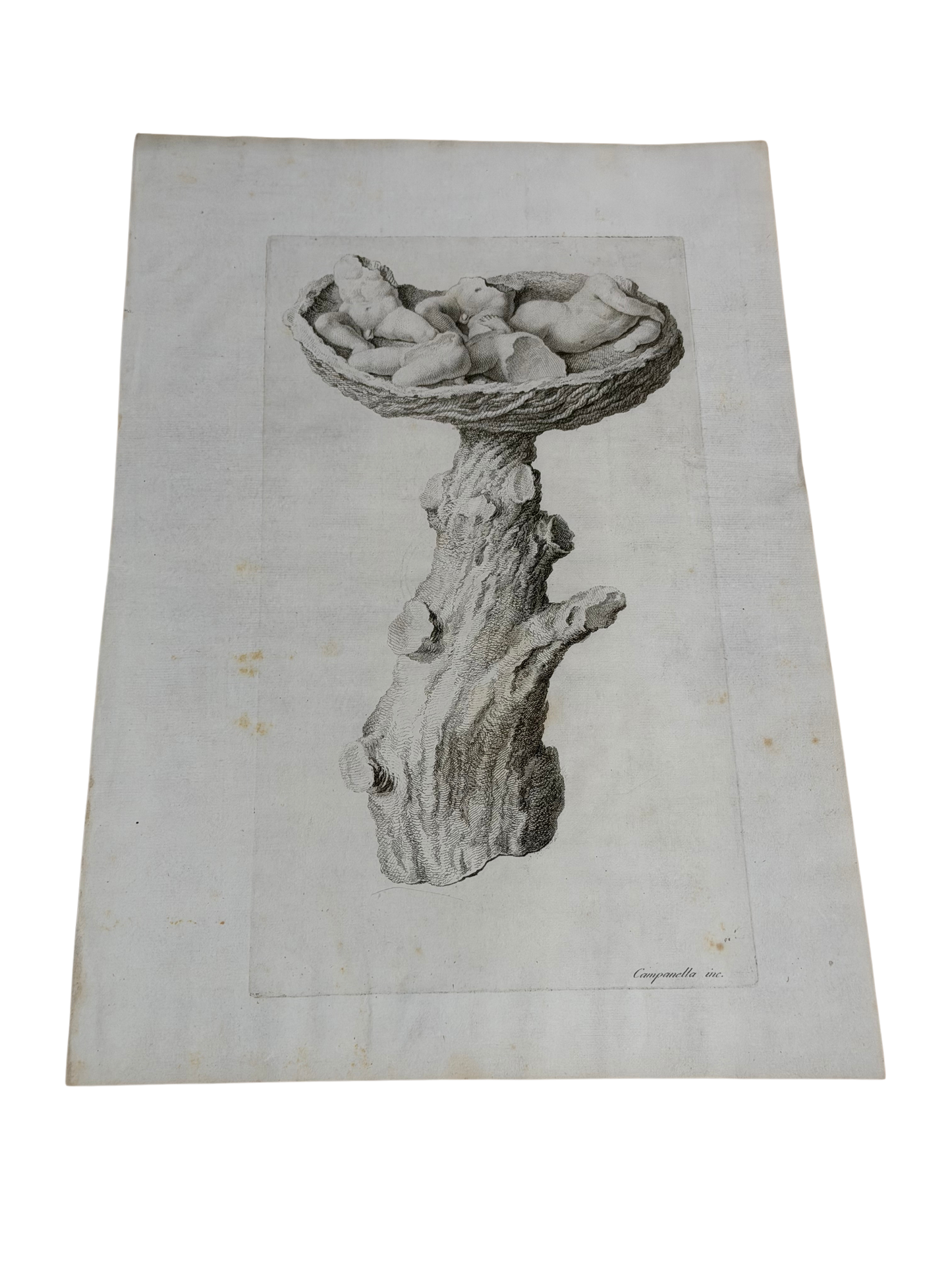
A basket or sculptural basin resting atop a textured tree-trunk pedestal, rendered in fine detail
The basin holds a pile of classical torsos and limbs, appearing like a repository of fragmented sculptures
These fragmented figures, many headless and limb-less, strongly evoke classical ruins or a sculptor’s studio full of antique casts or fragments
This image likely served as a visual metaphor or academic reference plate:
Such plates were included in catalogues of antique sculpture, or manuals for artists learning from classical forms
The tree-trunk pedestal may symbolize nature vs. artifice, or simply serve as a visually arresting way to display the fragments
It’s also possible this exact image was meant to catalog:
A specific sculptural assemblage or study model owned by a Roman academy or noble collector (common in the 18th century)
Or to serve as an allegorical composition about the ruins of Antiquity — a ""nest"" of broken ideals
Prints of Classical Sculpture & Architecture - Campanella - The Nest
Tree of Male Bodies
18th C
15.75" x 10.75"
Engraved on laid paper
Angelo Campanella (c. 1746–1811) as the engraver. It is almost certainly from the same suite or publication as your torso engraving — both are studies of classical fragments or sculptural ensembles, likely produced for scholarly or artistic use in the late 18th century.
A basket or sculptural basin resting atop a textured tree-trunk pedestal, rendered in fine detail
The basin holds a pile of classical torsos and limbs, appearing like a repository of fragmented sculptures
These fragmented figures, many headless and limb-less, strongly evoke classical ruins or a sculptor’s studio full of antique casts or fragments
This image likely served as a visual metaphor or academic reference plate:
Such plates were included in catalogues of antique sculpture, or manuals for artists learning from classical forms
The tree-trunk pedestal may symbolize nature vs. artifice, or simply serve as a visually arresting way to display the fragments
It’s also possible this exact image was meant to catalog:
A specific sculptural assemblage or study model owned by a Roman academy or noble collector (common in the 18th century)
Or to serve as an allegorical composition about the ruins of Antiquity — a ""nest"" of broken ideals