


18th Century Italian Vellum-Bound Ecclesiastical Volume – Sermoni di S. Lorenzo Giustiniani (Padua, 1750)
18th Century Italian Vellum-Bound Ecclesiastical Volume – Sermoni di S. Lorenzo Giustiniani (Padua, 1750)
Couldn't load pickup availability
Share
Additional Description:
A highly evocative and historically rich 18th-century Italian ecclesiastical volume, bound in original limp vellum and printed in Padua in 1750. This work, Sermoni di S. Lorenzo Giustiniani, presents the sermons of Saint Lorenzo Giustiniani, the first Patriarch of Venice, translated into Italian for devotional and clerical use.
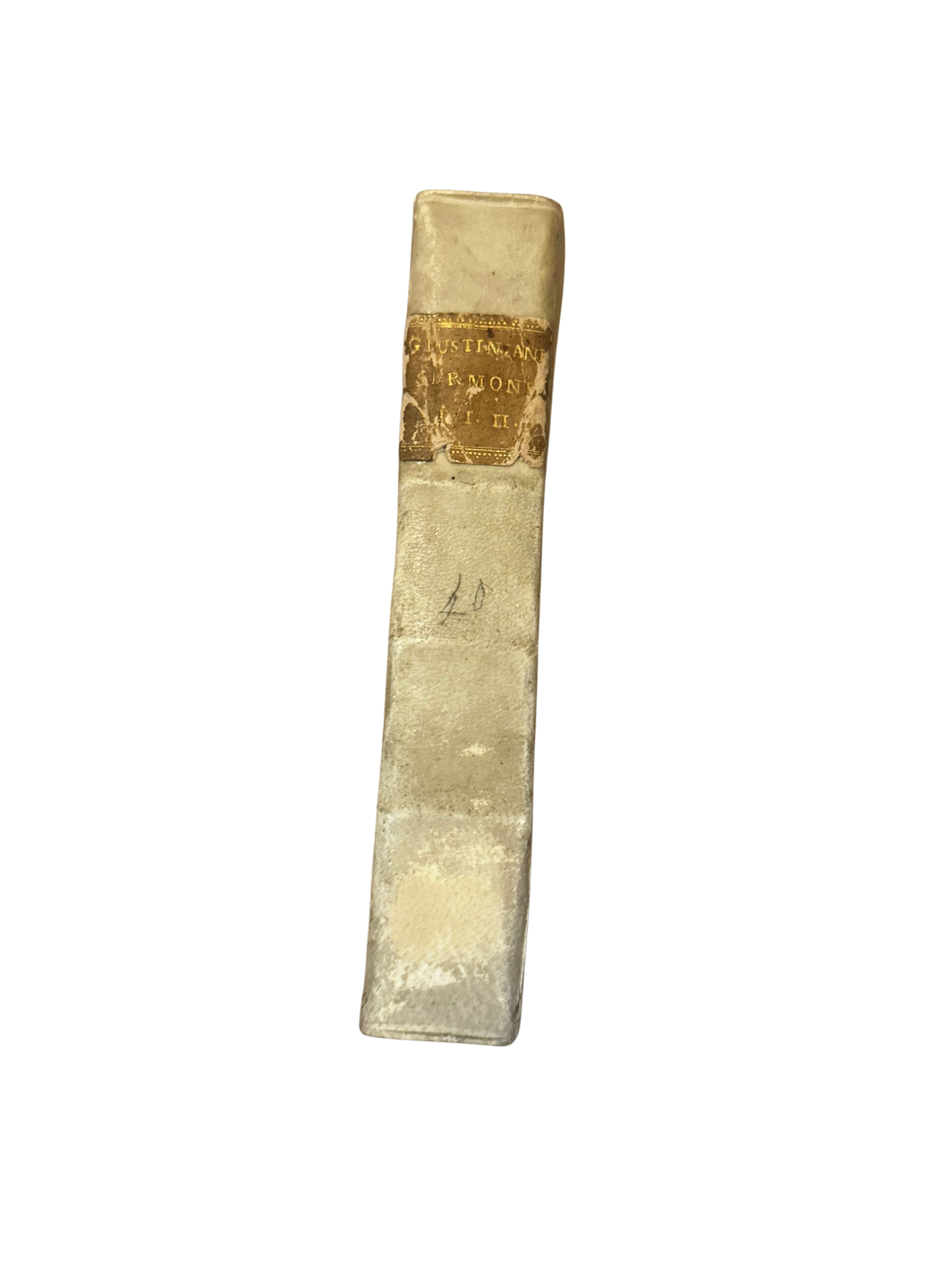
The binding is executed in traditional vellum over boards, now beautifully aged to a warm ivory tone with areas of natural patina, handling wear, and soft undulation consistent with centuries of use. The spine retains a period paper label, partially worn yet still legible, adding to its authentic character.
Internally, the book features crisp letterpress printing on laid paper, with visible chain lines and a pleasingly irregular texture. The text is set in a clear serif type with decorative elements, including a charming engraved vignette on the title page. The page edges display a rich, warm tone from age and oxidation, enhancing its visual depth.
Of particular importance is the original manuscript inscription on the front endpaper, written in iron gall ink, indicating the book’s use within a Franciscan religious community. The inscription assigns the volume to a specific friar and explicitly states its status as property of a monastic library, offering a rare and tangible connection to its institutional and devotional life.
Era:
Mid-18th Century (dated 1750)
History:
Printed in Padua in 1750, this volume reflects the continued importance of sermon literature within Catholic Europe, particularly in Italy where religious scholarship and preaching were central to both clerical training and public devotion.
Saint Lorenzo Giustiniani (1381–1456), the first Patriarch of Venice, was a significant figure in Venetian religious history, known for his theological writings and moral instruction. His sermons were widely circulated and studied well into the 18th century.
The manuscript inscription reveals that this book belonged to the Reformed Observant Franciscans (Minori Osservanti Riformati) and was housed within a monastic setting in Monselice, a historic town in the Veneto region. Such inscriptions were commonly used to regulate the circulation of books within religious communities, ensuring that volumes remained part of the communal library rather than personal possessions.
This places the book firmly within the lived intellectual and devotional practices of an 18th-century Franciscan house, where it would have been read, studied, and possibly used in sermon preparation.
Provenance:
Italy (Padua printing; Monselice Franciscan monastic use)
Retains original 18th-century manuscript inscription indicating use by a Franciscan friar and ownership by a monastic library.
Materials:
Vellum binding, laid paper, letterpress print, iron gall ink inscription
Dimensions:
[To be provided]
Disclaimers:
Wear consistent with age and use, including soiling, staining, edge wear, and minor losses to the vellum and spine label. Vellum exhibits natural warping and tonal variation. Interior pages show age toning and occasional foxing. Manuscript inscription remains legible. Structurally sound for age.
Additional Description:
A highly evocative and historically rich 18th-century Italian ecclesiastical volume, bound in original limp vellum and printed in Padua in 1750. This work, Sermoni di S. Lorenzo Giustiniani, presents the sermons of Saint Lorenzo Giustiniani, the first Patriarch of Venice, translated into Italian for devotional and clerical use.
The binding is executed in traditional vellum over boards, now beautifully aged to a warm ivory tone with areas of natural patina, handling wear, and soft undulation consistent with centuries of use. The spine retains a period paper label, partially worn yet still legible, adding to its authentic character.
Internally, the book features crisp letterpress printing on laid paper, with visible chain lines and a pleasingly irregular texture. The text is set in a clear serif type with decorative elements, including a charming engraved vignette on the title page. The page edges display a rich, warm tone from age and oxidation, enhancing its visual depth.
Of particular importance is the original manuscript inscription on the front endpaper, written in iron gall ink, indicating the book’s use within a Franciscan religious community. The inscription assigns the volume to a specific friar and explicitly states its status as property of a monastic library, offering a rare and tangible connection to its institutional and devotional life.
Era:
Mid-18th Century (dated 1750)
History:
Printed in Padua in 1750, this volume reflects the continued importance of sermon literature within Catholic Europe, particularly in Italy where religious scholarship and preaching were central to both clerical training and public devotion.
Saint Lorenzo Giustiniani (1381–1456), the first Patriarch of Venice, was a significant figure in Venetian religious history, known for his theological writings and moral instruction. His sermons were widely circulated and studied well into the 18th century.
The manuscript inscription reveals that this book belonged to the Reformed Observant Franciscans (Minori Osservanti Riformati) and was housed within a monastic setting in Monselice, a historic town in the Veneto region. Such inscriptions were commonly used to regulate the circulation of books within religious communities, ensuring that volumes remained part of the communal library rather than personal possessions.
This places the book firmly within the lived intellectual and devotional practices of an 18th-century Franciscan house, where it would have been read, studied, and possibly used in sermon preparation.
Provenance:
Italy (Padua printing; Monselice Franciscan monastic use)
Retains original 18th-century manuscript inscription indicating use by a Franciscan friar and ownership by a monastic library.
Materials:
Vellum binding, laid paper, letterpress print, iron gall ink inscription
Dimensions:
[To be provided]
Disclaimers:
Wear consistent with age and use, including soiling, staining, edge wear, and minor losses to the vellum and spine label. Vellum exhibits natural warping and tonal variation. Interior pages show age toning and occasional foxing. Manuscript inscription remains legible. Structurally sound for age.