


1910 Benedetto Croce Problemi di Estetica — First Edition, Bari, Laterza, with Calvin S. Brown Provenance
1910 Benedetto Croce Problemi di Estetica — First Edition, Bari, Laterza, with Calvin S. Brown Provenance
Couldn't load pickup availability
Share


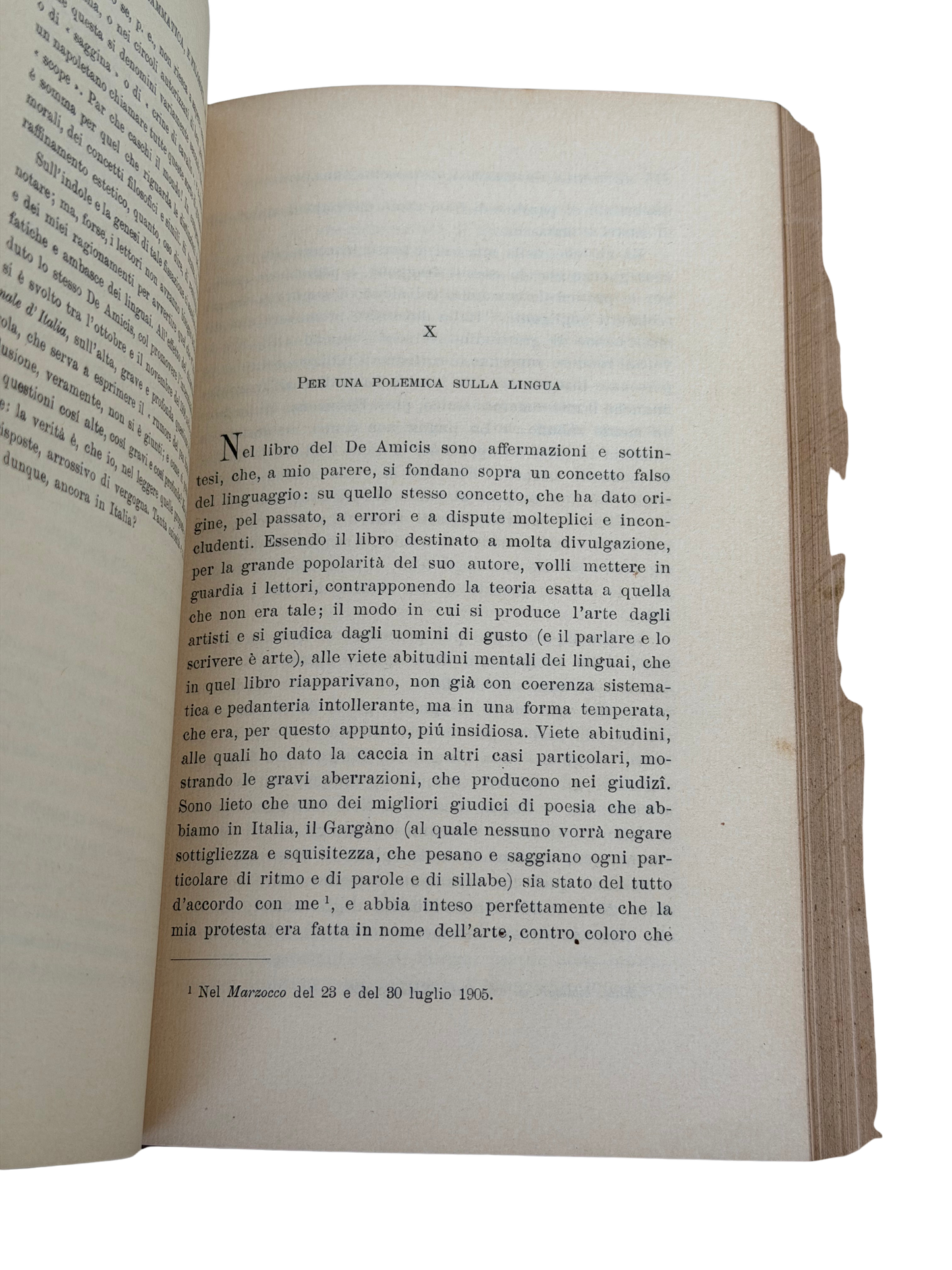
An appealing first edition of Italian philosopher and historian Benedetto Croce’s Problemi di estetica e contributi alla storia dell’estetica italiana, published in Bari by Gius. Laterza & Figli in 1910.
An important work in the development of Croce’s philosophy of aesthetics, the volume is especially interesting for its academic provenance. It bears a handwritten ownership inscription reading “Calvin S. Brown, 1915” and later institutional markings from the University of Texas at Dallas Library.
The book retains an attractive period quarter-leather binding with marbled paper boards, gilt spine lettering and decoration, raised bands, and hand-marbled endpapers.
The title page reads:
Benedetto Croce
Problemi di Estetica
e contributi alla storia dell’estetica italiana
Bari
Gius. Laterza & Figli
1910
Bibliographic records confirm that the work was first published by Laterza in Bari in 1910 and contains approximately 513 pages. It became the first volume in Croce’s series Saggi filosofici.
The volume gathers essays in which Croce developed, defended, and refined his highly influential philosophy of art and aesthetic expression. Subjects include literary and artistic criticism, the nature of intuition and expression, historical aesthetics, and the relationship between artistic creation and criticism.
The binding is in quarter brown leather over marbled paper-covered boards, with raised spine bands and gilt rules and lettering. The interior retains striking hand-marbled endpapers in cream, black, red, and yellow.
A handwritten inscription on an interior leaf reads:
“Calvin S. Brown, 1915.”
The volume later entered an institutional collection and bears UTD Library stamps to the title page and upper page edge, along with former shelf or catalog markings.
An appealing first edition of Italian philosopher and historian Benedetto Croce’s Problemi di estetica e contributi alla storia dell’estetica italiana, published in Bari by Gius. Laterza & Figli in 1910.
An important work in the development of Croce’s philosophy of aesthetics, the volume is especially interesting for its academic provenance. It bears a handwritten ownership inscription reading “Calvin S. Brown, 1915” and later institutional markings from the University of Texas at Dallas Library.
The book retains an attractive period quarter-leather binding with marbled paper boards, gilt spine lettering and decoration, raised bands, and hand-marbled endpapers.
The title page reads:
Benedetto Croce
Problemi di Estetica
e contributi alla storia dell’estetica italiana
Bari
Gius. Laterza & Figli
1910
Bibliographic records confirm that the work was first published by Laterza in Bari in 1910 and contains approximately 513 pages. It became the first volume in Croce’s series Saggi filosofici.
The volume gathers essays in which Croce developed, defended, and refined his highly influential philosophy of art and aesthetic expression. Subjects include literary and artistic criticism, the nature of intuition and expression, historical aesthetics, and the relationship between artistic creation and criticism.
The binding is in quarter brown leather over marbled paper-covered boards, with raised spine bands and gilt rules and lettering. The interior retains striking hand-marbled endpapers in cream, black, red, and yellow.
A handwritten inscription on an interior leaf reads:
“Calvin S. Brown, 1915.”
The volume later entered an institutional collection and bears UTD Library stamps to the title page and upper page edge, along with former shelf or catalog markings.
8.5"h x 5.5"w x 1.5"d
8.5"h x 5.5"w x 1.5"d
Benedetto Croce (1866–1952) was one of the most influential Italian philosophers, historians, literary critics, and intellectuals of the late 19th and early 20th centuries.
Croce developed an extensive philosophical system encompassing aesthetics, logic, history, and ethics. His aesthetic theory placed particular emphasis on intuition and expression, arguing that artistic creation is fundamentally an expressive form of knowledge rather than merely an exercise in technique or imitation.
His earlier Estetica come scienza dell’espressione e linguistica generale, first published in 1902, established the foundation of his aesthetic philosophy. Problemi di estetica, issued in 1910, served as a collection of supplementary essays addressing specific questions, criticisms, and developments arising from that system. Croce himself later described the book as a supplementary collection dealing with the “minor problems” and objections surrounding his aesthetic theory.
Among the important essays included is “L’intuizione pura e il carattere lirico dell’arte,” originally presented at the 1908 International Congress of Philosophy at Heidelberg.
The work therefore represents an important early stage in the development of one of the most significant aesthetic philosophies of the 20th century.
Benedetto Croce (1866–1952) was one of the most influential Italian philosophers, historians, literary critics, and intellectuals of the late 19th and early 20th centuries.
Croce developed an extensive philosophical system encompassing aesthetics, logic, history, and ethics. His aesthetic theory placed particular emphasis on intuition and expression, arguing that artistic creation is fundamentally an expressive form of knowledge rather than merely an exercise in technique or imitation.
His earlier Estetica come scienza dell’espressione e linguistica generale, first published in 1902, established the foundation of his aesthetic philosophy. Problemi di estetica, issued in 1910, served as a collection of supplementary essays addressing specific questions, criticisms, and developments arising from that system. Croce himself later described the book as a supplementary collection dealing with the “minor problems” and objections surrounding his aesthetic theory.
Among the important essays included is “L’intuizione pura e il carattere lirico dell’arte,” originally presented at the 1908 International Congress of Philosophy at Heidelberg.
The work therefore represents an important early stage in the development of one of the most significant aesthetic philosophies of the 20th century.
Early 20th Century Published: 1910 Bari, Italy First Edition Bibliographic sources identify 1910 as the first edition, with subsequent editions appearing in 1923, 1940, 1949, 1954, and later.
Early 20th Century Published: 1910 Bari, Italy First Edition Bibliographic sources identify 1910 as the first edition, with subsequent editions appearing in 1923, 1940, 1949, 1954, and later.
Printed paper
Quarter leather binding
Marbled paper-covered boards
Raised spine bands
Gilt spine lettering and decoration
Hand-marbled paper endpapers
Sewn text block
Printed paper
Quarter leather binding
Marbled paper-covered boards
Raised spine bands
Gilt spine lettering and decoration
Hand-marbled paper endpapers
Sewn text block
The most intriguing feature of this copy is the handwritten ownership inscription:
“Calvin S. Brown, 1915.”
There were two closely related scholars named Calvin S. Brown who are potentially relevant to the inscription.
Calvin Smith Brown Jr. (1866–1945) was an American professor and scholar of modern languages and comparative literature. He studied at Vanderbilt and later at the Universities of Paris and Leipzig, earned a Ph.D. in comparative literature, and taught French, German, and Italian at the University of Mississippi, eventually chairing its Department of Modern Languages.
His son, Calvin Smith Brown III (1909–1989), later became a distinguished comparative literature scholar at the University of Georgia and an influential pioneer in the interdisciplinary study of literature and music. Because the inscription is dated 1915, when the younger Brown would have been approximately six years old, the elder Calvin Smith Brown is the substantially more plausible candidate if the inscription relates to this academic family.
The elder Brown’s specialization in Romance languages, Italian, and comparative literature makes ownership of a first-edition Italian philosophical work such as Croce’s particularly plausible. However, the handwriting has not been independently matched to authenticated examples, so the attribution should remain tentative rather than definitive.
The book subsequently entered the University of Texas at Dallas Library, as indicated by prominent institutional stamps on the title page and upper page edge. A removed or partially removed library label is visible on the rear board.
The most intriguing feature of this copy is the handwritten ownership inscription:
“Calvin S. Brown, 1915.”
There were two closely related scholars named Calvin S. Brown who are potentially relevant to the inscription.
Calvin Smith Brown Jr. (1866–1945) was an American professor and scholar of modern languages and comparative literature. He studied at Vanderbilt and later at the Universities of Paris and Leipzig, earned a Ph.D. in comparative literature, and taught French, German, and Italian at the University of Mississippi, eventually chairing its Department of Modern Languages.
His son, Calvin Smith Brown III (1909–1989), later became a distinguished comparative literature scholar at the University of Georgia and an influential pioneer in the interdisciplinary study of literature and music. Because the inscription is dated 1915, when the younger Brown would have been approximately six years old, the elder Calvin Smith Brown is the substantially more plausible candidate if the inscription relates to this academic family.
The elder Brown’s specialization in Romance languages, Italian, and comparative literature makes ownership of a first-edition Italian philosophical work such as Croce’s particularly plausible. However, the handwriting has not been independently matched to authenticated examples, so the attribution should remain tentative rather than definitive.
The book subsequently entered the University of Texas at Dallas Library, as indicated by prominent institutional stamps on the title page and upper page edge. A removed or partially removed library label is visible on the rear board.
Antique condition with visible wear consistent with age, use, and former institutional ownership.
The leather spine displays rubbing, scratches, abrasions, fading, and surface losses, with additional wear at the spine head and tail. Gilt lettering and decorative tooling remain visible but show age-related fading.
The marbled paper boards exhibit rubbing, scratches, edge wear, losses, and bumped corners. A former library label or label residue is present on the rear board.
The page edges display toning, soiling, and institutional markings. Interior pages show age-related toning, foxing, spotting, handling marks, and occasional minor staining.
Institutional markings include UTD Library stamps, catalog or shelf inscriptions, and other evidence of former library ownership.
The handwritten “Calvin S. Brown, 1915” inscription is historic, but the identity of the signer has not been conclusively authenticated. While the elder Calvin Smith Brown is a compelling possibility based on name, date, and scholarly field, no definitive attribution is made.
No page-by-page collation has been completed, and completeness should not be assumed beyond what is visible in the photographs.
As with all antique books, additional minor flaws, annotations, repairs, or signs of historic use may be present.
Antique condition with visible wear consistent with age, use, and former institutional ownership.
The leather spine displays rubbing, scratches, abrasions, fading, and surface losses, with additional wear at the spine head and tail. Gilt lettering and decorative tooling remain visible but show age-related fading.
The marbled paper boards exhibit rubbing, scratches, edge wear, losses, and bumped corners. A former library label or label residue is present on the rear board.
The page edges display toning, soiling, and institutional markings. Interior pages show age-related toning, foxing, spotting, handling marks, and occasional minor staining.
Institutional markings include UTD Library stamps, catalog or shelf inscriptions, and other evidence of former library ownership.
The handwritten “Calvin S. Brown, 1915” inscription is historic, but the identity of the signer has not been conclusively authenticated. While the elder Calvin Smith Brown is a compelling possibility based on name, date, and scholarly field, no definitive attribution is made.
No page-by-page collation has been completed, and completeness should not be assumed beyond what is visible in the photographs.
As with all antique books, additional minor flaws, annotations, repairs, or signs of historic use may be present.