


1948 Signed Church Interior with Stained Glass, Oil on Canvas by J. Patay
1948 Signed Church Interior with Stained Glass, Oil on Canvas by J. Patay
Couldn't load pickup availability
Share
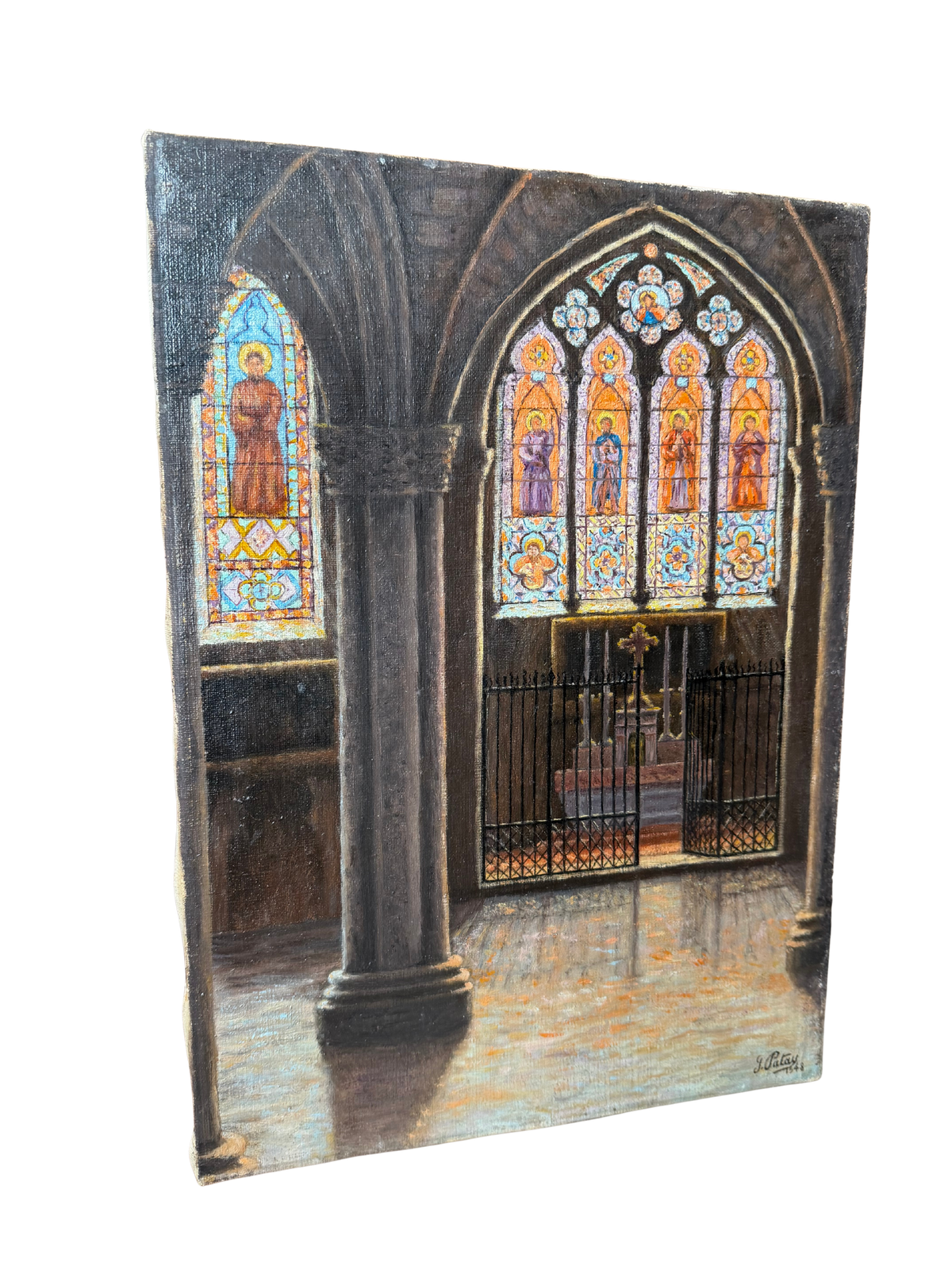
A striking mid-century oil on canvas depicting the interior of a Gothic church or chapel, signed “J. Patay” and dated 1948 at the lower right.
The composition looks toward a small gated altar or devotional chapel framed by heavy stone piers and pointed Gothic arches. The otherwise shadowed interior is illuminated by richly colored stained-glass windows in jewel tones of orange, turquoise, violet, blue, and gold. The principal window contains a series of haloed saints arranged beneath Gothic canopies, while a narrower lancet window at left depicts a single standing saint.
Particularly effective is the contrast between the dark architectural interior and the brilliantly colored glass. The artist has used relatively loose, textured brushwork for the stone and floor while treating the stained glass with much finer linear detail, including individual lead lines, floral tracery, haloed figures, and decorative quatrefoils.
A wrought-iron screen encloses the altar at center, where a gilt cross catches the limited interior light. The perspective of the columns and receding pavement gives the work a quiet, almost contemplative atmosphere.
Signed lower right:
“J. Patay”
1948
The canvas remains on its original-looking wooden stretcher.
Era
Mid-20th century, dated 1948
Likely Continental European.
History
Church interiors became a particularly evocative subject for European painters during the first half of the 20th century, allowing artists to contrast monumental medieval architecture with the changing effects of colored light.
The detailed stained-glass program here suggests that the artist was working from observation rather than inventing a generalized Gothic interior. The inclusion of individual saints, decorative glazing, ironwork, altar furnishings, and architectural details may eventually allow the specific church to be identified.
I searched for a documented painter working as “J. Patay” around 1948 but did not find a secure identification matching this signature. There were artists with the surname Patay active during the period—including Hungarian painter and graphic artist Éva Patay (1900–1984), who began exhibiting in 1948—but the signature and initial on this work do not provide sufficient evidence to attribute the painting to her or another known Patay artist.
Provenance
Private collection.
Signed and dated lower right:
“J. Patay / 1948.”
Artist otherwise unidentified.
Materials
Oil on canvas
Original or period wooden stretcher
Unframed.
Dimensions
Please add physical measurements:
Canvas: ___" H × ___" W
Condition
Good vintage condition consistent with age. The canvas remains mounted to its wooden stretcher and displays expected surface wear and minor age-related irregularities. There are scattered abrasions and small areas of paint loss, particularly around the outer edges where the work was likely previously framed. The painted surface shows some accumulated surface grime and minor rubbing.
The canvas edges and tacking margins show age-related wear. No major tears are visible in the photographs provided.
Please review all photographs closely, as they form an important part of the condition description.
Disclaimers
The signature is read as “J. Patay” and the date as 1948.
The artist has not been conclusively identified. Although artists bearing the Patay surname were active in Europe during this period, no attribution to a specific documented artist is presently made.
The church or chapel represented has not yet been identified.
A striking mid-century oil on canvas depicting the interior of a Gothic church or chapel, signed “J. Patay” and dated 1948 at the lower right.
The composition looks toward a small gated altar or devotional chapel framed by heavy stone piers and pointed Gothic arches. The otherwise shadowed interior is illuminated by richly colored stained-glass windows in jewel tones of orange, turquoise, violet, blue, and gold. The principal window contains a series of haloed saints arranged beneath Gothic canopies, while a narrower lancet window at left depicts a single standing saint.
Particularly effective is the contrast between the dark architectural interior and the brilliantly colored glass. The artist has used relatively loose, textured brushwork for the stone and floor while treating the stained glass with much finer linear detail, including individual lead lines, floral tracery, haloed figures, and decorative quatrefoils.
A wrought-iron screen encloses the altar at center, where a gilt cross catches the limited interior light. The perspective of the columns and receding pavement gives the work a quiet, almost contemplative atmosphere.
Signed lower right:
“J. Patay”
1948
The canvas remains on its original-looking wooden stretcher.
Era
Mid-20th century, dated 1948
Likely Continental European.
History
Church interiors became a particularly evocative subject for European painters during the first half of the 20th century, allowing artists to contrast monumental medieval architecture with the changing effects of colored light.
The detailed stained-glass program here suggests that the artist was working from observation rather than inventing a generalized Gothic interior. The inclusion of individual saints, decorative glazing, ironwork, altar furnishings, and architectural details may eventually allow the specific church to be identified.
I searched for a documented painter working as “J. Patay” around 1948 but did not find a secure identification matching this signature. There were artists with the surname Patay active during the period—including Hungarian painter and graphic artist Éva Patay (1900–1984), who began exhibiting in 1948—but the signature and initial on this work do not provide sufficient evidence to attribute the painting to her or another known Patay artist.
Provenance
Private collection.
Signed and dated lower right:
“J. Patay / 1948.”
Artist otherwise unidentified.
Materials
Oil on canvas
Original or period wooden stretcher
Unframed.
Dimensions
Please add physical measurements:
Canvas: ___" H × ___" W
Condition
Good vintage condition consistent with age. The canvas remains mounted to its wooden stretcher and displays expected surface wear and minor age-related irregularities. There are scattered abrasions and small areas of paint loss, particularly around the outer edges where the work was likely previously framed. The painted surface shows some accumulated surface grime and minor rubbing.
The canvas edges and tacking margins show age-related wear. No major tears are visible in the photographs provided.
Please review all photographs closely, as they form an important part of the condition description.
Disclaimers
The signature is read as “J. Patay” and the date as 1948.
The artist has not been conclusively identified. Although artists bearing the Patay surname were active in Europe during this period, no attribution to a specific documented artist is presently made.
The church or chapel represented has not yet been identified.