

19th C French Table Jardiniere/Centerpiece with Ormolu Caging
19th C French Table Jardiniere/Centerpiece with Ormolu Caging
Couldn't load pickup availability
Share
Small Glass Jardiniere with Gold Bow Caging
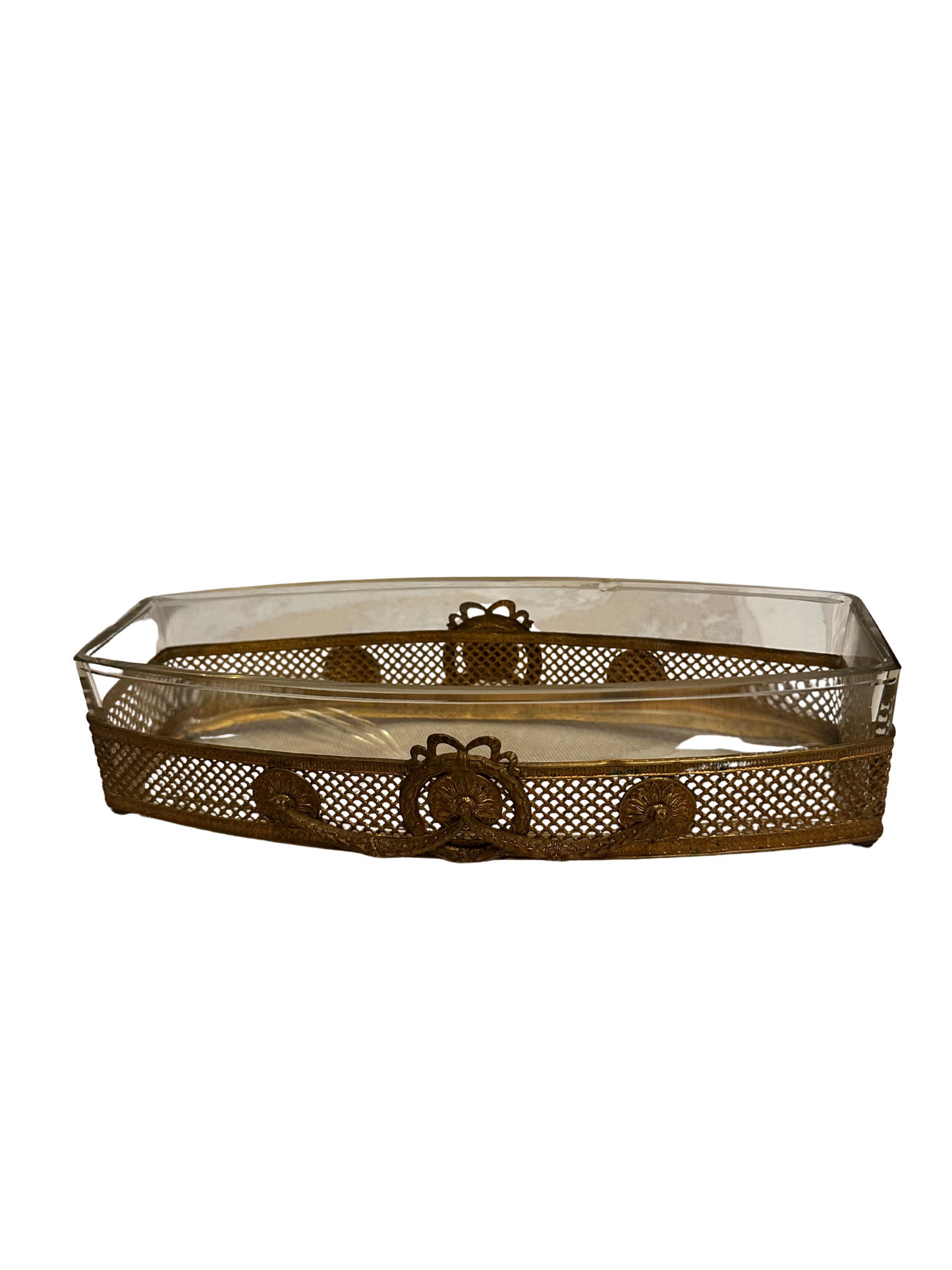
Empire / Restauration French Ormolu & Cut Glass Centerpiece Trough (Jardinière / Surtout de Table Element)
France, c. 1810–1835
Ormolu (gilded bronze), not brass. The color is the slightly warm gold of mercury gilding — the real thing.
Empire wreath-and-sunburst medallions, joined by laurel swags — these are pure Napoleonic vocabulary.
The basket-weave (vannerie) pattern is directly associated with Empire/Restauration table ware.
The tiny toupie feet (turned bun feet) are early 19th-century French table object feet.
The shape (elongated, slightly boat-like) is characteristic of table centerpiece liners used for: flowers, oranges/citrus, small floral clusters, or placed inside larger ormolu mirrored plats (surtouts de table)
The chip is unfortunately real damage
Small Glass Jardiniere with Gold Bow Caging
Empire / Restauration French Ormolu & Cut Glass Centerpiece Trough (Jardinière / Surtout de Table Element)
France, c. 1810–1835
Ormolu (gilded bronze), not brass. The color is the slightly warm gold of mercury gilding — the real thing.
Empire wreath-and-sunburst medallions, joined by laurel swags — these are pure Napoleonic vocabulary.
The basket-weave (vannerie) pattern is directly associated with Empire/Restauration table ware.
The tiny toupie feet (turned bun feet) are early 19th-century French table object feet.
The shape (elongated, slightly boat-like) is characteristic of table centerpiece liners used for: flowers, oranges/citrus, small floral clusters, or placed inside larger ormolu mirrored plats (surtouts de table)
The chip is unfortunately real damage