

19th C Portrait Miniature of a Seated Lady in Oval Giltwood Frame
19th C Portrait Miniature of a Seated Lady in Oval Giltwood Frame
Couldn't load pickup availability
Share
Additional Description:
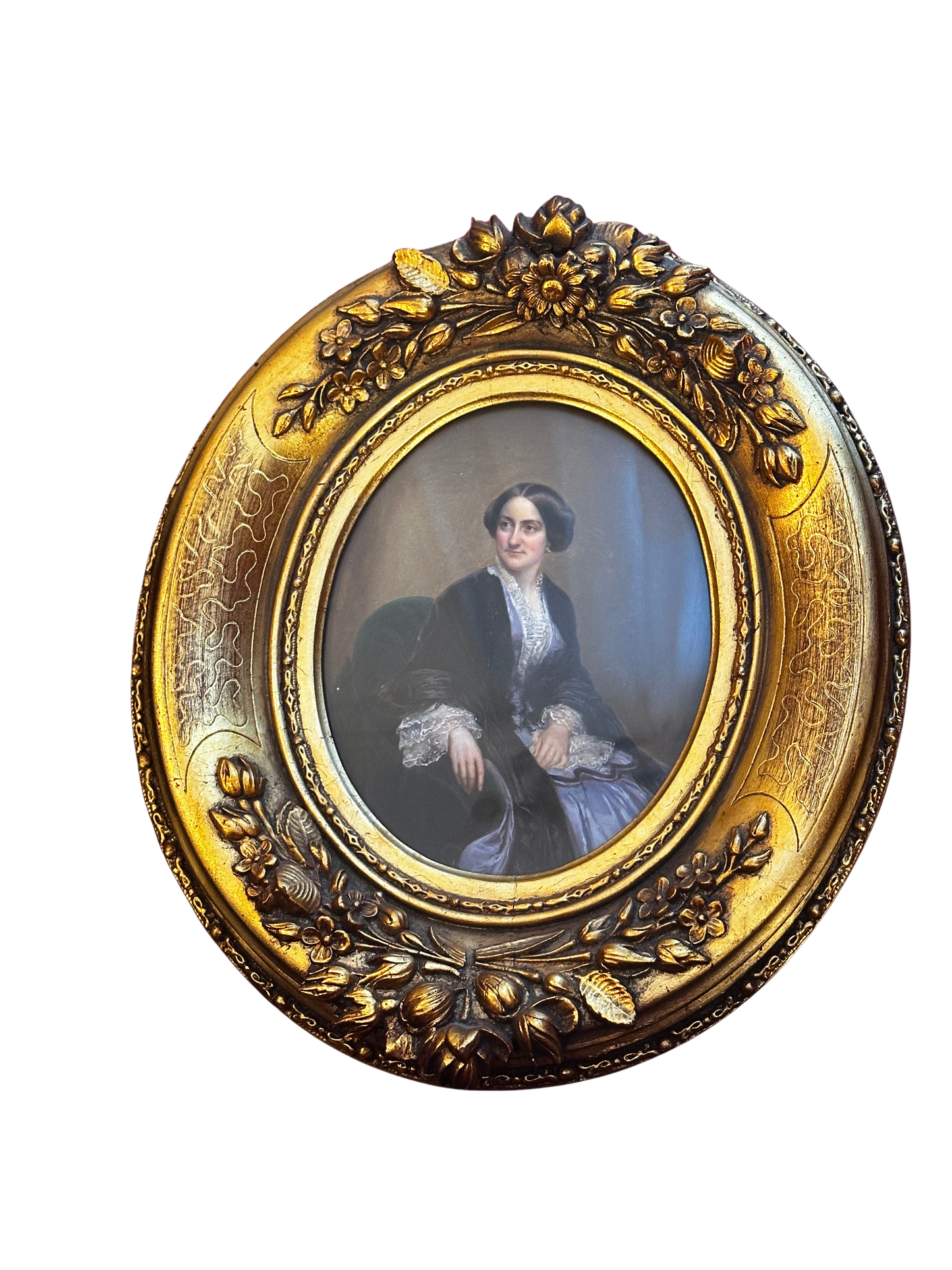
A finely executed 19th-century portrait miniature depicting a seated woman in three-quarter view, elegantly dressed in a black silk shawl over a soft lavender gown with delicate lace cuffs and collar. The sitter is portrayed with refined naturalism, her softly modeled features and composed expression characteristic of mid-19th century academic portraiture.
The painting is executed with remarkable attention to detail, particularly in the rendering of textiles—the sheen of the silk, the translucency of lace, and the subtle tonal transitions of the flesh. The handling suggests a trained hand, likely working within the European academic tradition, possibly French or English.
The miniature is housed within a richly ornamented oval giltwood frame, adorned with high-relief floral garlands, foliate scrollwork, and a central bow motif at the base. The frame itself is a strong decorative element, enhancing the overall presentation with its warm gilded surface and sculptural depth.
Verso retains an early backing with remnants of handwritten notation, now largely faded, adding to its sense of age and authenticity.
Era:
Mid-19th Century (circa 1840–1860)
History:
Portrait miniatures and small-scale cabinet portraits were highly popular in the 19th century, serving as intimate likenesses of loved ones or commemorative pieces for the home. This example reflects the transition from earlier miniature traditions into slightly larger, more painterly compositions intended for domestic display.
The sitter’s attire—particularly the lacework and silhouette—aligns with mid-Victorian fashion, suggesting a date in the mid-19th century. Such portraits were often commissioned by the rising bourgeoisie as symbols of refinement, lineage, and personal legacy.
The ornate giltwood frame complements this purpose, elevating the work from a simple likeness to a decorative and sentimental object meant to be prominently displayed.
Provenance:
European origin, likely French or English school. Acquired through the antique trade.
Materials:
Oil on panel (or board)
Giltwood frame
Glass cover
Paper backing (verso)
Dimensions:
[Insert]
Disclaimers:
Surface shows light wear consistent with age, including minor scuffs and speckling visible under glass. Frame exhibits expected age-related wear, including small losses and rubbing to gilding. Verso backing is later and shows discoloration and handling wear. Faint, largely illegible handwritten markings present on reverse.
Additional Description:
A finely executed 19th-century portrait miniature depicting a seated woman in three-quarter view, elegantly dressed in a black silk shawl over a soft lavender gown with delicate lace cuffs and collar. The sitter is portrayed with refined naturalism, her softly modeled features and composed expression characteristic of mid-19th century academic portraiture.
The painting is executed with remarkable attention to detail, particularly in the rendering of textiles—the sheen of the silk, the translucency of lace, and the subtle tonal transitions of the flesh. The handling suggests a trained hand, likely working within the European academic tradition, possibly French or English.
The miniature is housed within a richly ornamented oval giltwood frame, adorned with high-relief floral garlands, foliate scrollwork, and a central bow motif at the base. The frame itself is a strong decorative element, enhancing the overall presentation with its warm gilded surface and sculptural depth.
Verso retains an early backing with remnants of handwritten notation, now largely faded, adding to its sense of age and authenticity.
Era:
Mid-19th Century (circa 1840–1860)
History:
Portrait miniatures and small-scale cabinet portraits were highly popular in the 19th century, serving as intimate likenesses of loved ones or commemorative pieces for the home. This example reflects the transition from earlier miniature traditions into slightly larger, more painterly compositions intended for domestic display.
The sitter’s attire—particularly the lacework and silhouette—aligns with mid-Victorian fashion, suggesting a date in the mid-19th century. Such portraits were often commissioned by the rising bourgeoisie as symbols of refinement, lineage, and personal legacy.
The ornate giltwood frame complements this purpose, elevating the work from a simple likeness to a decorative and sentimental object meant to be prominently displayed.
Provenance:
European origin, likely French or English school. Acquired through the antique trade.
Materials:
Oil on panel (or board)
Giltwood frame
Glass cover
Paper backing (verso)
Dimensions:
[Insert]
Disclaimers:
Surface shows light wear consistent with age, including minor scuffs and speckling visible under glass. Frame exhibits expected age-related wear, including small losses and rubbing to gilding. Verso backing is later and shows discoloration and handling wear. Faint, largely illegible handwritten markings present on reverse.