


19th C Solid Wood Plateau
19th C Solid Wood Plateau
Couldn't load pickup availability
Share
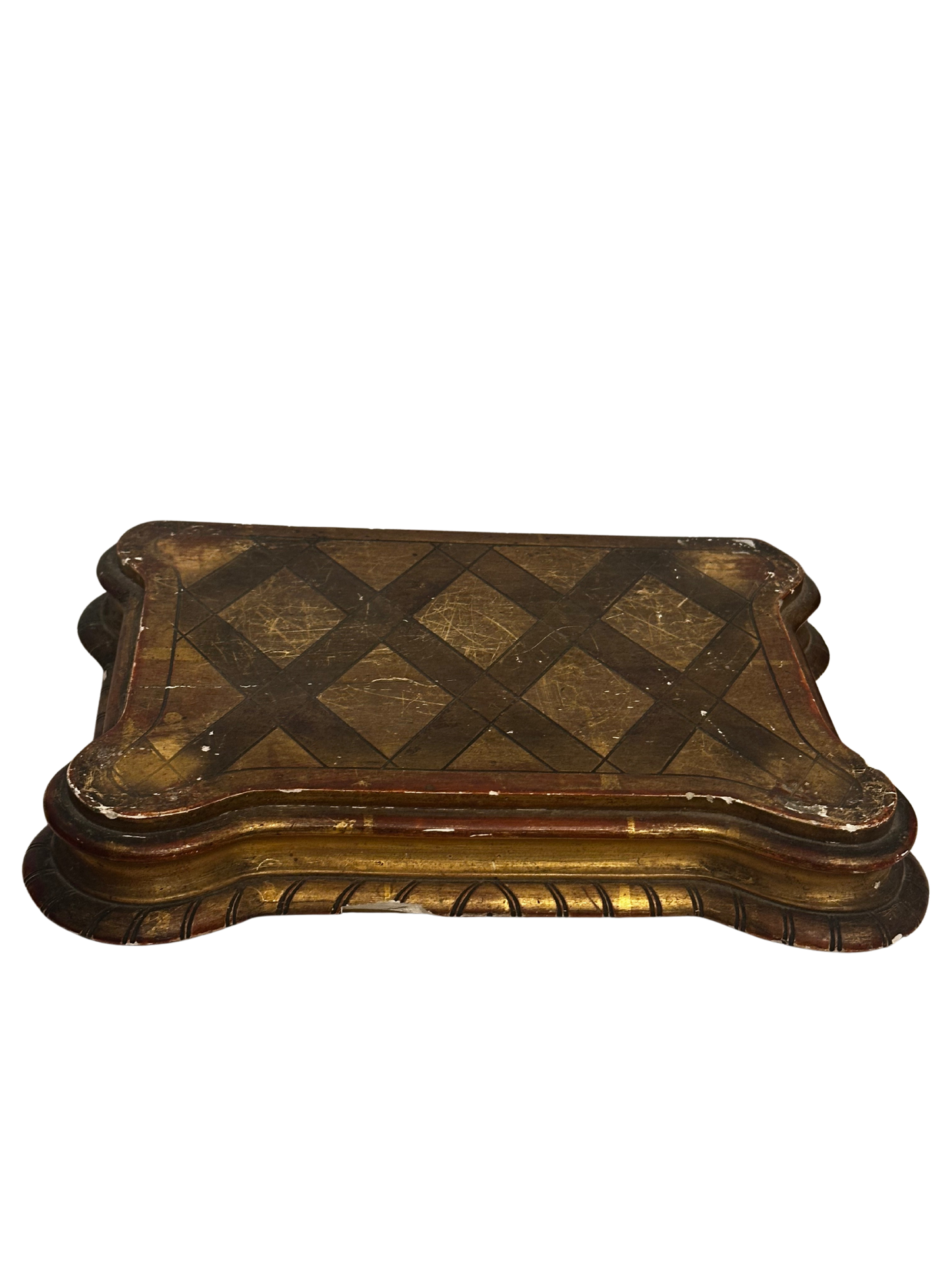
Antique 19th C Plateau
The solid wood block with visible hand-tooling marks and the cross brace inset (not machine cut) strongly suggest 19th century, possibly late 18th century.
The oxidized nails and natural shrinkage cracks indicate genuine age — these are not modern assembly marks.
The gilding shows red bole underlayer with genuine wear from decades (if not centuries) of handling, not factory distressing.
That faint burnished gold tone transitioning to deeper ochre at worn spots is consistent with fire-gilded or hand-applied leaf over gesso, not the sprayed finish of postwar Florentine decor.
The diamond pattern is hand-painted (you can see irregularities at the intersections), and the crazing pattern (micro-cracks) appears natural from age, not chemically induced.
The gilded border and delicate molded edge carving are closer to late 18th–early 19th century Tuscan or Venetian work than to 20th-century decorative pieces.
Object: Giltwood and painted display plinth or base
Date: Circa 1820–1850, possibly late Neoclassical to early Rococo Revival
Origin: Northern Italy (Florence or Venice)
Purpose: Base for a small devotional statue, clock, or objet de vertu — possibly part of an altar or vitrine ensemble.
Antique 19th C Plateau
The solid wood block with visible hand-tooling marks and the cross brace inset (not machine cut) strongly suggest 19th century, possibly late 18th century.
The oxidized nails and natural shrinkage cracks indicate genuine age — these are not modern assembly marks.
The gilding shows red bole underlayer with genuine wear from decades (if not centuries) of handling, not factory distressing.
That faint burnished gold tone transitioning to deeper ochre at worn spots is consistent with fire-gilded or hand-applied leaf over gesso, not the sprayed finish of postwar Florentine decor.
The diamond pattern is hand-painted (you can see irregularities at the intersections), and the crazing pattern (micro-cracks) appears natural from age, not chemically induced.
The gilded border and delicate molded edge carving are closer to late 18th–early 19th century Tuscan or Venetian work than to 20th-century decorative pieces.
Object: Giltwood and painted display plinth or base
Date: Circa 1820–1850, possibly late Neoclassical to early Rococo Revival
Origin: Northern Italy (Florence or Venice)
Purpose: Base for a small devotional statue, clock, or objet de vertu — possibly part of an altar or vitrine ensemble.