

19th Century Bronze Bust Wax Seal
19th Century Bronze Bust Wax Seal
Couldn't load pickup availability
Share
Item: 19th Century Bronze Wax Seal with Minerva / Athena Bust & Monogram Matrix
Additional Description
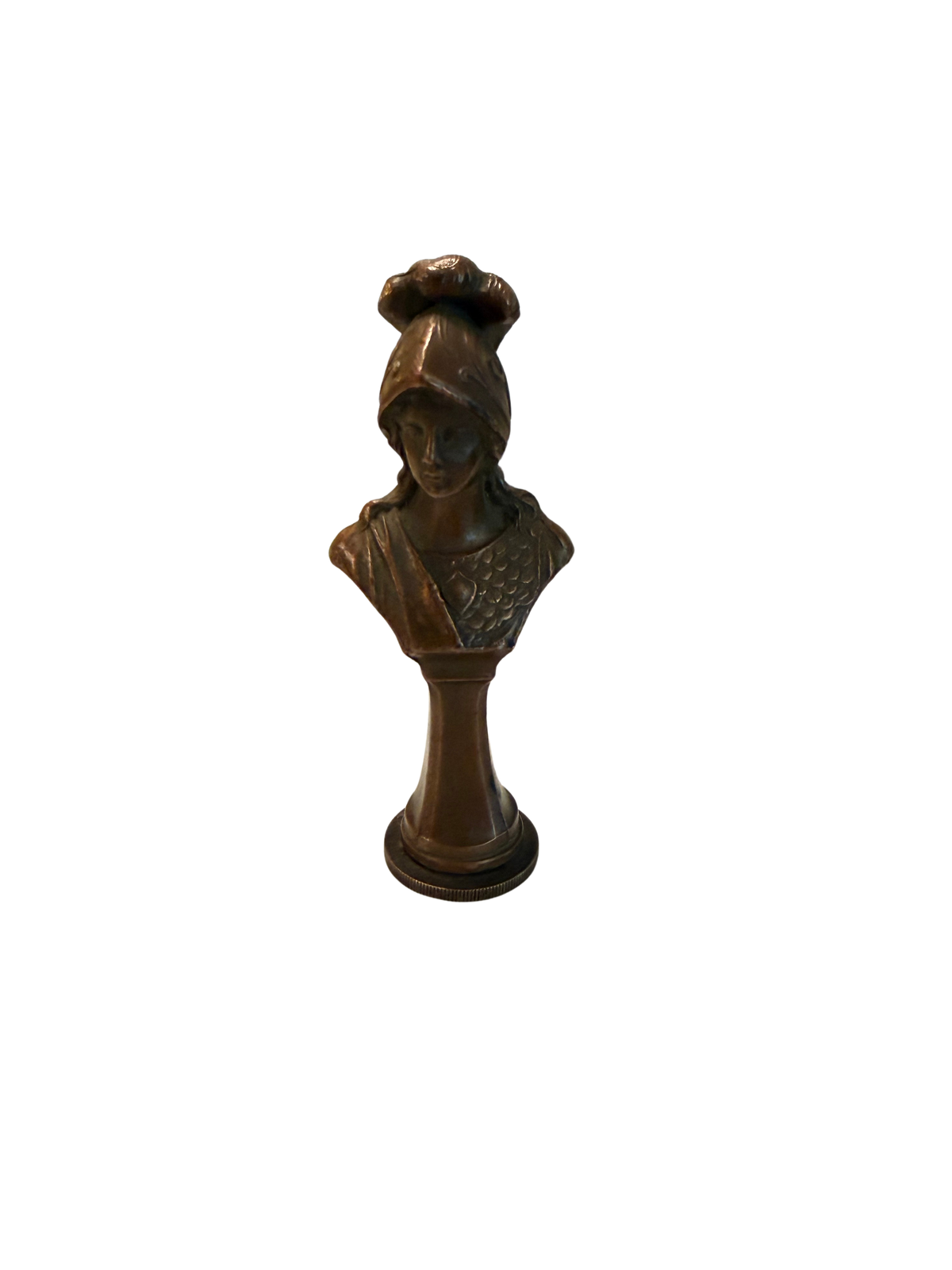
A wonderfully sculptural 19th-century bronze personal wax seal, modeled as the bust of Minerva (Athena), the classical goddess of wisdom, strategy, and the arts.
The figural handle depicts the goddess wearing her characteristic crested helmet, with long hair falling to her shoulders and a finely modeled cuirass or aegis across the chest. The armor is rendered with overlapping scale-like decoration and a central shield-shaped element, while a draped garment falls diagonally across one shoulder. The helmet is embellished with scrolling ornament along the sides and terminates in a dramatic raised crest.
The bust rises from a tapered, faceted pedestal-form stem terminating in a circular seal matrix with a finely reeded outer edge.
The underside is engraved with an elaborate interlaced cipher or monogram, likely representing the initials of the original owner. The looping letters are intentionally intertwined in the fashionable manner of 19th-century personal seals and are difficult to separate with certainty; the design appears to incorporate multiple letters rather than a simple single initial.
A handsome example that works equally well as a functional antique seal, desk accessory, or small classical sculpture.
Era
Date: Circa 1870–1900
Period: Late 19th century / Belle Époque
Origin: Continental European, likely French
The classical subject matter, naturalistic modeling, pedestal-form shaft and engraved monogram matrix are all consistent with decorative personal seals produced during the later 19th century.
History
Wax seals remained an important part of personal correspondence throughout the 19th century, even as adhesive envelopes became increasingly common. More elaborate examples were designed as luxury desk objects, with handles formed as animals, allegorical figures, historical personalities, mythological subjects, or miniature sculptures.
This example depicts Minerva, the Roman counterpart of the Greek Athena, recognizable by her helmet and armor. Minerva represented wisdom, strategic warfare, learning, craftsmanship and the arts, making her a particularly appropriate figure for a personal seal or scholarly desk accessory.
Her presence on an object associated with writing and correspondence would have carried both decorative and symbolic meaning, suggesting intellect, cultivation and classical education.
The circular matrix retains its original engraved personal cipher, allowing the seal to create a reversed monogram when impressed into warm sealing wax.
Iconography
Minerva / Athena
The figure is identifiable by several characteristic attributes:
- Crested classical helmet
- Scale-like armored breastplate or aegis
- Draped classical garment
- Idealized female features
- Martial yet scholarly presentation
Although Athena's aegis is traditionally associated with the head of Medusa, small decorative objects often simplify or reinterpret her armor, as appears to be the case here.
Monogram
The matrix is engraved with a complex interlaced monogram or cipher composed of several looping letterforms.
From the photographs, I would not assign definitive initials because the letters overlap heavily and, importantly, a seal matrix is cut in reverse so that the resulting wax impression reads correctly.
The cipher appears to include a prominent tall central stroke with rounded loops crossing on either side, possibly incorporating letters such as B, P, D, J, or F, but identification would be much more reliable from an actual wax or clay impression.
Materials
- Patinated bronze or bronze-toned metal
- Engraved metal seal matrix
The warm brown surface retains attractive age-related patination and highlights to the raised details.
Dimensions
Dimensions: To be added
Condition
Good antique condition with wear consistent with age and use.
- Attractive overall brown patina with lighter wear to raised areas.
- Scattered rubbing, oxidation, scratches and surface marks consistent with handling.
- Fine modeled detail remains clearly visible throughout the face, helmet, armor and drapery.
- Minor casting irregularities and age-related surface variation are present.
- Small opening or casting void visible at the back of the bust near the shoulder/hair area.
- Matrix retains a crisp engraved monogram.
- Reeded border at the seal base displays expected handling wear.
No significant structural damage is apparent from the photographs.
Disclaimers
All antique and vintage items are sold in as-found condition and may exhibit wear, patina, repairs, losses, alterations or other evidence of age and use.
Dating, material and country of origin are attributed based upon visual examination, construction and stylistic characteristics unless otherwise documented.
The engraved initials have not been definitively identified. Because seal matrices are engraved in reverse, interpretation from the matrix itself can be difficult.
Please review all photographs carefully as they form an important part of the description.
Item: 19th Century Bronze Wax Seal with Minerva / Athena Bust & Monogram Matrix
Additional Description
A wonderfully sculptural 19th-century bronze personal wax seal, modeled as the bust of Minerva (Athena), the classical goddess of wisdom, strategy, and the arts.
The figural handle depicts the goddess wearing her characteristic crested helmet, with long hair falling to her shoulders and a finely modeled cuirass or aegis across the chest. The armor is rendered with overlapping scale-like decoration and a central shield-shaped element, while a draped garment falls diagonally across one shoulder. The helmet is embellished with scrolling ornament along the sides and terminates in a dramatic raised crest.
The bust rises from a tapered, faceted pedestal-form stem terminating in a circular seal matrix with a finely reeded outer edge.
The underside is engraved with an elaborate interlaced cipher or monogram, likely representing the initials of the original owner. The looping letters are intentionally intertwined in the fashionable manner of 19th-century personal seals and are difficult to separate with certainty; the design appears to incorporate multiple letters rather than a simple single initial.
A handsome example that works equally well as a functional antique seal, desk accessory, or small classical sculpture.
Era
Date: Circa 1870–1900
Period: Late 19th century / Belle Époque
Origin: Continental European, likely French
The classical subject matter, naturalistic modeling, pedestal-form shaft and engraved monogram matrix are all consistent with decorative personal seals produced during the later 19th century.
History
Wax seals remained an important part of personal correspondence throughout the 19th century, even as adhesive envelopes became increasingly common. More elaborate examples were designed as luxury desk objects, with handles formed as animals, allegorical figures, historical personalities, mythological subjects, or miniature sculptures.
This example depicts Minerva, the Roman counterpart of the Greek Athena, recognizable by her helmet and armor. Minerva represented wisdom, strategic warfare, learning, craftsmanship and the arts, making her a particularly appropriate figure for a personal seal or scholarly desk accessory.
Her presence on an object associated with writing and correspondence would have carried both decorative and symbolic meaning, suggesting intellect, cultivation and classical education.
The circular matrix retains its original engraved personal cipher, allowing the seal to create a reversed monogram when impressed into warm sealing wax.
Iconography
Minerva / Athena
The figure is identifiable by several characteristic attributes:
- Crested classical helmet
- Scale-like armored breastplate or aegis
- Draped classical garment
- Idealized female features
- Martial yet scholarly presentation
Although Athena's aegis is traditionally associated with the head of Medusa, small decorative objects often simplify or reinterpret her armor, as appears to be the case here.
Monogram
The matrix is engraved with a complex interlaced monogram or cipher composed of several looping letterforms.
From the photographs, I would not assign definitive initials because the letters overlap heavily and, importantly, a seal matrix is cut in reverse so that the resulting wax impression reads correctly.
The cipher appears to include a prominent tall central stroke with rounded loops crossing on either side, possibly incorporating letters such as B, P, D, J, or F, but identification would be much more reliable from an actual wax or clay impression.
Materials
- Patinated bronze or bronze-toned metal
- Engraved metal seal matrix
The warm brown surface retains attractive age-related patination and highlights to the raised details.
Dimensions
Dimensions: To be added
Condition
Good antique condition with wear consistent with age and use.
- Attractive overall brown patina with lighter wear to raised areas.
- Scattered rubbing, oxidation, scratches and surface marks consistent with handling.
- Fine modeled detail remains clearly visible throughout the face, helmet, armor and drapery.
- Minor casting irregularities and age-related surface variation are present.
- Small opening or casting void visible at the back of the bust near the shoulder/hair area.
- Matrix retains a crisp engraved monogram.
- Reeded border at the seal base displays expected handling wear.
No significant structural damage is apparent from the photographs.
Disclaimers
All antique and vintage items are sold in as-found condition and may exhibit wear, patina, repairs, losses, alterations or other evidence of age and use.
Dating, material and country of origin are attributed based upon visual examination, construction and stylistic characteristics unless otherwise documented.
The engraved initials have not been definitively identified. Because seal matrices are engraved in reverse, interpretation from the matrix itself can be difficult.
Please review all photographs carefully as they form an important part of the description.