
19th Century French Gilt Brass and Enamel Lyre Wax Seal with Monogram
19th Century French Gilt Brass and Enamel Lyre Wax Seal with Monogram
Couldn't load pickup availability
Share
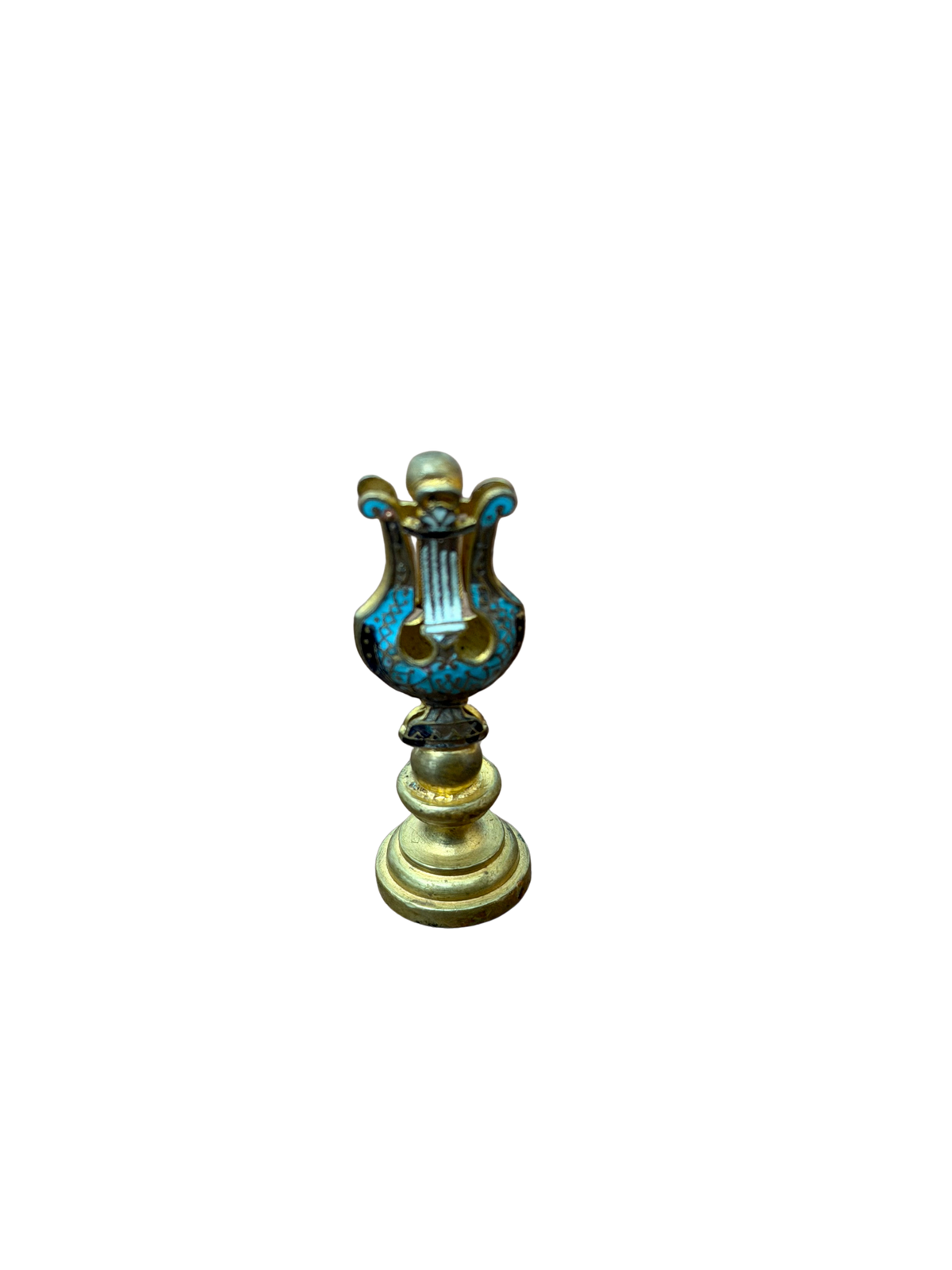
A charming 19th-century French personal wax seal, fashioned in gilt brass and surmounted by a finely detailed classical lyre decorated with turquoise-blue enamel.
The handle takes the form of a miniature pedestal supporting the lyre, whose scrolling arms and body are embellished with delicate engraved ornament and remnants of vivid blue enamel. The neoclassical musical motif gives the piece a particularly romantic and refined character.
The circular seal matrix at the base is engraved with an elegant intertwined “A M” monogram, intended to be impressed into sealing wax for correspondence, notes, or personal documents.
Its diminutive scale, decorative enamel work, and personalized matrix suggest it was a private desk or correspondence seal, likely made as a fashionable personal accessory rather than for commercial or official use.
Era
Circa 1850–1880
Mid-19th century, likely Second Empire / Napoleon III period.
History
Personal wax seals remained an important part of correspondence throughout the 18th and 19th centuries. Before envelopes became universally gummed and mass-produced, letters were frequently folded and secured with sealing wax bearing the sender’s initials, crest, or emblem.
By the 19th century, seals had also become highly decorative personal objects. French makers produced examples incorporating gilt bronze, hardstone, mother-of-pearl, porcelain, enamel, and carved ivory, often using classical or allegorical forms.
The lyre was a particularly appropriate decorative motif. Associated with Apollo, poetry, music, harmony, and the classical arts, it became a recurring element of French decorative design from the Neoclassical and Empire periods onward.
The turquoise enamel decoration seen here is reminiscent of the colorful champlevé-style and enamelled gilt-metal smallwares fashionable in France during the middle decades of the 19th century.
Provenance
Sourced in France.
Likely French manufacture.
Materials
Gilt brass or bronze
Turquoise-blue enamel decoration
Engraved brass seal matrix
Monogram
A M
The base appears engraved with an intertwined personal monogram, likely the initials A.M.
Dimensions
Please provide the exact height and seal diameter and I can add them.
From scale, approximately 2.5–3 inches tall.
Condition
Good antique condition with wear consistent with age.
The gilt surface shows rubbing, oxidation, and patination. There are losses and wear to the turquoise enamel, particularly around the perimeter and lower section of the lyre, but enough survives to clearly show the original decorative treatment.
The engraved monogram on the seal matrix remains crisp and legible.
Please review photographs closely for condition.
Disclaimers
Antique and vintage items may exhibit wear, patina, losses, repairs, oxidation, scratches, and other imperfections consistent with age and use. These characteristics are considered part of the piece’s history and authenticity.
A charming 19th-century French personal wax seal, fashioned in gilt brass and surmounted by a finely detailed classical lyre decorated with turquoise-blue enamel.
The handle takes the form of a miniature pedestal supporting the lyre, whose scrolling arms and body are embellished with delicate engraved ornament and remnants of vivid blue enamel. The neoclassical musical motif gives the piece a particularly romantic and refined character.
The circular seal matrix at the base is engraved with an elegant intertwined “A M” monogram, intended to be impressed into sealing wax for correspondence, notes, or personal documents.
Its diminutive scale, decorative enamel work, and personalized matrix suggest it was a private desk or correspondence seal, likely made as a fashionable personal accessory rather than for commercial or official use.
Era
Circa 1850–1880
Mid-19th century, likely Second Empire / Napoleon III period.
History
Personal wax seals remained an important part of correspondence throughout the 18th and 19th centuries. Before envelopes became universally gummed and mass-produced, letters were frequently folded and secured with sealing wax bearing the sender’s initials, crest, or emblem.
By the 19th century, seals had also become highly decorative personal objects. French makers produced examples incorporating gilt bronze, hardstone, mother-of-pearl, porcelain, enamel, and carved ivory, often using classical or allegorical forms.
The lyre was a particularly appropriate decorative motif. Associated with Apollo, poetry, music, harmony, and the classical arts, it became a recurring element of French decorative design from the Neoclassical and Empire periods onward.
The turquoise enamel decoration seen here is reminiscent of the colorful champlevé-style and enamelled gilt-metal smallwares fashionable in France during the middle decades of the 19th century.
Provenance
Sourced in France.
Likely French manufacture.
Materials
Gilt brass or bronze
Turquoise-blue enamel decoration
Engraved brass seal matrix
Monogram
A M
The base appears engraved with an intertwined personal monogram, likely the initials A.M.
Dimensions
Please provide the exact height and seal diameter and I can add them.
From scale, approximately 2.5–3 inches tall.
Condition
Good antique condition with wear consistent with age.
The gilt surface shows rubbing, oxidation, and patination. There are losses and wear to the turquoise enamel, particularly around the perimeter and lower section of the lyre, but enough survives to clearly show the original decorative treatment.
The engraved monogram on the seal matrix remains crisp and legible.
Please review photographs closely for condition.
Disclaimers
Antique and vintage items may exhibit wear, patina, losses, repairs, oxidation, scratches, and other imperfections consistent with age and use. These characteristics are considered part of the piece’s history and authenticity.