

19th Century French Mother-of-Pearl “Souvenir” Aide-Mémoire / Carnet de Bal, c. 1850–1880
19th Century French Mother-of-Pearl “Souvenir” Aide-Mémoire / Carnet de Bal, c. 1850–1880
Couldn't load pickup availability
Share
Item: 19th Century French Mother-of-Pearl “Souvenir” Aide-Mémoire / Carnet de Bal, c. 1850–1880
Additional Description
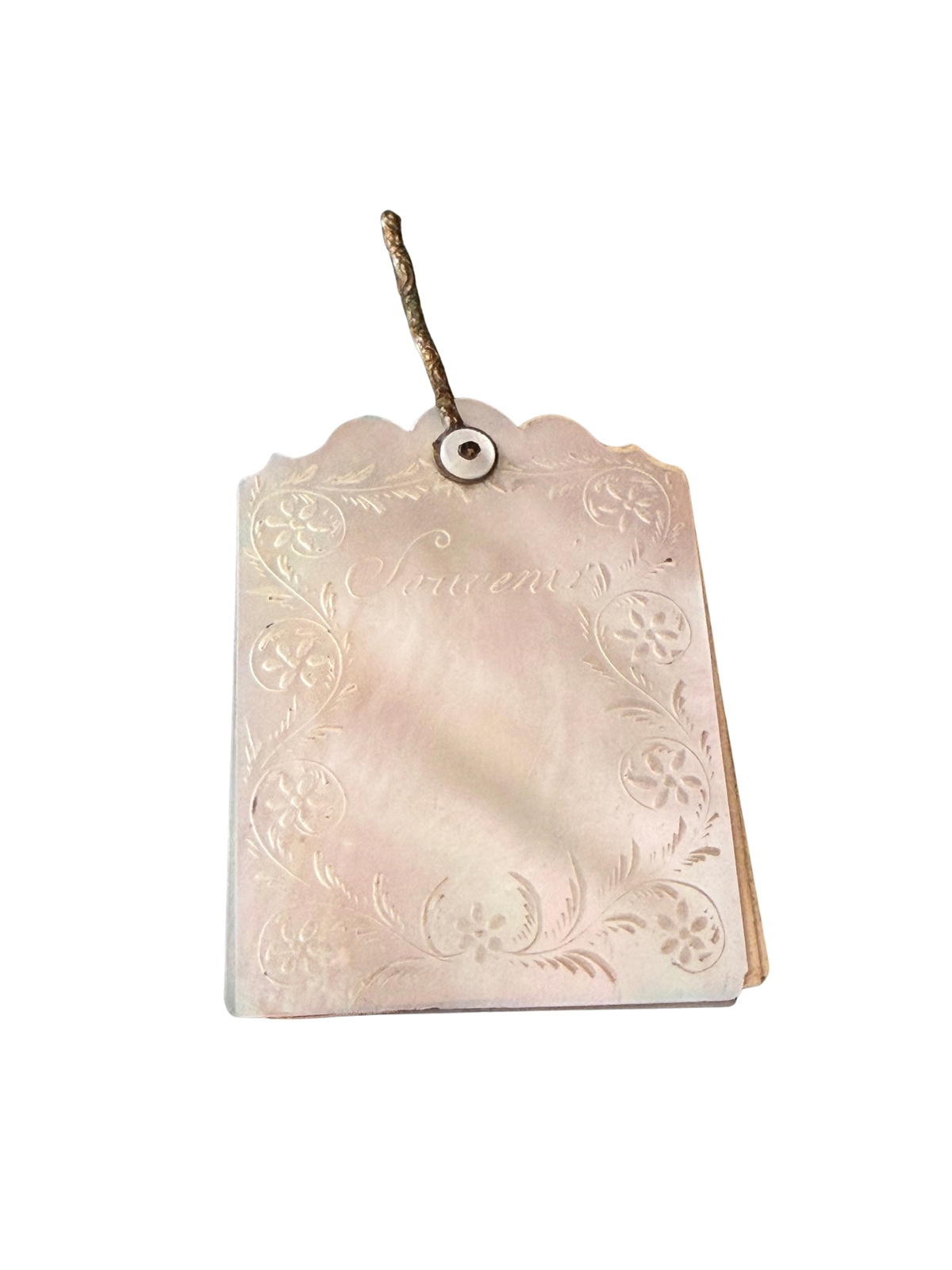
A charming 19th-century mother-of-pearl pocket aide-mémoire, or carnet de bal, with finely engraved scrolling floral decoration surrounding the script inscription “Souvenir.”
The front and back covers are cut from luminous mother-of-pearl, each with a shaped scalloped crest and delicately incised flowers, foliate scrolls, and feathered leaves. The pages are gathered at the top beneath a mother-of-pearl washer and an engraved metal pivoting clasp/keeper, allowing the little book to open fan-like.
Several of the original paper leaves remain and bear period handwritten names and notations, giving the piece particularly appealing evidence of its original use. Pieces of this type served as elegant portable memory books and, particularly in France, could function as carnets de bal, or dance cards, in which the owner recorded dances, partners, appointments, or personal notes.
The engraved “Souvenir” inscription is characteristic of French mother-of-pearl notebooks and aides-mémoire made as fashionable personal accessories during the 19th century. Comparable examples identified as French carnets de bal survive with mother-of-pearl covers, writing leaves, and metal fittings.
Era
Mid–Late 19th Century
Circa 1850–1880
History
The carnet de bal, literally “dance notebook,” became a fashionable ballroom accessory during the 19th century. At formal dances, an owner could record the order of dances and the names of the partners engaged for each one. These small books were frequently made in luxurious materials such as mother-of-pearl, silver, ivory, and gilt metal and were designed to be carried discreetly in the hand or a small evening bag.
Not every example was exclusively a dance card: related objects were sold more generally as aides-mémoire or souvenir notebooks, useful for recording names, appointments, remembrances, and other notes. Christie's records an early-19th-century mother-of-pearl example similarly engraved “Souvenir” and described as an aide mémoire.
The surviving handwritten leaves in this example make it especially evocative—the object remains not merely decorative, but a small piece of someone's personal social history.
Provenance
Likely France.
Acquired in France.
The attribution to France is based on the form, “Souvenir” inscription, mother-of-pearl decoration, and close correspondence with documented French carnets de bal and Palais-Royal-style aides-mémoire; no visible maker's mark or hallmark is present in the supplied photographs.
Materials
Mother-of-pearl / nacre
Engraved metal fitting, likely brass or gilt metal
Mother-of-pearl pivot washer
Original paper leaves
Period graphite/ink inscriptions
Dimensions
Approximately [insert height] H × [insert width] W × [insert depth] D
Condition
Good antique condition with wear consistent with age and use. Mother-of-pearl displays natural variation, surface scratching, and minor edge wear. The metal fitting shows oxidation, darkening, and loss to its original finish. Interior paper leaves exhibit expected toning, edge wear, small losses, creasing, and period handwriting.
The pivoting upper fitting remains present. The piece may originally have incorporated an additional writing implement or closure component; completeness of the original fitting cannot be guaranteed.
The period inscriptions have intentionally been left untouched as an important part of the object's history and character.
Disclaimers
Dating and French attribution are based on construction, materials, decoration, and comparison with documented 19th-century examples and should be considered approximate. Mother-of-pearl is a natural material and may exhibit variations, lines, inclusions, and irregularities inherent to the shell rather than later damage.
Antique objects are sold as found and may exhibit age-related wear not individually noted.
Item: 19th Century French Mother-of-Pearl “Souvenir” Aide-Mémoire / Carnet de Bal, c. 1850–1880
Additional Description
A charming 19th-century mother-of-pearl pocket aide-mémoire, or carnet de bal, with finely engraved scrolling floral decoration surrounding the script inscription “Souvenir.”
The front and back covers are cut from luminous mother-of-pearl, each with a shaped scalloped crest and delicately incised flowers, foliate scrolls, and feathered leaves. The pages are gathered at the top beneath a mother-of-pearl washer and an engraved metal pivoting clasp/keeper, allowing the little book to open fan-like.
Several of the original paper leaves remain and bear period handwritten names and notations, giving the piece particularly appealing evidence of its original use. Pieces of this type served as elegant portable memory books and, particularly in France, could function as carnets de bal, or dance cards, in which the owner recorded dances, partners, appointments, or personal notes.
The engraved “Souvenir” inscription is characteristic of French mother-of-pearl notebooks and aides-mémoire made as fashionable personal accessories during the 19th century. Comparable examples identified as French carnets de bal survive with mother-of-pearl covers, writing leaves, and metal fittings.
Era
Mid–Late 19th Century
Circa 1850–1880
History
The carnet de bal, literally “dance notebook,” became a fashionable ballroom accessory during the 19th century. At formal dances, an owner could record the order of dances and the names of the partners engaged for each one. These small books were frequently made in luxurious materials such as mother-of-pearl, silver, ivory, and gilt metal and were designed to be carried discreetly in the hand or a small evening bag.
Not every example was exclusively a dance card: related objects were sold more generally as aides-mémoire or souvenir notebooks, useful for recording names, appointments, remembrances, and other notes. Christie's records an early-19th-century mother-of-pearl example similarly engraved “Souvenir” and described as an aide mémoire.
The surviving handwritten leaves in this example make it especially evocative—the object remains not merely decorative, but a small piece of someone's personal social history.
Provenance
Likely France.
Acquired in France.
The attribution to France is based on the form, “Souvenir” inscription, mother-of-pearl decoration, and close correspondence with documented French carnets de bal and Palais-Royal-style aides-mémoire; no visible maker's mark or hallmark is present in the supplied photographs.
Materials
Mother-of-pearl / nacre
Engraved metal fitting, likely brass or gilt metal
Mother-of-pearl pivot washer
Original paper leaves
Period graphite/ink inscriptions
Dimensions
Approximately [insert height] H × [insert width] W × [insert depth] D
Condition
Good antique condition with wear consistent with age and use. Mother-of-pearl displays natural variation, surface scratching, and minor edge wear. The metal fitting shows oxidation, darkening, and loss to its original finish. Interior paper leaves exhibit expected toning, edge wear, small losses, creasing, and period handwriting.
The pivoting upper fitting remains present. The piece may originally have incorporated an additional writing implement or closure component; completeness of the original fitting cannot be guaranteed.
The period inscriptions have intentionally been left untouched as an important part of the object's history and character.
Disclaimers
Dating and French attribution are based on construction, materials, decoration, and comparison with documented 19th-century examples and should be considered approximate. Mother-of-pearl is a natural material and may exhibit variations, lines, inclusions, and irregularities inherent to the shell rather than later damage.
Antique objects are sold as found and may exhibit age-related wear not individually noted.