

19th Century French Neoclassical Gilt Bronze Figural Mount of a Dancing Bacchante with Tambourine, c. 1850–1900 (Fournier)
19th Century French Neoclassical Gilt Bronze Figural Mount of a Dancing Bacchante with Tambourine, c. 1850–1900 (Fournier)
Couldn't load pickup availability
Share
Item Title: 19th Century French Neoclassical Gilt Bronze Figural Mount of a Dancing Bacchante with Tambourine, c. 1850–1900
### Additional Description
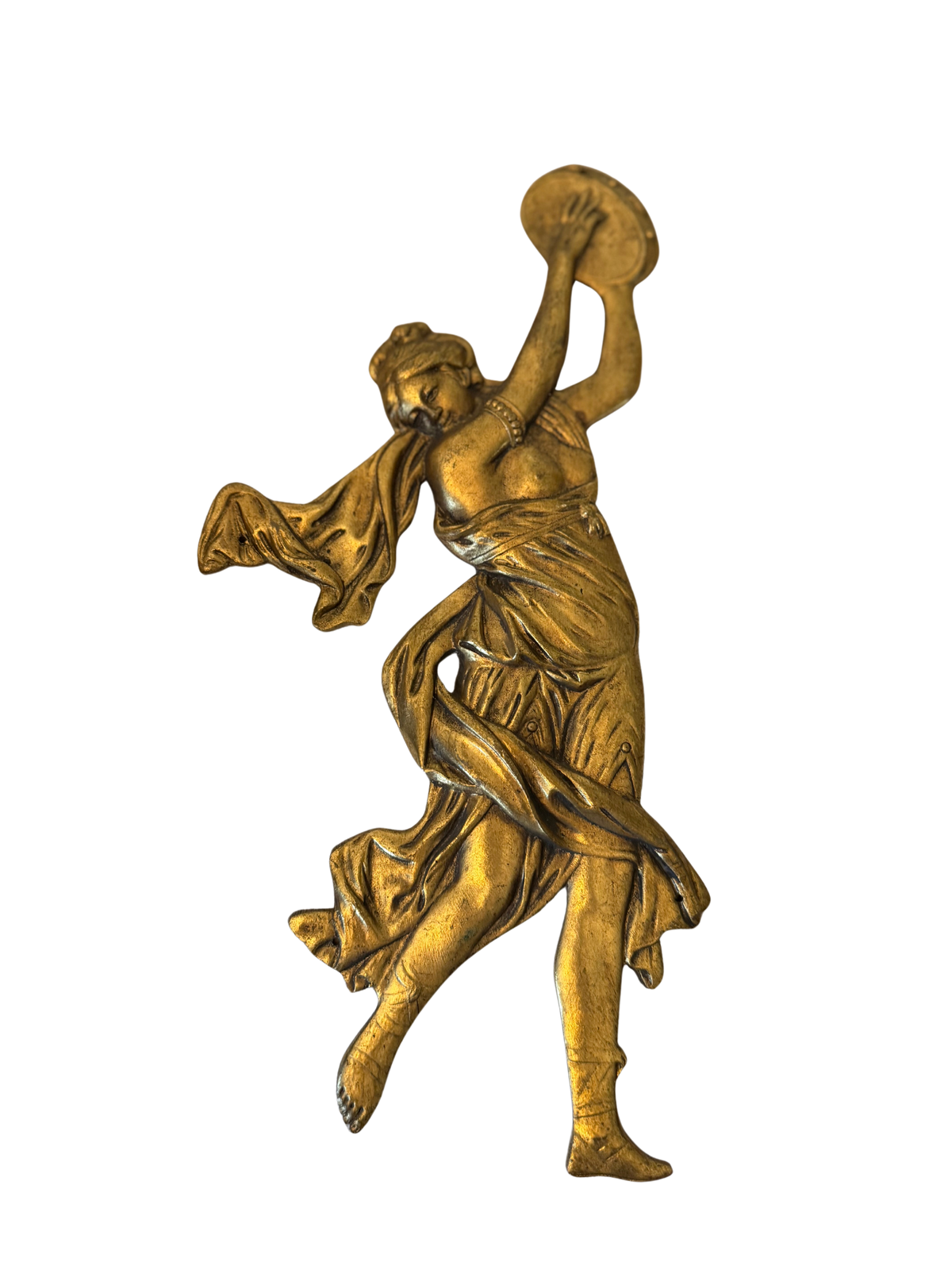
A beautifully modeled 19th-century gilt metal decorative mount depicting a classical female figure in a graceful dancing pose, holding a tambourine above her head.
The figure is represented in the guise of a Bacchante, a female follower of Bacchus, the Roman god of wine, celebration, and revelry. Her head is gently inclined downward, with softly modeled facial features, partially closed eyes, and upswept hair gathered into an elaborate classical arrangement.
Her arms extend dramatically overhead, supporting a circular tambourine, while her body twists in an elegant, animated pose suggesting movement and dance.
She wears a flowing classical garment, loosely draped across her torso and hips, with deeply modeled folds that billow outward around her legs. A long section of fabric extends dramatically from her shoulder, further emphasizing the sense of movement.
The figure's slender legs and delicately rendered feet emerge from the swirling drapery, creating a particularly expressive silhouette.
The gilt surface retains a warm golden appearance, with darker patination settled into the recessed details of the clothing, hair, and facial features, accentuating the sculptural modeling.
The reverse reveals a relatively flat, unfinished surface with remnants of gilding and several small mounting holes, indicating that the piece was originally intended as an applied decorative ornament rather than a freestanding sculpture.
Likely produced as a decorative furniture or architectural mount, the figure would have complemented an elaborate mirror, clock case, furniture panel, or other ornamental furnishing.
A lovely example of classical revival decorative metalwork, particularly appealing for its animated composition, sculptural detail, and romantic interpretation of an ancient mythological subject.
### Era
19th Century, circa 1850–1900 (estimated).
French Neoclassical Revival / Louis XVI Revival style.
The precise date and place of manufacture remain unconfirmed.
### History
Classical female figures engaged in music and dance became popular decorative subjects throughout European art, particularly during the Neoclassical period of the late 18th century.
Inspired by ancient Greek and Roman sculpture, reliefs, and painted vessels, artists frequently depicted dancing maidens, nymphs, Bacchantes, and other mythological figures in flowing garments.
Bacchantes were female worshippers associated with Bacchus, the Roman counterpart of Dionysus, god of wine, fertility, and ecstatic celebration.
In classical imagery, these women were frequently represented dancing, carrying tambourines, or participating in festive processions.
Their animated poses and swirling draperies provided artists with opportunities to explore movement, grace, and the expressive qualities of the human figure.
During the 18th century, such compositions became particularly fashionable in French decorative arts, appearing in gilt bronze furniture mounts, clocks, mirrors, wall ornaments, and architectural decoration.
The tradition continued throughout the 19th century, when French bronze founders and decorative arts workshops revived earlier Neoclassical and Louis XVI designs.
Applied decorative mounts of this kind were often cast separately before being gilded and affixed to wooden furniture, mirror frames, architectural panels, or other decorative objects.
The present figure reflects this classical tradition through her elegant dancing pose, flowing drapery, tambourine, and delicately modeled facial features.
### Provenance
France, attributed.
Specific maker, workshop, and previous ownership history unknown.
No identifiable manufacturer's mark or artist's signature is visible in the supplied photographs.
### Materials
- Cast gilt metal, possibly bronze, brass, or spelter
- Applied gilded surface
- Original mounting holes visible on the reverse
The precise metal alloy has not been independently tested.
### Dimensions
To be provided.
### Condition / Disclaimers
Good antique condition overall, with age-appropriate wear consistent with use and previous installation.
The gilt surface exhibits scattered rubbing, oxidation, minor scratches, and areas of darker patination, particularly within the recessed details of the drapery and figure.
The cast ornamentation remains well defined, with attractive detail throughout the face, hair, clothing, and tambourine.
Several small holes are visible in the reverse and along portions of the figure, consistent with its former use as an applied decorative mount.
The reverse exhibits areas of surface wear, discoloration, and irregular gilding, as expected for a decorative element originally intended to be mounted against another surface.
The figure appears intact overall, although minor edge wear and small imperfections are present.
The original furnishing or architectural object to which the mount was attached is unknown.
Age, geographic origin, iconographic identification, and metal composition are based on visual assessment and have not been independently verified.
Please review all photographs carefully, as they form part of the condition description.
### Value
**Estimated Retail Value: $75–$175 USD**
**Suggested Listing Price: $145 USD**
This preliminary valuation reflects the figure's attractive classical subject, decorative gilded finish, expressive modeling, and potential use as an antique architectural or furniture ornament.
Confirmed gilt bronze construction, an identified manufacturer, or evidence of an earlier 18th-century date could support a higher valuation.
Item Title: 19th Century French Neoclassical Gilt Bronze Figural Mount of a Dancing Bacchante with Tambourine, c. 1850–1900
### Additional Description
A beautifully modeled 19th-century gilt metal decorative mount depicting a classical female figure in a graceful dancing pose, holding a tambourine above her head.
The figure is represented in the guise of a Bacchante, a female follower of Bacchus, the Roman god of wine, celebration, and revelry. Her head is gently inclined downward, with softly modeled facial features, partially closed eyes, and upswept hair gathered into an elaborate classical arrangement.
Her arms extend dramatically overhead, supporting a circular tambourine, while her body twists in an elegant, animated pose suggesting movement and dance.
She wears a flowing classical garment, loosely draped across her torso and hips, with deeply modeled folds that billow outward around her legs. A long section of fabric extends dramatically from her shoulder, further emphasizing the sense of movement.
The figure's slender legs and delicately rendered feet emerge from the swirling drapery, creating a particularly expressive silhouette.
The gilt surface retains a warm golden appearance, with darker patination settled into the recessed details of the clothing, hair, and facial features, accentuating the sculptural modeling.
The reverse reveals a relatively flat, unfinished surface with remnants of gilding and several small mounting holes, indicating that the piece was originally intended as an applied decorative ornament rather than a freestanding sculpture.
Likely produced as a decorative furniture or architectural mount, the figure would have complemented an elaborate mirror, clock case, furniture panel, or other ornamental furnishing.
A lovely example of classical revival decorative metalwork, particularly appealing for its animated composition, sculptural detail, and romantic interpretation of an ancient mythological subject.
### Era
19th Century, circa 1850–1900 (estimated).
French Neoclassical Revival / Louis XVI Revival style.
The precise date and place of manufacture remain unconfirmed.
### History
Classical female figures engaged in music and dance became popular decorative subjects throughout European art, particularly during the Neoclassical period of the late 18th century.
Inspired by ancient Greek and Roman sculpture, reliefs, and painted vessels, artists frequently depicted dancing maidens, nymphs, Bacchantes, and other mythological figures in flowing garments.
Bacchantes were female worshippers associated with Bacchus, the Roman counterpart of Dionysus, god of wine, fertility, and ecstatic celebration.
In classical imagery, these women were frequently represented dancing, carrying tambourines, or participating in festive processions.
Their animated poses and swirling draperies provided artists with opportunities to explore movement, grace, and the expressive qualities of the human figure.
During the 18th century, such compositions became particularly fashionable in French decorative arts, appearing in gilt bronze furniture mounts, clocks, mirrors, wall ornaments, and architectural decoration.
The tradition continued throughout the 19th century, when French bronze founders and decorative arts workshops revived earlier Neoclassical and Louis XVI designs.
Applied decorative mounts of this kind were often cast separately before being gilded and affixed to wooden furniture, mirror frames, architectural panels, or other decorative objects.
The present figure reflects this classical tradition through her elegant dancing pose, flowing drapery, tambourine, and delicately modeled facial features.
### Provenance
France, attributed.
Specific maker, workshop, and previous ownership history unknown.
No identifiable manufacturer's mark or artist's signature is visible in the supplied photographs.
### Materials
- Cast gilt metal, possibly bronze, brass, or spelter
- Applied gilded surface
- Original mounting holes visible on the reverse
The precise metal alloy has not been independently tested.
### Dimensions
To be provided.
### Condition / Disclaimers
Good antique condition overall, with age-appropriate wear consistent with use and previous installation.
The gilt surface exhibits scattered rubbing, oxidation, minor scratches, and areas of darker patination, particularly within the recessed details of the drapery and figure.
The cast ornamentation remains well defined, with attractive detail throughout the face, hair, clothing, and tambourine.
Several small holes are visible in the reverse and along portions of the figure, consistent with its former use as an applied decorative mount.
The reverse exhibits areas of surface wear, discoloration, and irregular gilding, as expected for a decorative element originally intended to be mounted against another surface.
The figure appears intact overall, although minor edge wear and small imperfections are present.
The original furnishing or architectural object to which the mount was attached is unknown.
Age, geographic origin, iconographic identification, and metal composition are based on visual assessment and have not been independently verified.
Please review all photographs carefully, as they form part of the condition description.
### Value
**Estimated Retail Value: $75–$175 USD**
**Suggested Listing Price: $145 USD**
This preliminary valuation reflects the figure's attractive classical subject, decorative gilded finish, expressive modeling, and potential use as an antique architectural or furniture ornament.
Confirmed gilt bronze construction, an identified manufacturer, or evidence of an earlier 18th-century date could support a higher valuation.