

19th-Century Gilt Bronze Wax Seal with Classical Female Bust and Script Monogram
19th-Century Gilt Bronze Wax Seal with Classical Female Bust and Script Monogram
Couldn't load pickup availability
Share


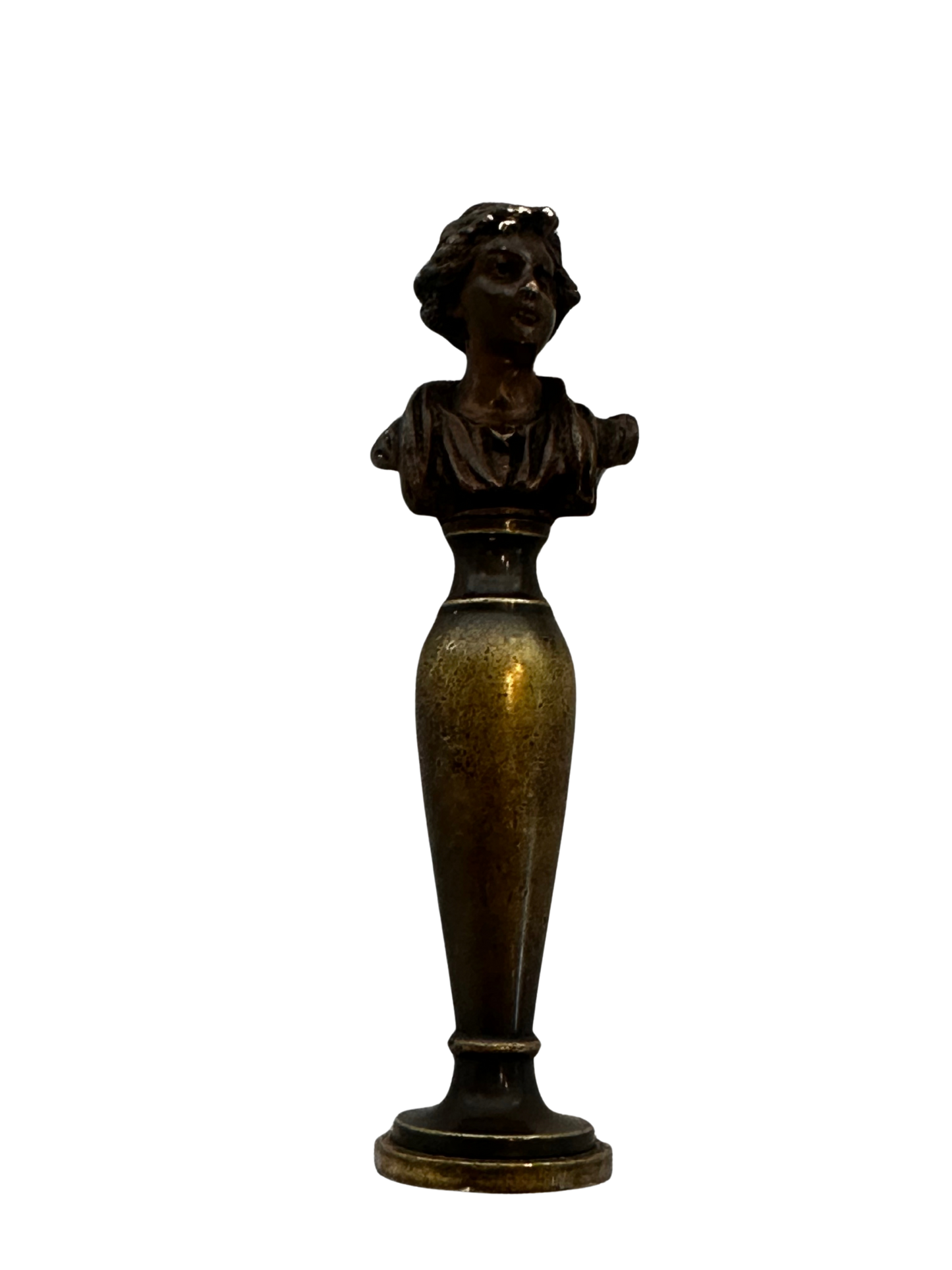
Gilt bronze wax seal featuring a cast classical female bust with softly modeled facial features, wavy hair arranged up and back and draped classical-style garment. The bust is mounted on a slender, tapered handle with a baluster-form shaft and circular foot. The underside terminates in a flat circular sealing matrix engraved with an intertwined script monogram, likely representing the initials of the original owner. The surface exhibits worn gilding and darkened patina consistent with age and handling. The seal stands upright and shows no visible cracks, breaks, or repairs.
Gilt bronze wax seal featuring a cast classical female bust with softly modeled facial features, wavy hair arranged up and back and draped classical-style garment. The bust is mounted on a slender, tapered handle with a baluster-form shaft and circular foot. The underside terminates in a flat circular sealing matrix engraved with an intertwined script monogram, likely representing the initials of the original owner. The surface exhibits worn gilding and darkened patina consistent with age and handling. The seal stands upright and shows no visible cracks, breaks, or repairs.
3.25"h x 0.75"w
3.25"h x 0.75"w
Wax seals remained an essential tool for sealing correspondence, documents, and legal papers throughout the 19th century. Female busts drawn from classical antiquity were a popular decorative motif, symbolizing refinement, virtue, and education. Monogrammed wax seals were typically custom-made personal objects, used to identify the sender and authenticate documents. Figural seals of this type were often produced in European workshops for private individuals rather than institutional use.
Wax seals remained an essential tool for sealing correspondence, documents, and legal papers throughout the 19th century. Female busts drawn from classical antiquity were a popular decorative motif, symbolizing refinement, virtue, and education. Monogrammed wax seals were typically custom-made personal objects, used to identify the sender and authenticate documents. Figural seals of this type were often produced in European workshops for private individuals rather than institutional use.
19th Century (mid to late 19th century)
19th Century (mid to late 19th century)
Gilt bronze
Gilt bronze
Europe
Exact origin unknown
Europe
Exact origin unknown
Surface wear and gilding loss consistent with age; patina throughout; light surface abrasions from use; engraving and metal composition untested; no visible structural damage observed.
Surface wear and gilding loss consistent with age; patina throughout; light surface abrasions from use; engraving and metal composition untested; no visible structural damage observed.