


19th-Century Hand-Painted Miniature of The Toilette of Venus, After Francesco Albani, in Ebonized Frame
19th-Century Hand-Painted Miniature of The Toilette of Venus, After Francesco Albani, in Ebonized Frame
Couldn't load pickup availability
Share
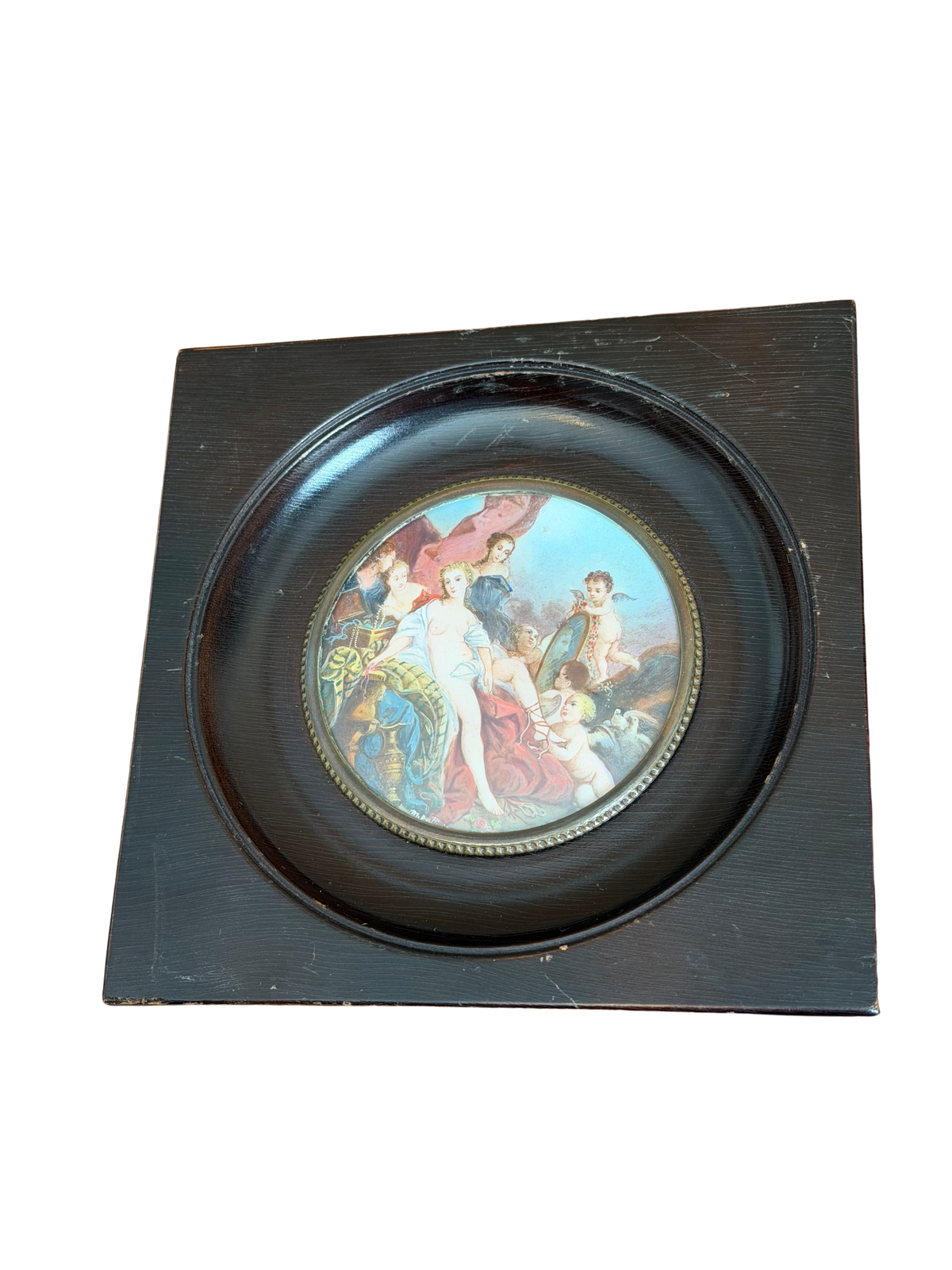
A richly detailed antique hand-painted miniature depicting Venus at her toilette, surrounded by female attendants and winged putti. Venus sits partially draped at the center of the composition while one cupid laces her sandal, another presents an oval mirror reflecting her face, and attendants arrange jewels and attend to her dressing. A pair of white doves—traditional attributes of Venus—appears at lower right.
The composition belongs to the celebrated “Toilette of Venus” iconography associated with the 17th-century Bolognese painter Francesco Albani (1578–1660). Albani returned to the subject repeatedly; surviving versions show Venus attended by the Graces and numerous cupids performing precisely these tasks, including tying her sandals and presenting a mirror. The Prado dates one of Albani's versions to 1635–1640, while related compositions formed part of the Louvre and Borghese cycles.
This miniature appears to be a later interpretation after Albani rather than a direct miniature copy of one specific surviving painting, with the figures condensed into an intimate circular composition.
Particularly lovely details include Venus's intricately highlighted golden curls, the tiny floral garland surrounding the mirror, strings of pearls spilling from a jewel casket, the jewel-toned blue and crimson draperies, and the diminutive reflection of Venus painted within the mirror.
A faint hand-painted signature or inscription is visible along the lower edge, although I cannot confidently resolve the artist's name from the photographs.
The circular miniature is mounted beneath a narrow gilt-metal beaded bezel within its original-style deeply molded ebonized wooden frame, retaining an old textured paper backing and hanging loop.
Era
Late 19th century, circa 1870–1900
Possibly Continental European, likely French or Italian.
History
The toilette of Venus was an especially popular mythological subject from the Renaissance through the 19th century. Venus—the Roman goddess of beauty and love—is shown preparing herself with the assistance of the Three Graces and Cupids, transforming an everyday dressing ritual into an allegory of beauty and love.
Francesco Albani became particularly associated with the subject. The Museo del Prado notes that his compositions helped popularize a refined, lyrical form of classical mythology, while the Metropolitan Museum records a 1672 engraving by Étienne Baudet after Albani showing Venus gazing into a mirror while attendants dress her and a putto ties her sandal.
The popularity of Albani's compositions through prints made them particularly suitable sources for later miniature painters working for the 18th- and 19th-century decorative-art market.
Provenance
Private collection.
Artist unidentified; signed or inscribed lower edge, presently illegible.
Materials
Hand-painted miniature
Smooth pale support, possibly porcelain or another prepared miniature support
Gilt/brass-toned metal bezel
Ebonized wood frame
Textured paper backing
I would not list the support as ivory without examination. I don't see enough diagnostic grain in these photographs to make that identification confidently.
Dimensions
5.75" x 5.75"
Condition
Antique condition consistent with age and use. The painting retains unusually vivid coloration and extensive fine detail. There is scattered surface dust/soiling and minor spotting visible beneath or upon the glazing, with some fine surface scratches. The ebonized frame displays scratches, rubbing, small abrasions and minor edge wear. The reverse paper covering has areas of loss and lifting, particularly around the perimeter. Gilt-metal bezel shows age-related patination.
Please review all photographs closely as they form an important part of the condition description.
Disclaimers
Attribution to the iconography of Francesco Albani's Toilette of Venus is based upon comparison with documented compositions and should be understood as “after / in the tradition of Francesco Albani,” rather than an attribution to Albani himself.
The precise painting support has not been independently tested. Signature remains unidentified.
A richly detailed antique hand-painted miniature depicting Venus at her toilette, surrounded by female attendants and winged putti. Venus sits partially draped at the center of the composition while one cupid laces her sandal, another presents an oval mirror reflecting her face, and attendants arrange jewels and attend to her dressing. A pair of white doves—traditional attributes of Venus—appears at lower right.
The composition belongs to the celebrated “Toilette of Venus” iconography associated with the 17th-century Bolognese painter Francesco Albani (1578–1660). Albani returned to the subject repeatedly; surviving versions show Venus attended by the Graces and numerous cupids performing precisely these tasks, including tying her sandals and presenting a mirror. The Prado dates one of Albani's versions to 1635–1640, while related compositions formed part of the Louvre and Borghese cycles.
This miniature appears to be a later interpretation after Albani rather than a direct miniature copy of one specific surviving painting, with the figures condensed into an intimate circular composition.
Particularly lovely details include Venus's intricately highlighted golden curls, the tiny floral garland surrounding the mirror, strings of pearls spilling from a jewel casket, the jewel-toned blue and crimson draperies, and the diminutive reflection of Venus painted within the mirror.
A faint hand-painted signature or inscription is visible along the lower edge, although I cannot confidently resolve the artist's name from the photographs.
The circular miniature is mounted beneath a narrow gilt-metal beaded bezel within its original-style deeply molded ebonized wooden frame, retaining an old textured paper backing and hanging loop.
Era
Late 19th century, circa 1870–1900
Possibly Continental European, likely French or Italian.
History
The toilette of Venus was an especially popular mythological subject from the Renaissance through the 19th century. Venus—the Roman goddess of beauty and love—is shown preparing herself with the assistance of the Three Graces and Cupids, transforming an everyday dressing ritual into an allegory of beauty and love.
Francesco Albani became particularly associated with the subject. The Museo del Prado notes that his compositions helped popularize a refined, lyrical form of classical mythology, while the Metropolitan Museum records a 1672 engraving by Étienne Baudet after Albani showing Venus gazing into a mirror while attendants dress her and a putto ties her sandal.
The popularity of Albani's compositions through prints made them particularly suitable sources for later miniature painters working for the 18th- and 19th-century decorative-art market.
Provenance
Private collection.
Artist unidentified; signed or inscribed lower edge, presently illegible.
Materials
Hand-painted miniature
Smooth pale support, possibly porcelain or another prepared miniature support
Gilt/brass-toned metal bezel
Ebonized wood frame
Textured paper backing
I would not list the support as ivory without examination. I don't see enough diagnostic grain in these photographs to make that identification confidently.
Dimensions
5.75" x 5.75"
Condition
Antique condition consistent with age and use. The painting retains unusually vivid coloration and extensive fine detail. There is scattered surface dust/soiling and minor spotting visible beneath or upon the glazing, with some fine surface scratches. The ebonized frame displays scratches, rubbing, small abrasions and minor edge wear. The reverse paper covering has areas of loss and lifting, particularly around the perimeter. Gilt-metal bezel shows age-related patination.
Please review all photographs closely as they form an important part of the condition description.
Disclaimers
Attribution to the iconography of Francesco Albani's Toilette of Venus is based upon comparison with documented compositions and should be understood as “after / in the tradition of Francesco Albani,” rather than an attribution to Albani himself.
The precise painting support has not been independently tested. Signature remains unidentified.