

19th Century Heraldic Wax Seal with Turned Wood Handle
19th Century Heraldic Wax Seal with Turned Wood Handle
Couldn't load pickup availability
Share
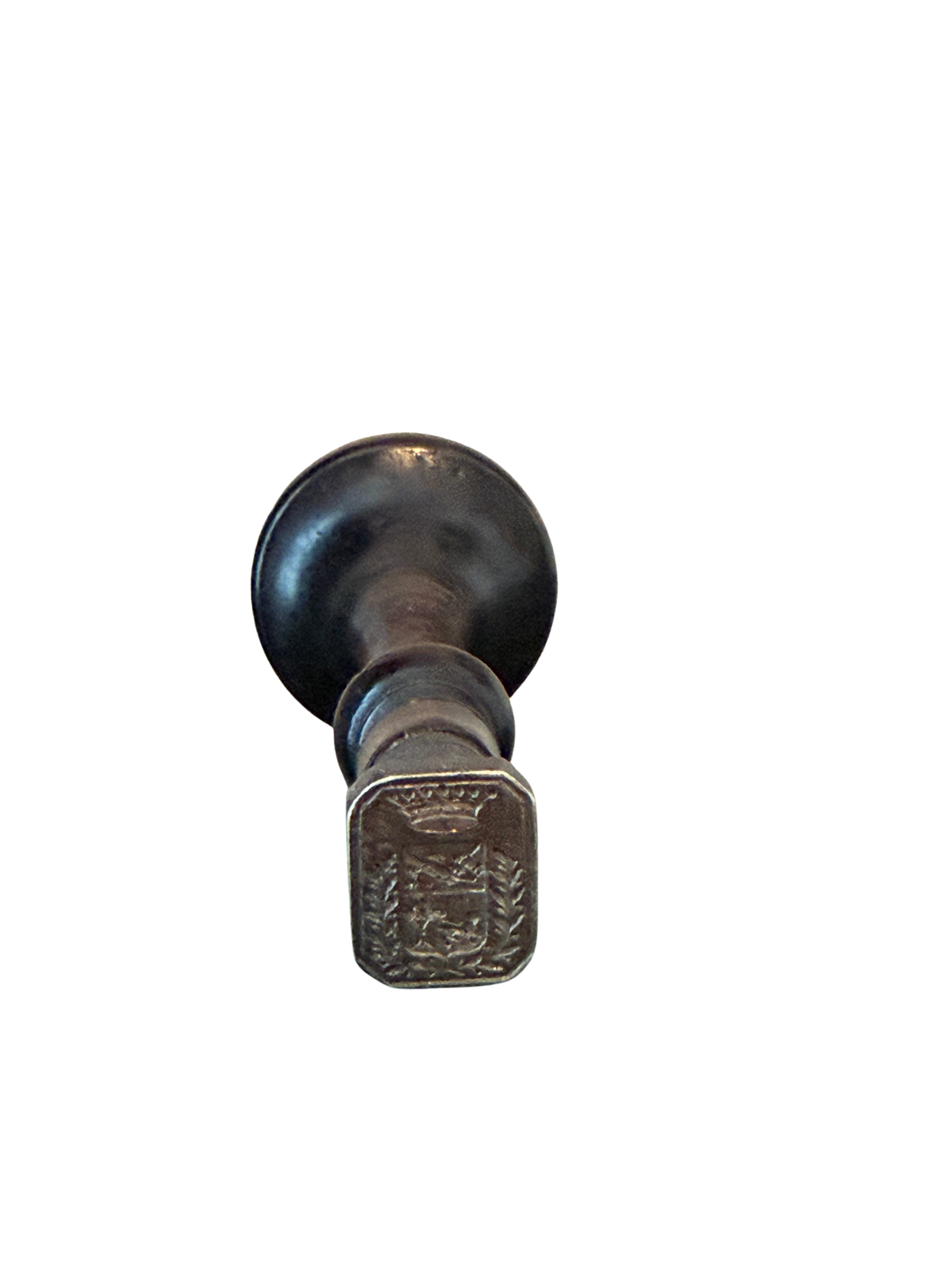
A substantial 19th-century personal wax seal with a dark turned wood handle and a finely engraved metal matrix bearing a full heraldic coat of arms.
The handle is formed from dark polished wood with a broad mushroom-form top, elongated turned stem, and molded collar above the seal matrix. The simple, tactile handle contrasts beautifully with the much more elaborate engraving beneath.
The rectangular matrix has clipped corners and is engraved with a crowned armorial achievement. At center is a shield divided horizontally into two fields. The upper field appears to contain a bird, likely an eagle or similar heraldic bird, amidst foliage or branches, while the lower field bears a lion passant or statant. The shield is surrounded by leafy branches, likely laurel or oak, and surmounted by a coronet.
The coronet appears to have a row of prominent pearls or rounded points, suggesting the arms belonged to a titled continental European family, although the precise rank and family attribution would require further heraldic research.
A very decorative example with strong graphic presence and an unusually detailed matrix.
Era
Date: Circa 1850–1900
Period: Mid to late 19th century
Origin: Continental Europe, likely French or Belgian
History
Wax seals were both practical and highly personal objects during the 18th and 19th centuries. Used to authenticate correspondence and documents, they frequently incorporated family crests, coats of arms, monograms, or personal devices.
Armorial seals such as this were closely associated with aristocratic, noble, and landowning families. The matrix would have been engraved in reverse so that, when pressed into warm sealing wax, the resulting impression displayed the arms correctly.
The combination of a relatively restrained turned wood handle with a sophisticated engraved heraldic matrix is typical of seals intended for repeated practical use rather than purely ornamental display.
Heraldry
The matrix depicts a crowned coat of arms enclosed by foliate branches.
The shield appears to be divided horizontally:
- Upper field: a bird, likely an eagle or related heraldic bird, shown among foliage or branches
- Lower field: a lion shown in profile, likely passant or statant
- Surround: symmetrical leafy branches
- Above: a coronet composed of multiple rounded pearls or points
The coronet suggests a titled owner, but I would avoid assigning a specific rank without further research. Depending on national heraldic convention, coronets with visible pearls can indicate different noble ranks in France, Belgium, Italy, and neighboring regions.
The engraving is especially attractive because it preserves not only the central arms but also the full surrounding achievement.
Materials
- Turned dark wood handle
- Engraved metal seal matrix, likely steel or iron
- Darkened or oxidized metal surface
Dimensions
Dimensions: To be added
Condition
Good antique condition with wear consistent with age and use.
- Wood handle retains an attractive dark patina and mellow surface.
- Scattered scratches, rubbing, and handling marks throughout.
- Some lighter wear visible along the turned stem and edges.
- Metal matrix shows age-related oxidation and darkening.
- Heraldic engraving remains remarkably crisp and legible.
- Minor surface pitting and wear visible under magnification.
- No major structural damage apparent from the photographs.
Disclaimers
All antique and vintage items are sold in as-found condition and may exhibit wear, patina, repairs, losses, alterations, or other evidence of age and use.
Dating, country of origin, heraldic interpretation, and material identification are attributed based upon visual examination and stylistic characteristics unless otherwise documented.
The exact family represented by the coat of arms has not yet been definitively identified.
Please review all photographs carefully as they form an important part of the description.
A substantial 19th-century personal wax seal with a dark turned wood handle and a finely engraved metal matrix bearing a full heraldic coat of arms.
The handle is formed from dark polished wood with a broad mushroom-form top, elongated turned stem, and molded collar above the seal matrix. The simple, tactile handle contrasts beautifully with the much more elaborate engraving beneath.
The rectangular matrix has clipped corners and is engraved with a crowned armorial achievement. At center is a shield divided horizontally into two fields. The upper field appears to contain a bird, likely an eagle or similar heraldic bird, amidst foliage or branches, while the lower field bears a lion passant or statant. The shield is surrounded by leafy branches, likely laurel or oak, and surmounted by a coronet.
The coronet appears to have a row of prominent pearls or rounded points, suggesting the arms belonged to a titled continental European family, although the precise rank and family attribution would require further heraldic research.
A very decorative example with strong graphic presence and an unusually detailed matrix.
Era
Date: Circa 1850–1900
Period: Mid to late 19th century
Origin: Continental Europe, likely French or Belgian
History
Wax seals were both practical and highly personal objects during the 18th and 19th centuries. Used to authenticate correspondence and documents, they frequently incorporated family crests, coats of arms, monograms, or personal devices.
Armorial seals such as this were closely associated with aristocratic, noble, and landowning families. The matrix would have been engraved in reverse so that, when pressed into warm sealing wax, the resulting impression displayed the arms correctly.
The combination of a relatively restrained turned wood handle with a sophisticated engraved heraldic matrix is typical of seals intended for repeated practical use rather than purely ornamental display.
Heraldry
The matrix depicts a crowned coat of arms enclosed by foliate branches.
The shield appears to be divided horizontally:
- Upper field: a bird, likely an eagle or related heraldic bird, shown among foliage or branches
- Lower field: a lion shown in profile, likely passant or statant
- Surround: symmetrical leafy branches
- Above: a coronet composed of multiple rounded pearls or points
The coronet suggests a titled owner, but I would avoid assigning a specific rank without further research. Depending on national heraldic convention, coronets with visible pearls can indicate different noble ranks in France, Belgium, Italy, and neighboring regions.
The engraving is especially attractive because it preserves not only the central arms but also the full surrounding achievement.
Materials
- Turned dark wood handle
- Engraved metal seal matrix, likely steel or iron
- Darkened or oxidized metal surface
Dimensions
Dimensions: To be added
Condition
Good antique condition with wear consistent with age and use.
- Wood handle retains an attractive dark patina and mellow surface.
- Scattered scratches, rubbing, and handling marks throughout.
- Some lighter wear visible along the turned stem and edges.
- Metal matrix shows age-related oxidation and darkening.
- Heraldic engraving remains remarkably crisp and legible.
- Minor surface pitting and wear visible under magnification.
- No major structural damage apparent from the photographs.
Disclaimers
All antique and vintage items are sold in as-found condition and may exhibit wear, patina, repairs, losses, alterations, or other evidence of age and use.
Dating, country of origin, heraldic interpretation, and material identification are attributed based upon visual examination and stylistic characteristics unless otherwise documented.
The exact family represented by the coat of arms has not yet been definitively identified.
Please review all photographs carefully as they form an important part of the description.