

19th Jesus Crucifix Watercolor on Wove Paper (Montgolfier St Marcel)
19th Jesus Crucifix Watercolor on Wove Paper (Montgolfier St Marcel)
Couldn't load pickup availability
Share
Painting of Jesus (Unframed Watercolor) - 1880 -1920
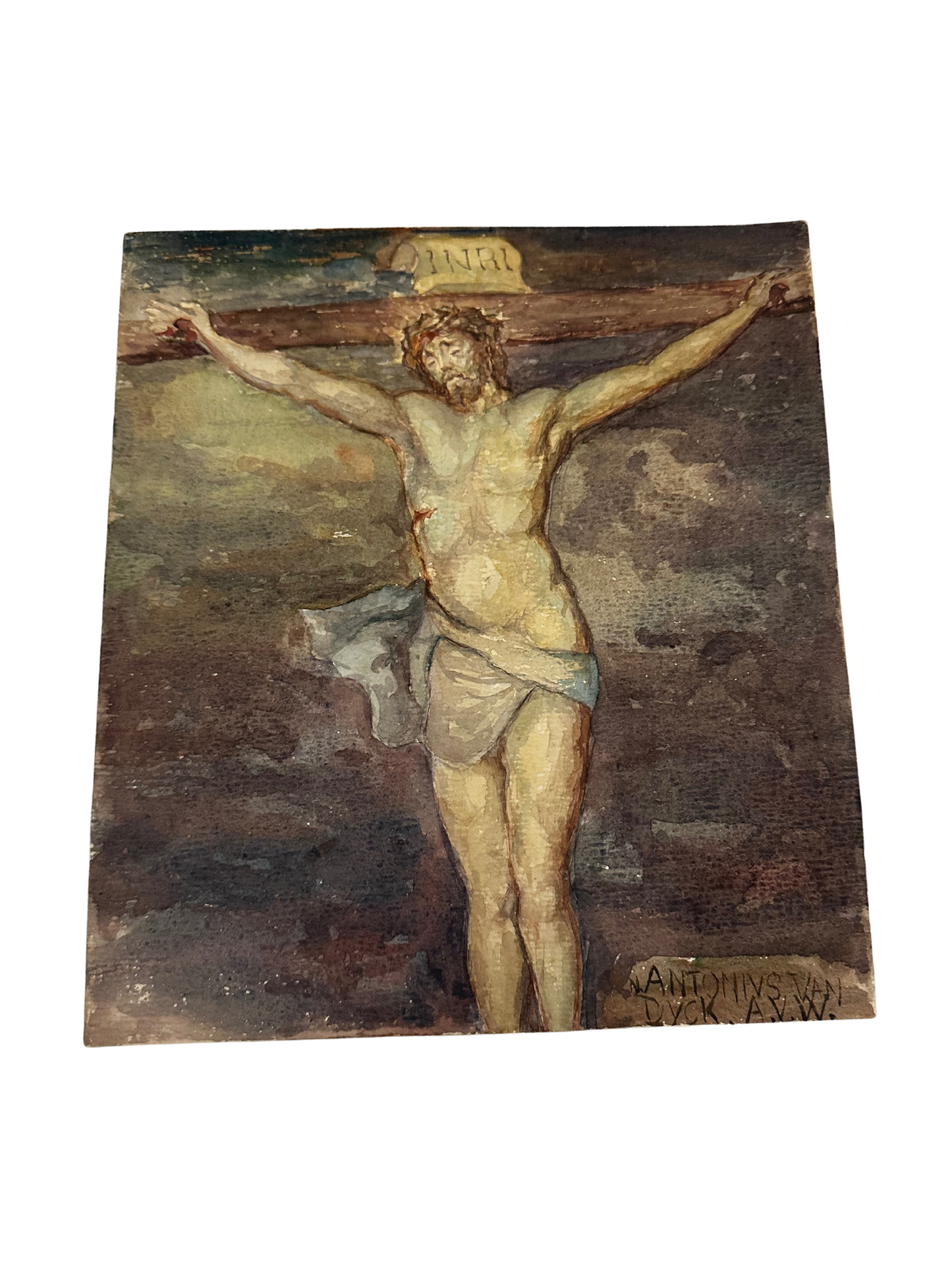
Devotional watercolor study of the Crucifixion inspired by the Flemish Baroque master Sir Anthony van Dyck (1599–1641) — as indicated by the inscription “ANTONIVS VAN DYCK A.V.V.” (an archaic Latinized rendering of his name).
Christ is shown crucified against a somber sky, crowned with thorns, with the inscription INRI above (Latin: Iesus Nazarenus, Rex Iudaeorum – “Jesus of Nazareth, King of the Jews”).
His body leans gently to the right, with blood marks at the hands and side, rendered in warm siennas and ochres.
Watercolor on laid or early wove paper (you can see the textured grain on the verso).
The palette—earth tones, muted purples, and grays—suggests late 19th to early 20th century pigment use rather than earlier handmade pigments.
The initials likely stand for Antonius van Dyck, Artis Van Dyck Verus or possibly Antonius van Dyck ad vivum (“after the life/work of Van Dyck”), used by later copyists or students to indicate a study after Van Dyck.
This is not an original Van Dyck, but rather a study or copy after one of his Crucifixion compositions, likely painted by a later admirer or student in the 19th century—possibly as an academic or devotional exercise.
Van Dyck painted multiple Crucifixions during his Antwerp and Italian periods (notably c. 1629–1631), characterized by the same upward gaze, twisting torso, and serene suffering expression—all echoed here.
The inscription is hand-applied, not printed.
The technique and pigment handling show 19th-century influence—particularly Romantic devotional studies that imitated Old Masters for private worship or academic training.
Painting of Jesus (Unframed Watercolor) - 1880 -1920
Devotional watercolor study of the Crucifixion inspired by the Flemish Baroque master Sir Anthony van Dyck (1599–1641) — as indicated by the inscription “ANTONIVS VAN DYCK A.V.V.” (an archaic Latinized rendering of his name).
Christ is shown crucified against a somber sky, crowned with thorns, with the inscription INRI above (Latin: Iesus Nazarenus, Rex Iudaeorum – “Jesus of Nazareth, King of the Jews”).
His body leans gently to the right, with blood marks at the hands and side, rendered in warm siennas and ochres.
Watercolor on laid or early wove paper (you can see the textured grain on the verso).
The palette—earth tones, muted purples, and grays—suggests late 19th to early 20th century pigment use rather than earlier handmade pigments.
The initials likely stand for Antonius van Dyck, Artis Van Dyck Verus or possibly Antonius van Dyck ad vivum (“after the life/work of Van Dyck”), used by later copyists or students to indicate a study after Van Dyck.
This is not an original Van Dyck, but rather a study or copy after one of his Crucifixion compositions, likely painted by a later admirer or student in the 19th century—possibly as an academic or devotional exercise.
Van Dyck painted multiple Crucifixions during his Antwerp and Italian periods (notably c. 1629–1631), characterized by the same upward gaze, twisting torso, and serene suffering expression—all echoed here.
The inscription is hand-applied, not printed.
The technique and pigment handling show 19th-century influence—particularly Romantic devotional studies that imitated Old Masters for private worship or academic training.