

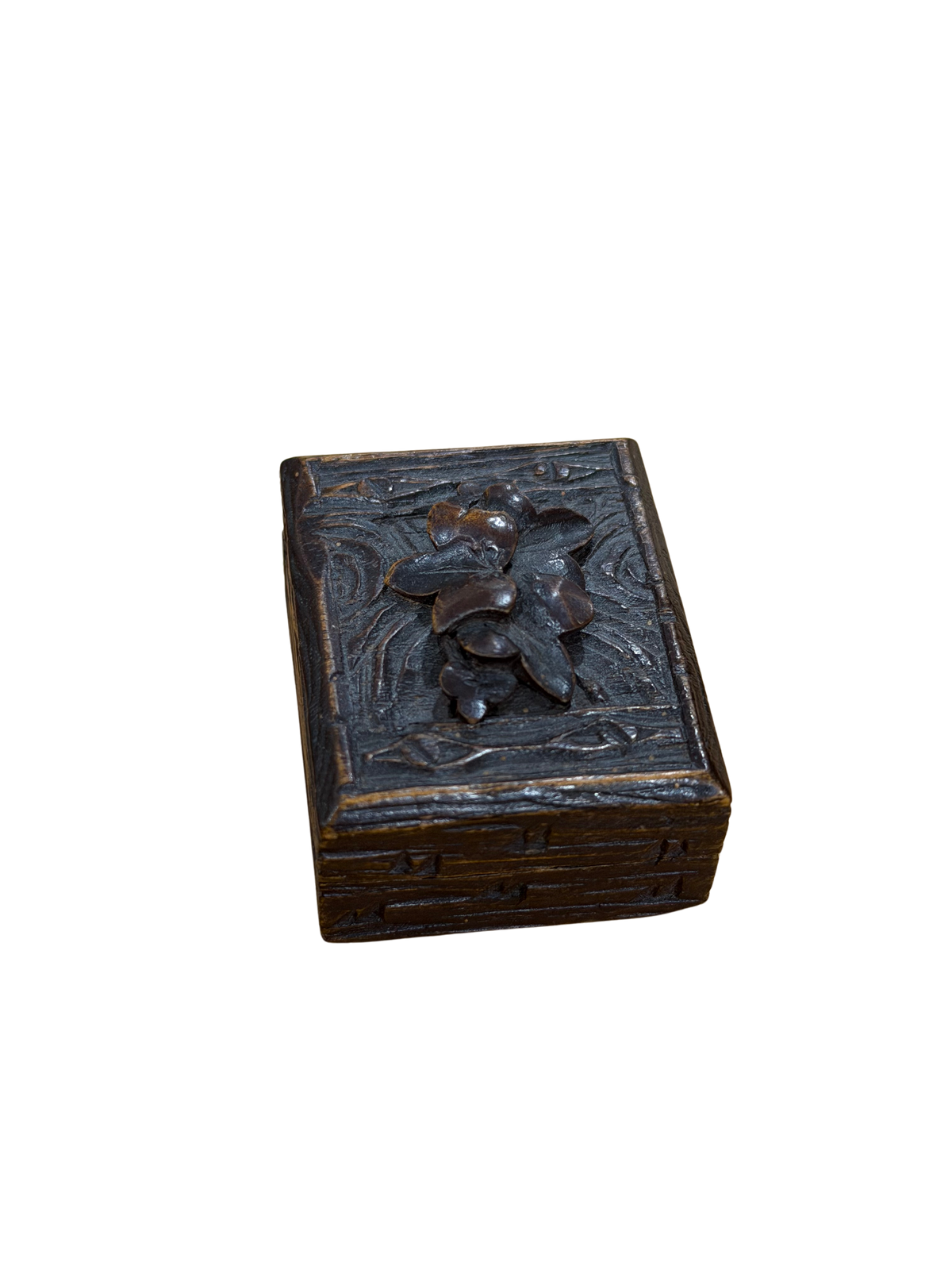
Antique Black Forest Carved Wood Floral Postage Stamp Box
Antique Black Forest Carved Wood Floral Postage Stamp Box
Couldn't load pickup availability
Share
Item:
Additional Description
A charming diminutive carved wooden postage stamp box, dating to the late 19th or early 20th century. The rectangular hinged box is richly worked despite its tiny scale, with a dark stained finish and a beautifully dimensional hand-carved floral spray applied to the lid.
The surrounding surface is carved in a rustic naturalistic manner, with linear wood-grain or bark-like detailing along the sides and additional scrolling foliage framing the floral decoration. The deeply modeled flowers and leaves stand proud of the lid, giving the little box considerably more character than a simple desk accessory.
Opening the hinged lid reveals a single recessed compartment proportioned specifically for postage stamps. Particularly charmingly, the box still contains an old French 20-centime “République Française” postage stamp, reinforcing its original use as a stamp keeper rather than a general trinket box.
Its carving and dark-stained wood are closely associated with the Swiss/Alpine “Black Forest” carving tradition, although similar rustic carved wares were also sold throughout France and neighboring Continental Europe. Without a maker’s mark, I would describe the origin conservatively as Continental European, likely French or Swiss/Alpine rather than definitively assigning it to Brienz.
Era
Late 19th to Early 20th Century, circa 1900–1920
Continental European, likely French or Swiss/Alpine.
History
Small stamp boxes became popular desk accessories during the late Victorian and Edwardian periods as personal correspondence expanded and adhesive postage stamps became an everyday necessity. They were produced in numerous materials—including silver, brass, porcelain, leather, and carved wood—and were often made as attractive objects intended to sit alongside writing boxes and stationery.
The naturalistic floral carving of this example belongs to the broader tradition commonly called Black Forest carving, a term now used for a wide range of 19th- and early-20th-century Alpine carved wooden objects. Workshops around Brienz, Switzerland, became particularly celebrated for intricately carved souvenir and domestic wares decorated with flowers, foliage, animals, and rustic motifs.
The surviving French postage stamp inside is an especially appealing piece of its history and should, in my opinion, remain with the box.
Provenance
Sourced in France.
Materials
Carved and stained wood
Metal hinge
Vintage French postage stamp
Dimensions
To be added
Condition / Disclaimers
Good antique condition with wear commensurate with age and use. Minor rubbing, scratches, small losses and irregularities to the dark stained finish are visible. The carved floral decoration remains attractive with age-related wear to some of the more delicate projecting elements. Interior shows expected wear from use. Hinge remains present and functional.
A vintage French postage stamp is retained inside the box and is included with the piece.
Please review all photographs as they form an important part of the condition description.