


Antique Cloisonné Enamel Trinket Box with Floral Motifs
Antique Cloisonné Enamel Trinket Box with Floral Motifs
Couldn't load pickup availability
Share


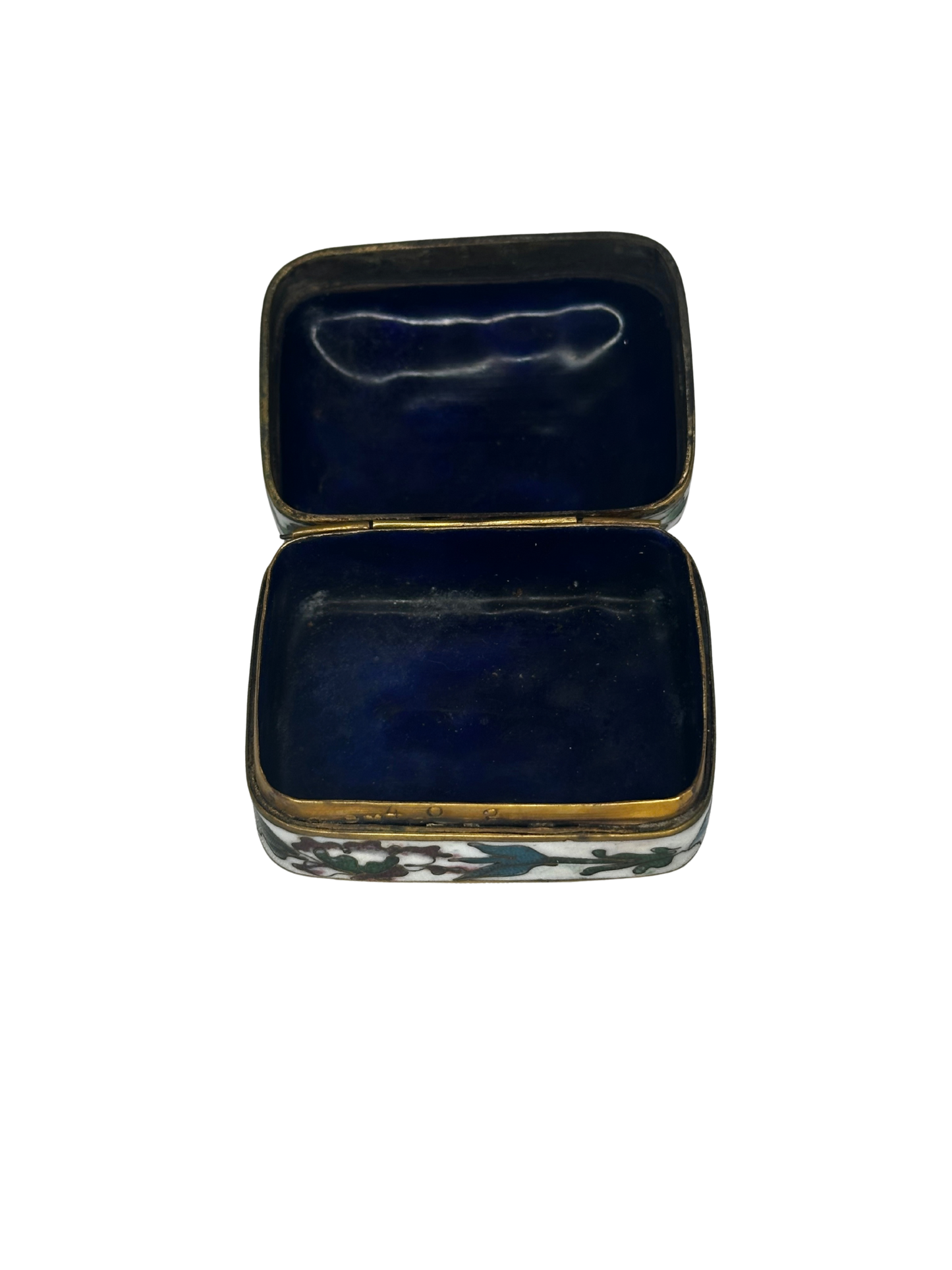
This antique cloisonné enamel trinket box features a softly rounded rectangular form, richly decorated on all sides with hand-applied enamel floral and foliate motifs. The design is composed of scrolling vines, leaves, and stylized blossoms rendered in deep greens, blues, turquoise, and burgundy tones against a creamy white enamel ground.
The cloisonné work is executed with fine metal wire partitions, clearly visible outlining each motif—an indicator of traditional craftsmanship. The box is fitted with a gilt metal mount and functioning hinge, opening to reveal a deep blue velvet-lined interior, likely original or early, designed to protect small personal items such as jewelry, keepsakes, or devotional objects.
The exterior enamel shows gentle surface wear consistent with age, with no major losses observed. The form, palette, and construction suggest late 19th to early 20th-century production, likely intended as a decorative luxury object rather than export souvenir ware.
This piece displays beautifully on a desk, vanity, or within a curated cabinet of smalls.
This antique cloisonné enamel trinket box features a softly rounded rectangular form, richly decorated on all sides with hand-applied enamel floral and foliate motifs. The design is composed of scrolling vines, leaves, and stylized blossoms rendered in deep greens, blues, turquoise, and burgundy tones against a creamy white enamel ground.
The cloisonné work is executed with fine metal wire partitions, clearly visible outlining each motif—an indicator of traditional craftsmanship. The box is fitted with a gilt metal mount and functioning hinge, opening to reveal a deep blue velvet-lined interior, likely original or early, designed to protect small personal items such as jewelry, keepsakes, or devotional objects.
The exterior enamel shows gentle surface wear consistent with age, with no major losses observed. The form, palette, and construction suggest late 19th to early 20th-century production, likely intended as a decorative luxury object rather than export souvenir ware.
This piece displays beautifully on a desk, vanity, or within a curated cabinet of smalls.
2"l x 1.5"d x 1.25"h
2"l x 1.5"d x 1.25"h
Cloisonné enamelwork has a long history in both China and Japan, with small decorative boxes becoming especially popular during the late 19th century as luxury objects for domestic interiors and export markets. These boxes were often used to store jewelry, snuff, or personal mementos and were prized for their vivid color palettes and intricate wirework.
During this period, cloisonné techniques were refined to allow for softer, more painterly floral designs, moving away from purely geometric patterns. The combination of a white enamel ground with jewel-toned florals reflects this transitional aesthetic and is characteristic of higher-quality decorative production.
Such boxes were commonly gifted or displayed rather than heavily used, which explains the survival of velvet-lined interiors in many examples.
Cloisonné enamelwork has a long history in both China and Japan, with small decorative boxes becoming especially popular during the late 19th century as luxury objects for domestic interiors and export markets. These boxes were often used to store jewelry, snuff, or personal mementos and were prized for their vivid color palettes and intricate wirework.
During this period, cloisonné techniques were refined to allow for softer, more painterly floral designs, moving away from purely geometric patterns. The combination of a white enamel ground with jewel-toned florals reflects this transitional aesthetic and is characteristic of higher-quality decorative production.
Such boxes were commonly gifted or displayed rather than heavily used, which explains the survival of velvet-lined interiors in many examples.
Late 19th – Early 20th Century
Late 19th – Early 20th Century
Metal body (likely brass or copper base)
Cloisonné enamel with hand-applied wirework
Gilt metal mounts and hinge
Metal body (likely brass or copper base)
Cloisonné enamel with hand-applied wirework
Gilt metal mounts and hinge
Likely East Asia (China or Japan)
Likely East Asia (China or Japan)
Light surface wear and minor enamel irregularities consistent with age
Minor rubbing to gilt metal edges
No major cracks or losses observed
Antique item; minor imperfections are inherent and expected
Light surface wear and minor enamel irregularities consistent with age
Minor rubbing to gilt metal edges
No major cracks or losses observed
Antique item; minor imperfections are inherent and expected